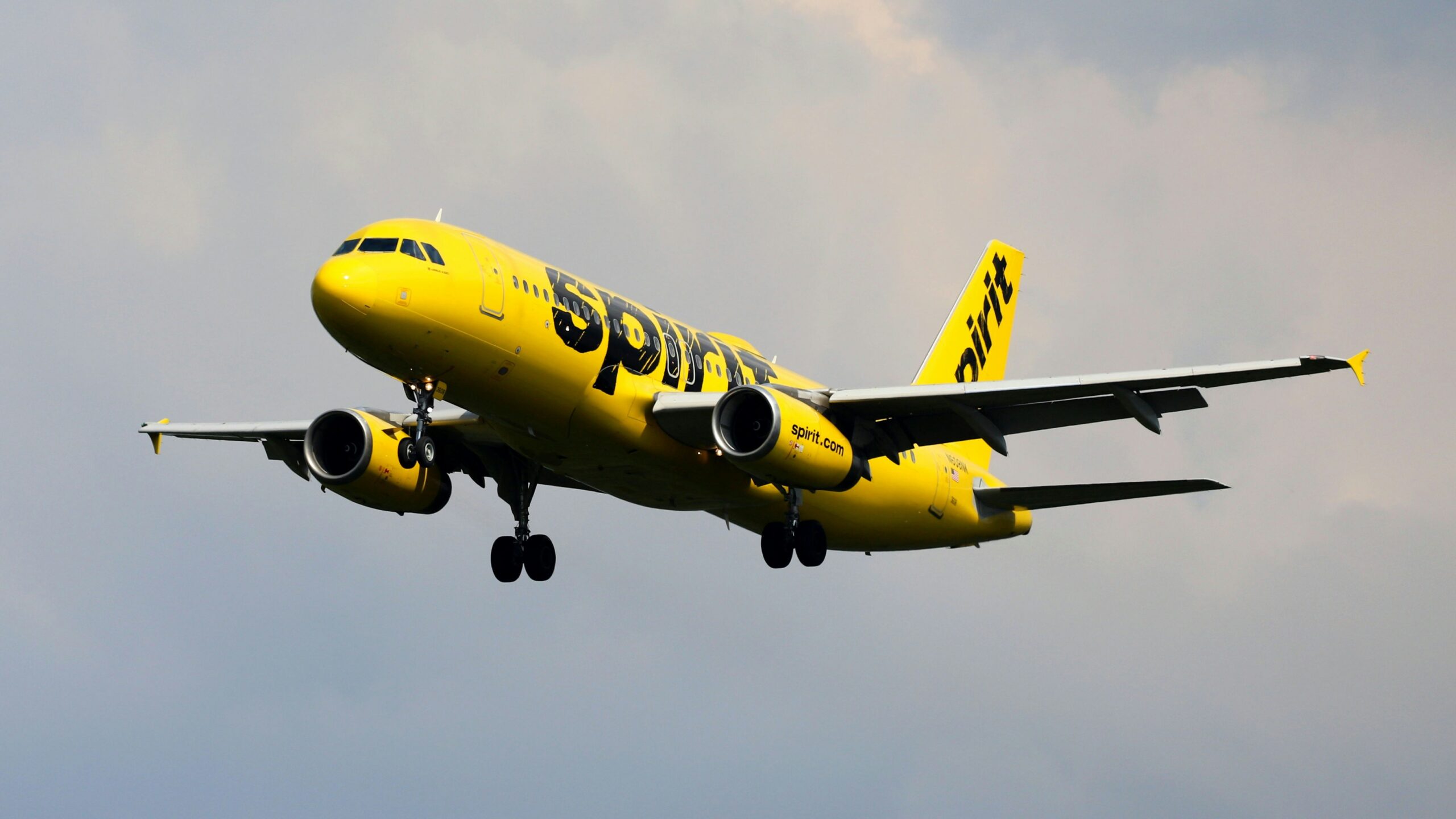
In late May 2026, Spirit Airlines flight 402 from Fort Lauderdale to San Juan flipped from “On Time” to “Canceled” on the departure board. The following account is drawn from passenger descriptions posted on social media and has not been independently verified: roughly 180 travelers at the gate reportedly received no rebooking, no vouchers, and no explanation beyond a brief announcement to contact customer service. Similar scenes played out at airports from Las Vegas to Orlando over the following days as the ultra-low-cost carrier, which at its peak operated more than 200 daily departures across the U.S., Caribbean, and Latin America, began an abrupt wind-down. The collapse followed months of financial turbulence, including a Chapter 11 bankruptcy filing in November 2024 and a rocky emergence earlier in 2025 that never fully stabilized the airline’s operations or balance sheet.
Multiple news outlets have cited a figure of roughly 60,000 stranded passengers per day, a number that reflects Spirit’s pre-shutdown booking volume but that has not been independently confirmed by the Department of Transportation, the FAA, or Spirit’s own public filings. Whatever the precise count, the scale is staggering, and the path to getting money back depends almost entirely on how and where each ticket was purchased and on a set of federal refund rules now being stress-tested in ways regulators never publicly anticipated.
Who qualifies for an automatic refund
A federal rule finalized by the U.S. Department of Transportation in April 2024 and published in the Federal Register requires airlines to issue automatic cash refunds whenever they cancel a flight or make a significant schedule change and the passenger does not accept an alternative. Codified at 14 CFR Part 260 and fully effective since October 28, 2024, the rule defines “significant” broadly: outright cancellations, domestic delays of three or more hours, international delays of six or more hours, airport switches, added connections, cabin downgrades, and changes that affect disability accessibility all trigger the obligation.
The critical word is automatic. If a traveler declines a rebooking or simply never flies, the airline must process the refund on its own. No form, no phone call, no hoops. The DOT’s consumer refund page states plainly that passengers do not have to accept vouchers, travel credits, or future flight coupons in place of cash.
The refund must cover the full ticket price plus any ancillary fees for services that were never delivered: seat selection charges, early boarding, checked bag fees, Wi-Fi packages. Credit card purchasers are entitled to see the money back within seven business days of the cancellation. Passengers who paid by debit card, cash, or another method have a 20-calendar-day window.
Those deadlines apply whether the airline is operating normally or shutting down entirely. A wind-down does not erase the legal obligation to return money for flights that never took off. The DOT’s public explainer on automatic refund protections reinforces this: the right to a refund is tied to the canceled flight, not to the carrier’s financial health or future plans. An airline cannot substitute travel credits on a carrier that may not exist next month.
Where the system breaks down for OTA bookings
That clean automatic process works best when the passenger bought directly from Spirit through its website, app, or call center. In those cases, Spirit is both the operator and the company that charged the card, so the legal chain is short.
For anyone who booked through an online travel agency like Expedia, Booking.com, or a smaller discount aggregator, the picture gets murkier. DOT guidance uses the concept of “merchant of record,” meaning whichever company actually ran the credit card charge bears primary responsibility for issuing the refund. When an OTA is the merchant of record, the passenger’s direct refund relationship is with that platform, not with Spirit. The airline may still owe money upstream to the OTA, but the consumer has to work through the booking platform’s own refund process, staffing capacity, and internal timelines.
That said, DOT enforcement actions have historically targeted airlines even when an OTA processed the original charge, on the theory that the airline bears ultimate responsibility for the flight it sold. That precedent could give OTA customers additional leverage if a booking platform tries to deflect blame entirely onto the defunct carrier.
During a routine schedule disruption, the merchant-of-record distinction rarely matters because the airline can rebook passengers on a later departure. During a full shutdown, it creates a two-tier reality. Direct bookers have a clear federal enforcement mechanism and a ticking refund clock backed by DOT oversight. OTA customers face a longer, less predictable path, especially if the travel agency is swamped with claims or is itself trying to recover funds from a carrier that has stopped flying.
Spirit’s collapse also removes the usual safety valve. There is no operating airline left to rebook anyone onto a later Spirit flight. Unlike legacy carriers, Spirit did not maintain traditional interline agreements that would automatically shift passengers to a competitor. That leaves three realistic remedies for most travelers: a direct refund from Spirit or the OTA, a credit card chargeback, or a travel insurance claim. Each comes with its own paperwork, evidence requirements, and waiting period.
What passengers should do right now
As of early June 2026, Spirit’s website still loads but its booking engine is non-functional, and passengers on social media report hold times on the customer service line stretching beyond two hours. The airline has not confirmed whether a dedicated refund portal is live or planned. Given that uncertainty, the single most important first step is checking a bank or credit card statement to determine whether the charge came from Spirit Airlines directly or from a third-party platform. That one detail dictates everything that follows.
If you booked directly with Spirit: The DOT’s automatic refund rule applies. Monitor your credit card statement starting from the date of cancellation. If the refund does not post within seven business days, file a complaint with the DOT’s Aviation Consumer Protection division, which tracks airline compliance and can pressure carriers to clear outstanding cases. Keep screenshots of your booking confirmation, the cancellation notice, and your statement showing no refund has posted.
If you booked through an OTA: Contact the platform immediately. Reference the DOT’s automatic refund rule (14 CFR Part 260) by name and request written confirmation of when the refund will be processed. Save every chat transcript, email, and case number. If the OTA stalls, refuses, or goes silent, escalate to a credit card chargeback through your card issuer. Most major card networks allow disputes for services not rendered, but there are time limits: Visa and Mastercard generally give cardholders 120 days from the expected service date to file, so acting quickly matters.
If you paid with a debit card or cash: Your leverage is more limited. Debit card dispute rights vary by bank and are often narrower than credit card protections. You may need to rely more heavily on the DOT complaint process, your state attorney general’s consumer protection office, or whatever claims procedure Spirit establishes during its wind-down. For future flights, consumer advocates consistently recommend paying with a major credit card precisely because it adds a chargeback layer when an airline fails to deliver.
Passengers who purchased travel insurance should review their policy language carefully. Many standard trip-cancellation policies cover airline cessation of operations, but some budget policies exclude carrier bankruptcy or financial default. Reading the fine print before filing can save time and set realistic expectations about what the insurer will and will not cover.
How a liquidation could delay or shrink refunds
If Spirit’s cessation leads to a full liquidation rather than a restructured sale, passenger refund claims could end up competing with secured creditors, aircraft lessors, fuel suppliers, and thousands of former employees in bankruptcy court. History is not encouraging on this front. When airlines have liquidated in the past, unsecured creditors, a category that typically includes passengers owed refunds, have recovered pennies on the dollar after proceedings that dragged on for months or years. That possibility makes the DOT’s seven-day and 20-day refund windows look optimistic for anyone whose claim is not resolved quickly through the automatic process or a chargeback.
The DOT has not publicly announced a formal enforcement action or dedicated task force for Spirit’s shutdown as of June 2026, though the agency has historically intervened during high-profile airline failures. Passengers should monitor the DOT’s newsroom and consumer protection pages for updates, and consider filing a complaint even if they have already initiated a chargeback, since complaint volume can influence how aggressively the agency pursues enforcement.
Why the clock matters more than the rules
The federal refund framework under 14 CFR Part 260 is the strongest set of passenger protections the U.S. has ever had for canceled flights. But protections on paper only work if there is a functioning entity on the other side to process the payment. Every day that passes without a refund is a day closer to potential liquidation proceedings where individual passengers have almost no leverage. The most effective thing any stranded Spirit customer can do right now is document everything, identify the merchant of record, and push for resolution through every available channel: the airline, the OTA, the credit card issuer, the DOT, and if necessary, a state attorney general. The rules exist. Whether they hold up under the weight of an entire airline’s collapse is the test playing out in departure halls and customer service queues across the country right now.