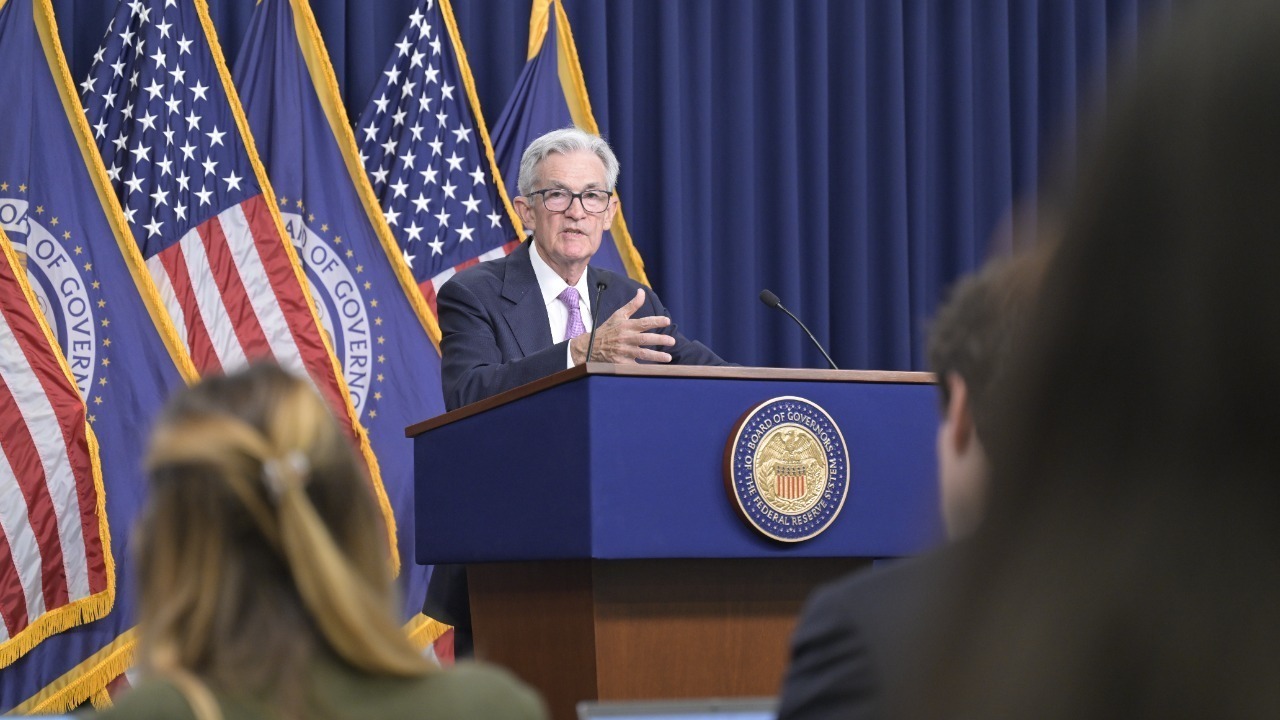
The Federal Reserve last cut interest rates in December 2025. Six months later, the federal funds rate is still parked at 3.50% to 3.75%, right where the FOMC left it. But Capital One, Marcus by Goldman Sachs, and Synchrony Bank didn’t wait around. All three have quietly trimmed the APYs on their high-yield savings accounts since the start of the year, and most of their customers probably have no idea.
The top-paying high-yield savings accounts still advertise rates near 4.03%, according to Bankrate’s tracking data through late May 2026. That number, though, is lower than it was three months ago, and the gap between the best-paying accounts and the ones coasting on name recognition keeps widening. If you haven’t checked your rate recently, you may already be earning less than you think.
The Fed is on hold, but banks aren’t waiting
The FOMC’s January 2026 policy statement held the target range steady and described an economy “expanding at a solid pace.” The March and May 2026 meetings produced the same outcome: no change. Inflation has remained sticky enough, and the labor market resilient enough, that policymakers have seen no reason to move.
Banks operate on a different logic. They price deposits based on their own funding needs, competitive pressure, and the yields they can earn on short-term assets like Treasury bills. When T-bill yields drift lower, as Treasury Department yield curve data shows they have through early 2026, banks lose some of the incentive to pay top dollar for deposits. Rate cuts follow, but they arrive without a press release, buried in updated disclosures on a bank’s website.
Marcus by Goldman Sachs, for instance, lowered its high-yield savings APY from 4.40% to 4.25% earlier this year, according to tracking by DepositAccounts. Capital One’s 360 Performance Savings and Synchrony’s high-yield account have made similar downward adjustments. None of these banks made a public announcement. The changes appeared in fine print that most customers never revisit after opening an account.
“Banks have very little incentive to advertise a rate decrease,” said Ken Tumin, founder of DepositAccounts and a senior industry analyst at LendingTree. “They’ll promote a rate hike aggressively, but when the cut comes, it just shows up on your statement.”
The national average tells a starker story
The FDIC’s national rate data, which calculates a weighted average across all insured depository institutions, puts the typical savings account yield at roughly 0.46% APY. That figure has barely moved in years, even as online banks pushed their rates above 4% and briefly past 5% during the Fed’s tightening cycle in 2023 and 2024.
The spread is enormous. A saver with $25,000 in a traditional bank account earning 0.46% APY would collect about $115 in interest over a year. The same $25,000 in an account paying 4.03% would generate roughly $1,008. That is nearly a $900 difference on the same federally insured deposit, requiring nothing more than a one-time transfer to a different institution.
Even within the high-yield category, the range matters. The difference between 4.03% and 3.80% on $25,000 works out to about $58 a year. Not dramatic, but not trivial either, especially when switching accounts is free and takes minutes.
Why the quiet cuts keep coming
A prolonged Fed pause should, in theory, keep high-yield rates relatively stable. But banks are not contractually bound to match the fed funds rate, and many have used the pause as cover to widen their margins. Research from the Federal Reserve Bank of New York on deposit pricing dynamics has documented a persistent asymmetry: banks tend to pass along rate decreases to depositors faster than they pass along increases. The pattern held during the 2019 easing cycle and appears to be repeating now.
The FOMC’s own quarterly projections have signaled a cautious path forward, and fed funds futures markets have reflected that uncertainty throughout the spring. No primary Fed document commits to a timeline for the next reduction. If inflation data runs hotter than expected, rates could stay right where they are well into the second half of 2026.
For depositors, that creates an uncomfortable reality. Even without a Fed cut, the APY on your savings account can still shrink. And if the FOMC does resume easing later this year, savings rates will almost certainly follow, likely faster than they rose on the way up.
Alternatives that compete with savings accounts right now
High-yield savings accounts are not the only option for cash you want to keep accessible. Certificates of deposit can lock in a fixed rate for six months to a year or longer, which is worth considering if you believe rates are headed lower. Several online banks are offering 12-month CDs above 4.00% APY as of late May 2026, according to Bankrate’s CD rate tracker, though those offers tend to close quickly.
Short-term Treasury bills, purchased directly through TreasuryDirect or via a brokerage account, offer yields backed by the full faith and credit of the U.S. government. A 6-month T-bill in the current environment pays a competitive rate, and the interest is exempt from state and local income tax, a meaningful advantage for savers in high-tax states like California and New York.
Government money market funds are another contender. They typically track the fed funds rate more closely than savings accounts, which means less lag when rates shift in either direction. The trade-off: they are not FDIC-insured, though funds that invest exclusively in government securities carry minimal credit risk.
How to tell if your bank has already cut your rate
The single most useful step is the simplest one: log into your savings account and look at the current APY. Not the rate you were quoted when you opened it. The rate it is paying today. Banks are required to disclose this, but they are not required to send you a notification every time it changes.
Compare that number against the FDIC national average and against the top rates listed on established comparison sites like Bankrate or DepositAccounts. If your account has slipped below roughly 3.90%, there is a strong chance you can do better without giving up FDIC insurance or same-week access to your money.
Moving money between online savings accounts is typically free and takes one to three business days. There is no penalty for closing a savings account, and most banks let you open a new one entirely online. The friction is minimal. The cost of doing nothing, measured in lost interest over the next 12 months, is not.
Rates on high-yield savings accounts remain historically strong by any measure. But “still strong” is not the same as “still the same.” Capital One, Marcus, and Synchrony have already moved. The question is whether you will notice before the next cut arrives.