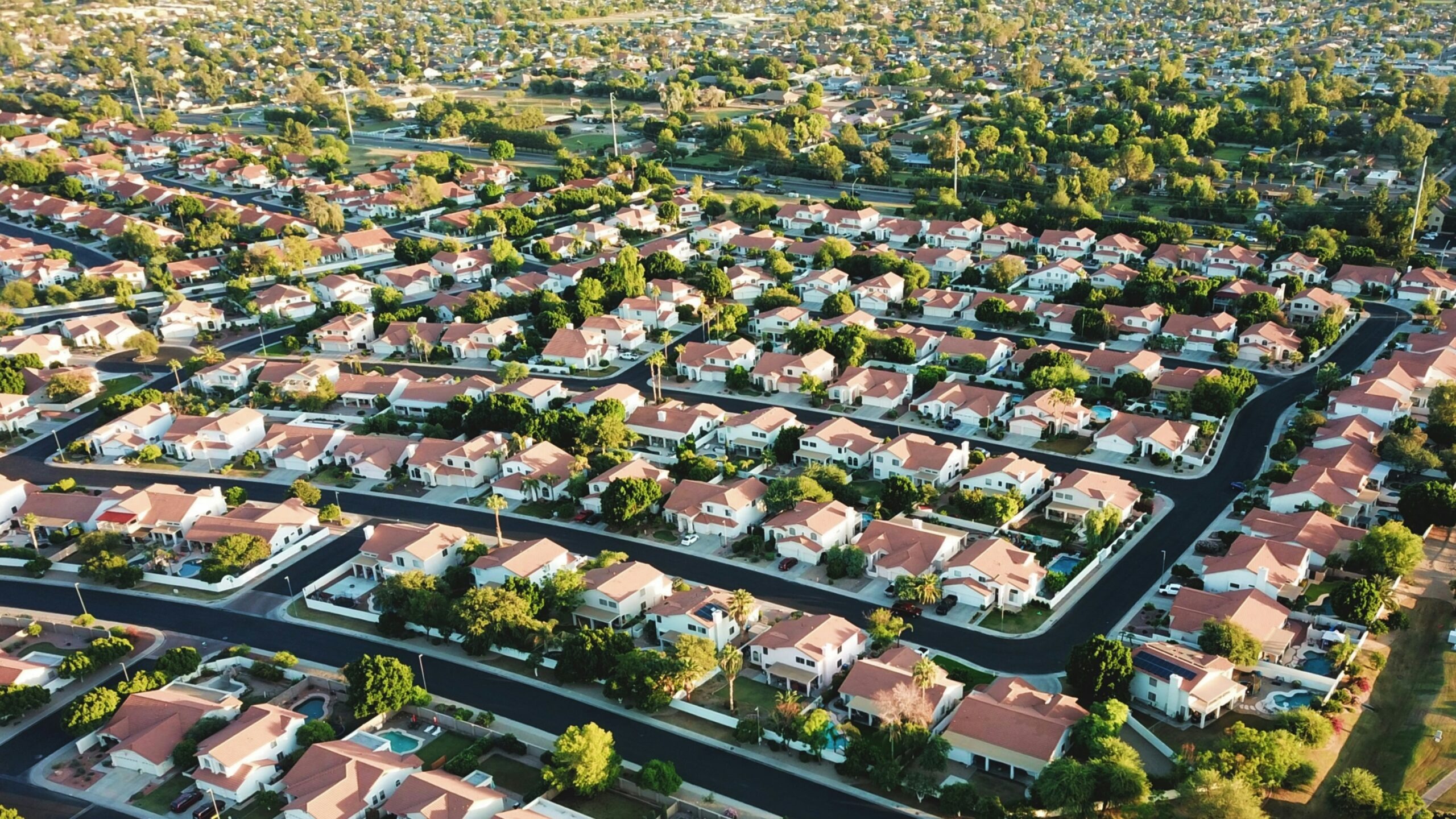
Cape Coral, Florida, lost roughly 9% of its home value over the past year. Chicago gained about 5%. Those two numbers, drawn from the same national housing market during the same interest-rate environment, capture a divergence that has become the defining story of American real estate in 2026.
Nationally, prices barely budged. The Federal Housing Finance Agency’s House Price Index, which tracks repeat sales on mortgages backed by Fannie Mae and Freddie Mac, registered a 1.7% year-over-year gain through February 2026 and zero month-over-month change on a seasonally adjusted basis. That 1.7% is among the weakest annual readings since the pandemic-era boom began.
But the national number is an average, and right now the average is hiding two very different realities.
Sun Belt prices are sliding, and not just at the margins
Tampa’s metro area posted a 3.6% annual price decline in the FHFA data. Denver fell 2.2%. Both metros had been cooling since late 2024, but the February figures confirm the softening has deepened rather than leveled off.
For a Tampa homeowner who bought near the 2022 peak, that 3.6% annual decline, layered on top of earlier softening, means the equity cushion they counted on for refinancing or tapping a home-equity line is thinner than expected. Some owners who stretched to buy at the top are now closer to breakeven than they realized.
Cape Coral’s steeper drop, roughly 9% year over year based on median-sale-price tracking from listing platforms like Redfin and Realtor.com, does not appear in the FHFA’s most granular published metro breakdowns. Those listing-based indexes use different methodologies than the federal repeat-sales approach, and the exact magnitude varies depending on the platform and the months compared. The direction is consistent with what FHFA data shows for southwest Florida broadly, but the 9% number carries a wider margin of uncertainty than the Tampa or Denver figures.
What these Sun Belt metros share is a common backstory: pandemic-era price surges driven by remote-work migration and aggressive investor buying, followed by a supply correction as new construction caught up with demand. In Cape Coral and Tampa, a wave of completed single-family permits from 2022 and 2023 has added inventory at the same time that mortgage rates near 7% have thinned the buyer pool.
Florida’s insurance market has compounded the problem. Homeowners insurance premiums across the state have climbed sharply over the past three years, with some coastal owners seeing annual costs double or triple.
When buyers factor in insurance alongside a mortgage payment calculated at nearly 7%, the monthly carrying cost of a Florida home looks far less attractive than it did in 2021. The result is more homes sitting on the market longer and sellers cutting prices to compete.
Chicago and New York keep grinding higher
Chicago’s 5% annual gain and New York’s 4.7% rise tell the opposite story. Both metros have older housing stock, stricter zoning, and far less new construction per capita than their Sun Belt counterparts. When supply is structurally limited, even modest demand keeps prices firm.
Chicago, in particular, has benefited from a dynamic that would have seemed unlikely five years ago: relative affordability. Compared with coastal cities where median prices still exceed $600,000, Chicago’s lower entry point has attracted buyers who can stretch their budgets further without the sticker shock. The metro area’s job market, anchored by healthcare, logistics, and financial services, has held steady enough to support that demand.
New York’s gains reflect a similar supply squeeze, compounded by the sheer density of high-income households competing for a limited number of units in desirable neighborhoods. Neither metro is poised for a new boom. With the national market growing at under 2% and Freddie Mac’s Primary Mortgage Market Survey showing 30-year fixed rates hovering near 6.8% as of late May 2026, the conditions for double-digit appreciation simply are not present.
But owners in Chicago and New York face a very different calculus than their peers in Tampa or Cape Coral: modest, steady gains rather than the anxiety of watching values slide.
The migration question no one can fully answer yet
One question that naturally follows: are people physically moving from declining Sun Belt metros to rising Northern ones? The honest answer is that current data cannot confirm or deny it.
The Census Bureau’s county-to-county migration estimates, drawn from the American Community Survey, run more than a year behind. The most recent release covers moves made in 2023 and early 2024, well before the price divergence widened to its current level.
Real estate agents in Chicago and parts of the Northeast have reported anecdotally that they are seeing more inquiries from buyers relocating out of Florida and Texas. Those reports are plausible given the price trends, but they are not yet visible in official statistics. Until fresher migration data arrives, the connection between Sun Belt price declines and Northern price gains remains a reasonable hypothesis, not a confirmed cause-and-effect relationship.
The FHFA’s index has a similar limitation: it tells us what prices are doing but not why. Analysts have pointed to construction pipelines, investor pullbacks, insurance cost spikes in Florida, and remote-work normalization as contributing factors. No single federal dataset ties all of those threads together neatly, which is part of what makes this split so hard to predict going forward.
What this means for buyers and sellers right now
For buyers eyeing a cooling Sun Belt market, falling prices translate directly into negotiating leverage. Sellers in Tampa and Denver are more willing to accept contingencies, cover closing costs, or reduce asking prices than they were even six months ago. That is a meaningful shift for first-time buyers who spent the past three years being outbid.
The tradeoff is real: buying into a declining market means accepting the possibility that the home could be worth less next year than it is today. Anyone purchasing in Cape Coral or Tampa right now should plan to hold for several years and not count on short-term appreciation to build equity.
For sellers in those same metros, the math is uncomfortable. Listing now means competing with growing inventory and accepting a price that may be 5% to 10% below what a neighbor got in 2022. Waiting carries its own risk, because there is no guarantee that rates will drop enough to reignite demand before more new supply hits the market.
In Chicago and New York, buyers face the opposite problem: tight inventory, firm prices, and limited room to negotiate. But they also face less downside risk. A 5% annual gain does not make anyone rich overnight, but it does mean the home is likely to be worth at least what they paid for it if they need to sell in three to five years.
Your zip code now matters more than the mortgage rate
For most of the past two decades, the national mortgage rate was the single biggest variable driving home prices up or down across the country. When rates dropped, prices rose almost everywhere. When rates spiked in 2022 and 2023, the entire market cooled in unison.
That era of synchronized movement appears to be over. What has replaced it is a housing market where local supply, local job growth, local construction pipelines, and even local insurance costs matter more than the national rate environment. Cape Coral and Chicago are both subject to the same 6.8% mortgage rate, but their housing markets are moving in opposite directions.
The national 1.7% appreciation figure is technically accurate and practically useless for anyone trying to understand what is happening in their own neighborhood. Other major metros, from Phoenix to Austin to Dallas, are landing at various points along this spectrum, each shaped by their own mix of supply, demand, and local economic conditions. The FHFA does not publish February 2026 breakdowns for every metro simultaneously, so precise figures for those cities are not yet available in the same release that covers Tampa and Chicago.
Until construction, migration, and rate trends converge again, the safest assumption is that this regional split will persist. Buyers, sellers, and policymakers who treat “the housing market” as a single entity are working with an outdated map. The two halves of this market are not moving toward each other anytime soon.