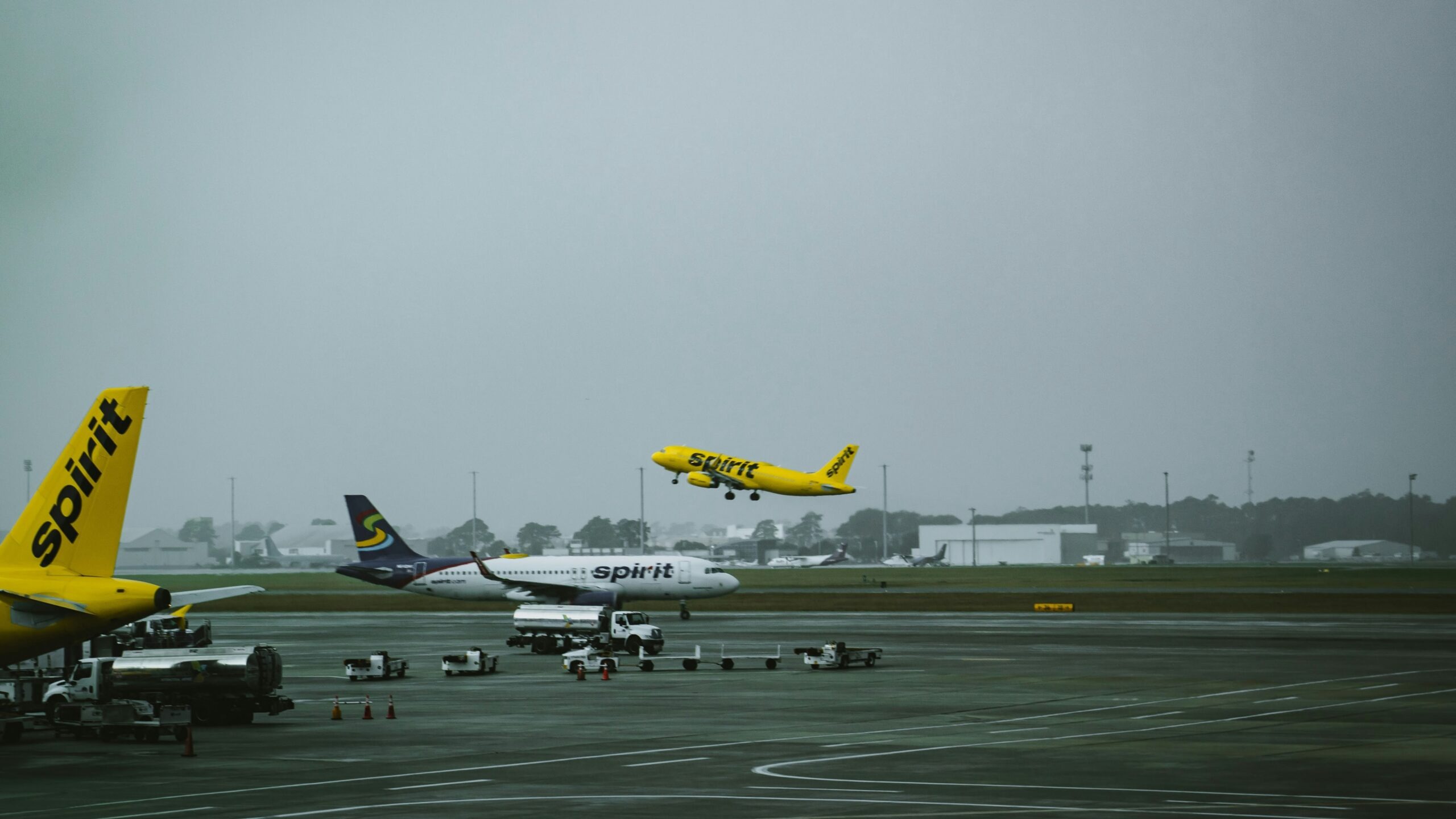
Until January 2026, a traveler willing to forgo a carry-on bag and squeeze into a 28-inch seat pitch could fly round-trip from Fort Lauderdale to Detroit on Spirit Airlines for under $100. That fare no longer exists. Spirit canceled every remaining flight in early 2026 and began auctioning off its planes, gates, and landing slots under court-supervised liquidation. The airline that defined rock-bottom pricing in American aviation is gone.
Its disappearance landed at the worst possible moment for budget-conscious flyers. The Bureau of Transportation Statistics reports that the average domestic round-trip fare reached $365 in the fourth quarter of 2025, the most recently available reporting period, up $70 from the Q4 2024 figure of roughly $295. That is one of the steepest single-year jumps since before the pandemic, and it arrived just as the cheapest seat in the country vanished for good.
The fare spike in context
The $365 figure comes from BTS’s long-running domestic fare series, which tracks the full itinerary price of a round-trip ticket, including taxes and fees paid at booking. These are nominal prices, meaning they have not been adjusted for inflation. The dataset excludes checked-bag charges, seat-selection fees, and other ancillary revenue that airlines increasingly collect outside the ticket price. It also filters out zero-fare tickets and bulk purchases.
“We are seeing the sharpest divergence between airfare growth and general inflation since the post-9/11 recovery,” said Hayley Berg, lead economist at the travel platform Hopper, in a May 2026 interview. “The loss of Spirit removed a price anchor on hundreds of routes, and the data is now catching up to what travelers have been feeling for months.”
To appreciate how fast fares have climbed, consider the trajectory. The BTS interactive fare database shows domestic averages bottomed out near $260 during the pandemic travel collapse of 2020 and recovered unevenly over the following years. The Q4 2025 reading of $365, up from approximately $295 in Q4 2024, represents a roughly 24 percent jump, far outpacing the broader consumer price index, which rose about 2.8 percent over the same stretch according to the Bureau of Labor Statistics. Airfare is not simply rising with general inflation. It is pulling sharply away from it.
One methodological note worth flagging: BTS has begun transitioning to a new data collection method called the Origin-Destination Survey of Airline Passengers (OD40), which draws on a larger ticket sample than the legacy survey. The Q4 2025 numbers still use the established methodology, so the $70 increase is a clean year-over-year comparison. But future quarters may require careful handling as the agency reconciles the two sampling frames.
How Spirit’s collapse unfolded
Spirit had been operating under Chapter 11 bankruptcy protection since late 2024 when it announced an immediate wind-down of all operations in early 2026, telling customers not to come to the airport. An SEC filing references monthly operating reports submitted to the U.S. Bankruptcy Court for December 2025 and January 2026, documenting months of deepening financial distress. Court filings cited sustained fuel costs, an inability to secure additional capital, and a fleet grounded by maintenance obligations the airline could no longer fund. Bankruptcy Judge Sean Lane authorized a rapid liquidation after the company reported zero revenue and no viable path to restart.
Spirit was not a niche carrier. At its peak, the airline served more than 90 destinations and carried roughly 33 million passengers a year across a network concentrated on leisure routes to Florida, the Caribbean, and Latin America. Its entire business model rested on selling the lowest possible base fare and then charging separately for nearly everything else: bags, seat assignments, water bottles, even boarding passes printed at the counter. That approach kept Spirit’s advertised prices far below those of legacy carriers and, critically, forced competitors to lower their own fares on overlapping routes.
The Department of Justice blocked JetBlue’s proposed acquisition of Spirit in early 2024, arguing the merger would reduce competition and raise prices for budget travelers. That ruling, upheld on appeal, left Spirit to restructure on its own. It could not. Whether the DOJ’s intervention ultimately protected or harmed the very consumers it was meant to help is now one of the most debated questions in aviation policy, and one that congressional oversight committees have signaled they intend to revisit.
What this means on specific routes
The national average tells a broad story, but the sharpest impact will land on the city pairs where Spirit held significant market share. Routes like Orlando to Newark, Fort Lauderdale to Atlanta, and Las Vegas to Los Angeles were among Spirit’s busiest, and on many of them the airline was the only carrier offering base fares under $80. BTS publishes airport-level fare data, but the most recent granular breakdowns do not yet reflect the post-shutdown period. Those numbers are expected in late 2026.
“I used to fly Spirit from Orlando to Newark six or seven times a year to visit my parents,” said Maria Delgado, a 34-year-old nurse in central Florida. “My usual fare was $67 each way. Now the cheapest option on that route is $180, and that is on Frontier with no bag. I just cannot afford to go home as often.”
Delgado’s experience tracks with what fare-tracking services have reported: noticeable price increases on former Spirit routes in the weeks following the shutdown, particularly on short-haul leisure corridors in the Southeast. The dynamic is straightforward. When the lowest-priced competitor on a route disappears, the remaining airlines face less pressure to discount. Economists call this the “price anchor” effect. Spirit was one of the strongest anchors in domestic aviation, and its removal has loosened pricing discipline across the board.
There is also a raw capacity problem. Spirit operated a fleet of roughly 200 Airbus A320-family jets. Those aircraft are being sold or returned to lessors, and while some may eventually re-enter service with other U.S. carriers, the process takes months of inspections, repainting, and recertification. In the interim, total domestic seat supply is lower, handing airlines more pricing power on routes where demand has held steady.
Why no one is racing to replace Spirit
Frontier Airlines is the closest remaining budget alternative, but Frontier has been steadily repositioning itself. The Denver-based carrier introduced bundled fare products, added assigned seating, and began courting connecting passengers through partnerships. Those moves blur the line between ultra-low-cost and traditional low-cost models, and they come with higher ticket prices. Frontier’s evolution suggests its leadership sees more profit in moving upmarket than in racing to the bottom.
Southwest Airlines, long considered a consumer-friendly counterweight to legacy pricing, eliminated its open-seating policy and introduced premium fare tiers starting in 2025, signaling a deliberate shift toward higher-yield passengers. JetBlue, which tried and failed to acquire Spirit, has been cutting unprofitable routes and concentrating on its Mint premium cabin. Neither airline is positioning itself to absorb Spirit’s budget-conscious customer base.
Newer entrants like Breeze Airways and Avelo Airlines serve limited route networks and lack the fleet size to replicate Spirit’s national footprint. No carrier currently operating in the United States offers the depth of sub-$100 fare inventory that Spirit maintained at its peak.
Meanwhile, the legacy carriers have spent years refining revenue management systems engineered to extract the maximum price each passenger is willing to pay. Without a true ultra-low-cost competitor forcing them to keep base fares low, there is little market incentive for prices to retreat. Fuel costs remain elevated. Labor contracts negotiated after pandemic-era shortages have pushed airline payrolls higher. And demand for domestic leisure travel, particularly to warm-weather destinations, has shown no sign of softening.
A higher floor with no carrier willing to undercut it
For the millions of Americans who treated Spirit as their default airline, the math has changed. Fare-comparison tools, flexible date searches, and midweek departures can still surface prices below the national average. But the structural reality as of mid-2026 is that the floor on domestic airfare has risen, and the carrier that once defined that floor is gone. The remaining airlines are under no competitive obligation to replace it. The BTS data, reflecting the most recently completed quarter, confirms what travelers have already felt at checkout: $365 is the new baseline, and for anyone who once flew Spirit, even that number may feel generous.