Three market-moving events are about to land within 48 hours, and Wall Street is not ready for all of them at once. Nvidia reports first-quarter earnings Tuesday after the close. The Federal Reserve publishes minutes from its April policy meeting Wednesday at 2 p.m. ET. And the 10-year Treasury yield is sitting at its highest level in roughly a year, quietly repricing risk across every asset class before either catalyst hits.
Any one of those developments can move billions of dollars in a single session. Stacked this tightly together, they create the kind of compressed risk window where traders are forced to act on incomplete information, repositioning after Nvidia’s numbers only to face a second jolt from the Fed less than 24 hours later.
Nvidia earnings: Tuesday, May 20
Nvidia, whose market capitalization has hovered north of $3 trillion on the strength of AI infrastructure demand, will hold its fiscal first-quarter earnings call on May 20, according to a GlobeNewswire advisory. The company has not issued preliminary figures or updated guidance since last quarter, leaving a potentially wide gap between Wall Street’s models and what management actually delivers.
That gap carries outsized consequences. Nvidia has become the single stock most capable of dragging the Nasdaq-100 in either direction on an earnings day. Options chains heading into the weekend were pricing an implied move of roughly 8% to 9% for the post-report session, according to derivatives strategists tracking Cboe data. Mandy Xu, head of derivatives market intelligence at Cboe Global Markets, has previously noted that Nvidia’s implied earnings moves have consistently ranked among the largest of any mega-cap name.
The pressure points are specific. Data center revenue, which has driven the bulk of Nvidia’s growth, faces questions about sustainability as hyperscaler capital expenditure plans come under scrutiny. Export-related headwinds, particularly around U.S. chip restrictions affecting sales to China, could weigh on forward guidance even if the backward-looking quarter looks clean. A miss on guidance would test whether the broader tech rally can survive a stumble from its most important stock. A beat would reinforce the thesis that AI spending remains durable even as borrowing costs climb.
FOMC minutes: Wednesday, May 21
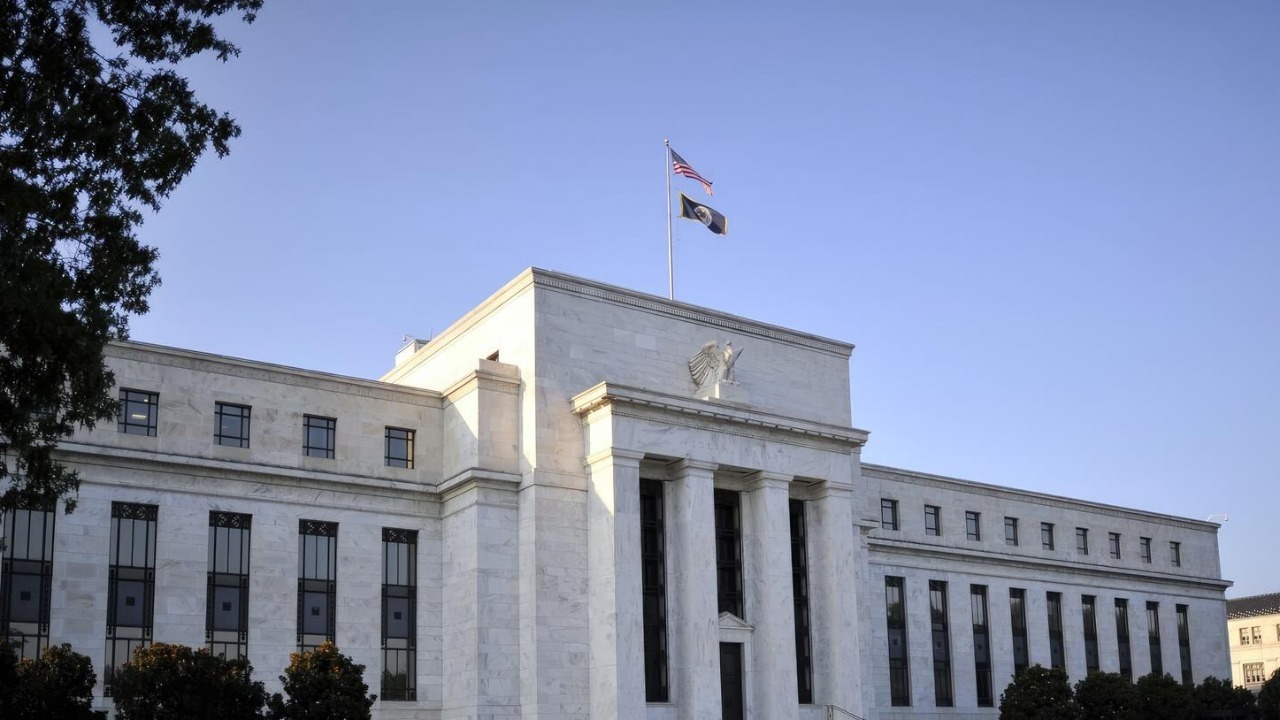
The Federal Reserve held its benchmark rate steady at its April 29-30 meeting, keeping the federal funds target range at 3-1/2 to 3-3/4 percent. The post-meeting statement leaned on familiar “data-dependent” language, and at least one committee member dissented. What the statement did not reveal is how close the rest of the committee came to shifting its stance, or how seriously members debated the risk that inflation could re-accelerate.
The full minutes land Wednesday, May 21, per the Fed’s standard three-week lag and the official FOMC calendar. Three sections will draw the most attention: any discussion of re-accelerating price pressures, the committee’s read on whether current financial conditions are tight enough, and whether members debated the timing of additional rate cuts.
As of late last week, fed funds futures tracked by the CME FedWatch tool were pricing in roughly one more quarter-point cut by September. That expectation is fragile. Hawkish language in the minutes could push the timeline out further, while dovish undertones could pull it forward. Either shift would ripple immediately into bond prices, equity valuations, and the dollar.
The timing compounds the difficulty for traders. The minutes drop less than 24 hours after Nvidia’s numbers. Anyone who repositioned overnight based on the earnings call may have to reverse course before Wednesday’s closing bell.
Treasury yields grinding toward a breaking point
Underneath both scheduled events sits a bond market that has been tightening financial conditions on its own. The U.S. Treasury’s daily par yield curve data shows the 10-year note has been climbing through May, with recent readings approaching levels last seen in the spring of 2025.
Gennadiy Goldberg, head of U.S. rates strategy at TD Securities, wrote in a May 16 research note that the 10-year was trading near 4.55% in the secondary market. He attributed the move to persistent supply pressure from Treasury auctions and fading expectations for near-term rate relief. Official settlement data from Treasury’s series can lag by a day or two, but the direction has been unmistakable: yields are rising, and the bond market is not waiting for the Fed to confirm it.
For everyday investors, this is not abstract. Higher long-term rates feed directly into mortgage pricing, corporate borrowing costs, and the discount rate analysts use to value future earnings. Growth stocks, whose profits are weighted further into the future, absorb that math most painfully. When the 10-year yield rises 20 or 30 basis points over a few weeks, it can shave meaningful percentage points off fair-value estimates for companies like Nvidia, even if nothing about their underlying business has changed.
The open question heading into the week: do bond sellers keep pushing yields higher, or do the FOMC minutes offer enough dovish language to relieve pressure on the long end? If yields hold near these levels through Nvidia’s report, the options market will likely price steeper single-session swings for the Nasdaq-100 than for the S&P 500, amplifying the stakes for tech-heavy portfolios.
When catalysts collide, sequencing becomes the risk
Weeks with multiple catalysts are common. Weeks where the catalysts interact this directly are not. Nvidia’s earnings will set the tone for AI sentiment Tuesday evening. The FOMC minutes will either reinforce or undercut the rate backdrop Wednesday afternoon. And Treasury yields will function as a running scoreboard, reflecting how bond traders interpret both in real time.
The danger is not just that one event disappoints. It is that a negative surprise on one front compounds the reaction to the next. A soft Nvidia guide followed by hawkish Fed minutes could trigger a sharper selloff than either would produce alone, because the combination attacks both the growth narrative and the rate outlook simultaneously. The reverse also holds: strong Nvidia numbers paired with patient-sounding Fed language could fuel a relief rally that pulls yields back from their highs.
Adding to the complexity, this week also brings a wave of retail earnings and fresh housing data, both of which are sensitive to the same interest-rate dynamics. If Treasury yields stay elevated, weak housing numbers or cautious retailer guidance could reinforce a narrative that higher rates are starting to bite the real economy, not just financial models.
What is documented so far: the Fed’s April statement, the FOMC calendar, and the Treasury’s yield data are primary sources published directly by the institutions setting policy. Nvidia’s scheduled call is confirmed, but until management speaks, everything around it is modeling and expectation. The gap between what is known and what is assumed will narrow fast this week. For most investors, the smartest move is making sure they know which side of that line their positions are sitting on before Tuesday’s close.