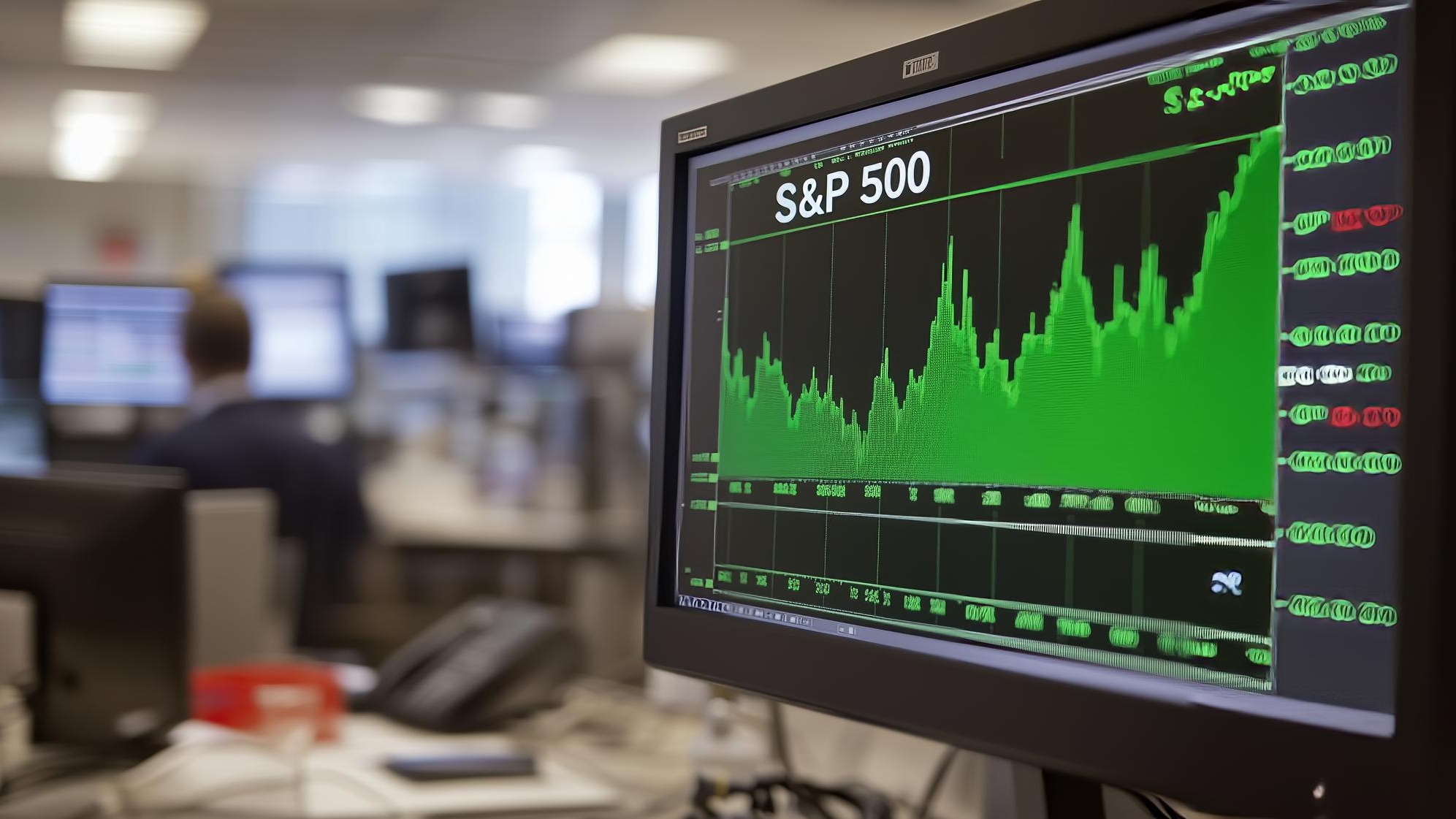
The S&P 500 just hit another record high at 7,399 — while gas costs $4.55, mortgage rates are 6.37%, and 1.55 million workers dropped out of the labor force
The S&P 500 closed at 7,398.93 on May 8, 2026, a fresh all-time high. That same morning, the Bureau of Labor Statistics published its April jobs report and delivered a very different number: 1.55 million Americans had left the labor force in a single month. Taken together with a national average gas price near $4.55 a gallon and 30-year mortgage rates parked at 6.37%, the day’s data captured an economy that is simultaneously soaring for investors and grinding for almost everyone else.
A record close, powered by a narrow rally
The S&P 500 gained roughly 62 points on the session, jumping from 7,337.11 the day before, according to daily index data maintained by the Federal Reserve Bank of St. Louis and sourced from S&P Dow Jones Indices LLC. The move extended a rally that has been concentrated in mega-cap technology and artificial intelligence stocks, a pattern that has persisted for much of 2025 and into 2026.
That concentration matters. When a handful of trillion-dollar companies drive the index higher, the headline number can mask weakness elsewhere. Sectors like manufacturing, regional banking, and consumer discretionary have posted far more modest gains this year, and some have declined outright. For the roughly 58% of American adults who own stocks, either directly or through retirement accounts, the rally helps. For the other 42%, a record S&P 500 is largely an abstraction.
1.55 million workers walked away
The April 2026 Employment Situation report showed a net decline of 1.55 million people in the civilian labor force, based on seasonally adjusted household survey data in BLS Table A-1. The drop pulled the labor force participation rate lower at a time when employers in healthcare, logistics, and parts of the service sector are still posting openings.
A single month’s swing in the household survey can be volatile, and the BLS cautions that sampling variability is larger for month-over-month changes than for longer trends. Still, 1.55 million is a striking figure. Monthly labor force changes during 2024 and 2025 rarely exceeded a few hundred thousand in either direction outside of seasonal adjustment quirks. A drop this size invites comparison to the early pandemic period, when millions exited at once, though the causes today are almost certainly different.
The April release does not include a detailed breakdown of why people left. Retirements among aging baby boomers, a return to school, caregiving responsibilities, and discouragement all play roles in any given month. The report also did not include average hourly earnings growth strong enough to suggest that workers were leaving from a position of strength; wage gains came in below the pace of inflation, reinforcing the cost-of-living pressure that runs through the rest of this data. Until the BLS publishes supplemental analysis or the JOLTS data fills in the picture, the number tells us the “what” but not the “why.”
Mortgage rates and gas prices keep squeezing household budgets
The 30-year fixed mortgage rate averaged 6.37% as of early May, according to Freddie Mac’s Primary Mortgage Market Survey. Reporting from the Associated Press linked the rate to persistent inflation expectations and bond-market volatility. That rate has barely moved since early spring, stalling what is normally the busiest stretch of the home-buying season.
To put it in dollar terms: on a $400,000 loan, the difference between today’s 6.37% and the sub-3% rates available in early 2021 adds roughly $850 to a monthly payment. For first-time buyers already contending with elevated home prices, that gap is often the difference between qualifying and being shut out entirely. Consider a couple in their early thirties earning a combined $95,000 a year, enough to qualify for a modest home at 2021 rates but now priced out of the same property by that extra $850 a month in debt service. That household is not a hypothetical; it is the median dual-income profile in dozens of mid-size metro areas, according to Census Bureau income tables.
At the pump, drivers are facing national average prices near $4.55 a gallon. The AAA daily fuel gauge and the Energy Information Administration’s weekly retail gasoline report both track national averages, and prices in that range reflect refinery maintenance season and global crude benchmarks that have stayed above $80 a barrel through much of 2026. For a household driving two cars roughly 12,000 miles a year each at an average fuel economy of about 25 miles per gallon, gas at $4.55 translates to about $4,400 annually. That is up from roughly $3,100 when prices were closer to $3.00 a gallon in mid-2023.
The gap between the portfolio economy and the paycheck economy
None of this means the stock market is wrong or that the labor market is collapsing. Equity prices reflect expectations about future corporate earnings, and those expectations have been buoyed by strong results from AI infrastructure companies, a Federal Reserve that has held the federal funds rate at its current range rather than hiking further, and optimism around recent trade negotiations. The economy added jobs in April on a net basis even as the labor force shrank, which pushed the headline unemployment rate in a direction that looks benign on paper.
But the lived experience of cost pressures does not show up in an index price. Lower- and middle-income households exposed to higher fuel, housing, and food costs are drawing down savings buffers that were built up during the pandemic stimulus era. Federal Reserve survey data from late 2023 — now nearly three years old and the most recent the Fed has published — showed that 37% of adults said they would struggle to cover an unexpected $400 expense. Updated figures for 2025 and 2026 have not yet been released, but credit card delinquency rates tracked by the New York Fed’s Household Debt and Credit Report have been trending upward through early 2026, a signal that financial fragility has worsened, not improved, in the intervening period.
Stock ownership, meanwhile, remains heavily tilted toward wealthier households. The top 10% of earners hold roughly 87% of all equities, according to the Federal Reserve’s Distributional Financial Accounts. A record S&P 500 overwhelmingly benefits that group, while the bottom half of the income distribution feels the market’s gains mostly as a line item on a 401(k) statement they may not check for years.
June data releases that will sharpen the picture
Several releases in the coming weeks will help clarify whether May 8 was a one-day snapshot or the start of a more durable divergence. The BLS will publish its Job Openings and Labor Turnover Survey (JOLTS) for April in early June, which will show whether the labor force decline coincided with fewer available positions or whether openings held steady while workers chose to step back. The next Consumer Price Index report will indicate whether inflation is cooling enough to give the Fed room to begin cutting rates, a move futures markets have been pricing in for the second half of 2026 and one that could eventually bring mortgage costs down.
For now, the numbers speak plainly on their own terms. The S&P 500 is at a record. Borrowing for a home costs more than it has in over two decades relative to incomes. Filling a gas tank takes a bigger share of a paycheck than it did a year ago. And more than a million and a half Americans stopped looking for work in a single month. Those facts coexist, and for tens of millions of households, they do every single day.