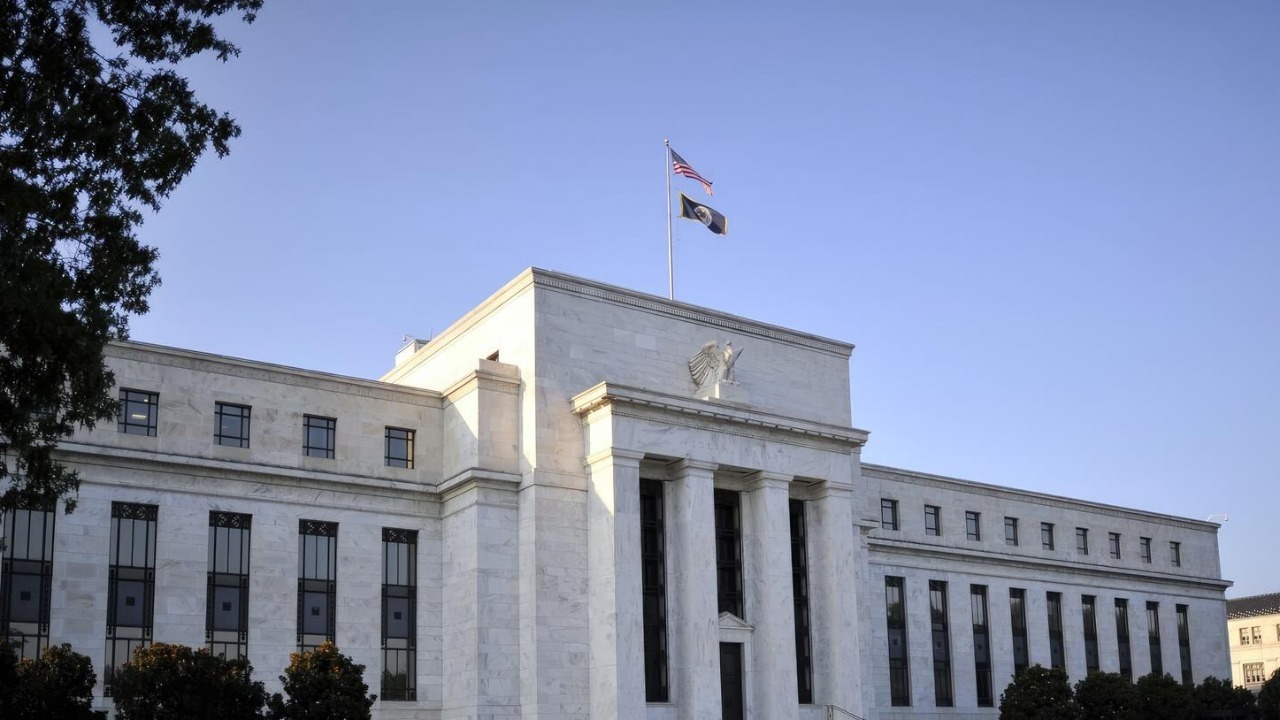
In the span of five days, the three Wall Street banks whose rate forecasts move markets all arrived at the same conclusion: the Federal Reserve is done cutting for 2026.
Between May 19 and May 23, research teams at Goldman Sachs, Morgan Stanley, and Citigroup each published notes withdrawing their remaining calls for Fed rate reductions this year. The result is a rare unanimous view among the Street’s most-watched economics desks: the fed funds target range will finish 2026 at 4.25% to 4.50%, exactly where it has sat since the Fed’s last quarter-point cut in December 2024.
That December move capped a three-cut easing cycle that began in September 2024, when the Fed pivoted after more than a year of holding rates at a two-decade high. At the time, futures markets were pricing in several more reductions through 2025 and into 2026. Those bets have now fully unwound.
For the roughly 40 million U.S. households carrying variable-rate debt, according to Federal Reserve Bank of New York data, the message is blunt: relief on credit card APRs, adjustable-rate mortgages, and home equity lines is not coming this year. For savers still earning above 4% on money-market funds and short-term Treasuries, those yields look durable for longer than almost anyone predicted 12 months ago.
The data that forced the reversal
All three banks pointed to the same pair of government releases as the tipping point.
The Bureau of Labor Statistics’ April 2026 jobs report, published in early May, showed nonfarm payrolls expanding by 205,000, the third straight month above 200,000. The unemployment rate held at 3.9%, a level that gives Fed officials little reason to worry about labor-market deterioration and even less reason to ease preemptively.
On inflation, the Bureau of Economic Analysis reported that the core Personal Consumption Expenditures Price Index, the Fed’s preferred price gauge, ran at 2.8% year over year in its latest reading. That figure has barely moved since late 2025 and remains well above the central bank’s 2% target. Services inflation and shelter costs have proven especially resistant to the rate increases already in place, and none of the three banks now see a credible path to 2% that would justify further easing before January.
The Federal Open Market Committee’s May policy statement reinforced the shift. The committee held rates steady, acknowledged “some further progress” on goods prices, but flagged that services inflation and a tight labor market warranted continued patience. Notably, the statement dropped earlier language about the “balance of risks” tilting toward easing, a subtle edit that analysts at all three firms read as the Fed closing the door on 2026 cuts without saying so outright.
How quickly the forecasts collapsed
What makes the convergence striking is how recently each firm was still calling for at least some easing.
Goldman Sachs’ economics team, led by chief economist Jan Hatzius, had penciled in one 25-basis-point cut in the fourth quarter as recently as April. Morgan Stanley’s U.S. economics group had carried two cuts in its baseline through early spring. Citigroup was the most dovish of the three, maintaining a forecast for three cuts as late as March before trimming to one in April and then to zero last week.
When three independently run research operations land on the same number in the same week, it typically signals that the underlying data has become difficult to argue with. A third consecutive strong payrolls print paired with a core PCE reading stuck above 2.7% appears to have been the breaking point.
The shift also showed up in market pricing. As of May 23, the CME FedWatch tool assigned less than a 10% probability to any rate cut before December, down from nearly 45% at the start of the year. Two-year Treasury yields, which are sensitive to near-term rate expectations, climbed above 4.5% during the week as traders repriced.
Where the consensus could break
Wall Street unanimity has a mixed track record. In early 2024, fed funds futures priced in as many as six rate cuts for that year; only three materialized, and all came in the final four months. The lesson is that consensus forecasts reflect current conditions projected forward, and conditions can shift faster than models anticipate.
Several catalysts could force the banks to reverse course again:
The June dot plot. The FOMC’s next Summary of Economic Projections, due at the June 17-18 meeting, will include an updated dot plot charting each policymaker’s rate expectations through year-end. If even a handful of officials pencil in one or two cuts for late 2026, the market narrative could shift overnight.
Shelter-cost relief. Core PCE is a composite, and its components do not all move in the same direction. Private-sector rent indexes from Zillow and Apartment List have shown cooling for months, but the BEA’s shelter measure captures those declines with a significant lag. A catch-up effect in the second half of 2026 could pull the headline number closer to target faster than current models assume.
Payroll revisions. The BLS preliminary payroll estimate for any given month can be revised by 100,000 jobs or more once additional survey responses arrive. Revisions have been unusually large in recent cycles. If the strong spring hiring numbers are marked down, the case for holding rates steady weakens with them.
Trade policy. Tariffs imposed or expanded in 2025 have fed into goods prices in ways that are hard to separate from underlying demand-driven inflation. If trade tensions ease, some of the price pressure the Fed is monitoring could dissipate on its own, giving officials room to cut even if domestic demand stays firm.
It is also worth noting what the other major banks are saying. JPMorgan’s economics team still carries one cut in its 2026 baseline, and Bank of America has flagged a “close call” between zero and one. The Goldman-Morgan Stanley-Citi consensus is dominant but not yet universal.
What it means for household budgets
For borrowers, the practical takeaway is to budget as if today’s rates will persist through December. The average 30-year fixed mortgage rate has hovered near 6.9% for months, according to Freddie Mac’s Primary Mortgage Market Survey, and the no-cut consensus suggests that is unlikely to change materially before 2027. Credit card APRs, which track the fed funds rate closely, will remain elevated as well; the national average sits above 20%, per Federal Reserve data.
Savers and conservative investors, by contrast, can plan around yields that stay attractive by recent historical standards. High-yield savings accounts and six-month Treasury bills are still offering returns above 4%, a level that was unthinkable as recently as 2021. The risk for savers is not that rates fall tomorrow but that they eventually fall without warning if the economy weakens sharply; locking in longer-duration instruments now could hedge that scenario.
Why the June meeting carries outsized weight
The Fed’s June 17-18 gathering will produce the first updated set of policymaker projections since March. Those projections will reveal whether officials agree with the banks or whether internal views are more divided than the outside consensus suggests. The May and June core PCE readings, plus two more monthly jobs reports, will land before or shortly after that meeting, giving both the Fed and the Street fresh data to test the zero-cut thesis against.
Until then, the call from Goldman, Morgan Stanley, and Citi is the market’s working assumption. It is built on data trends that are real and persistent, but it remains a forecast, not a policy commitment. If the numbers break in a dovish direction, the consensus that just formed could dissolve just as fast as it came together.