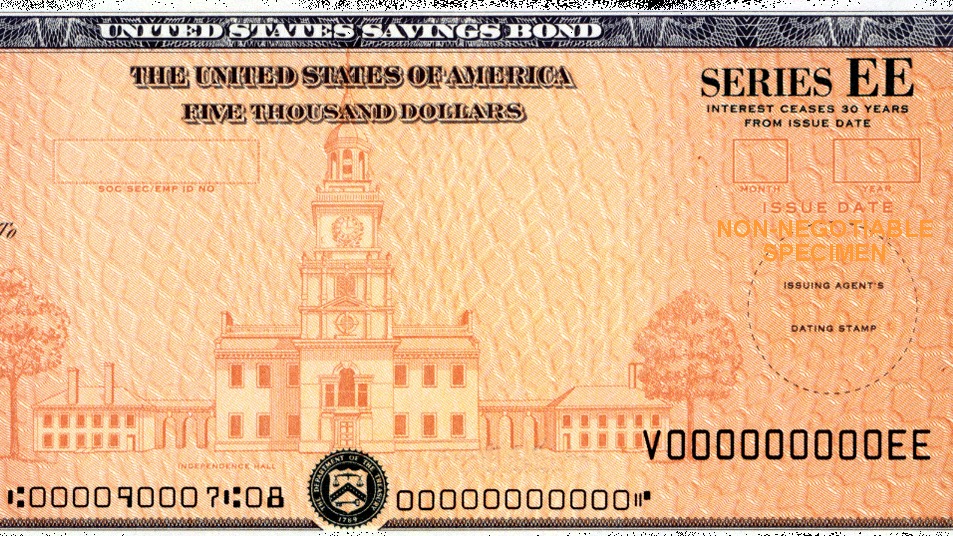
Savers who buy a Series EE bond from the U.S. Treasury and hold it for 20 years are guaranteed to receive at least double their purchase price, a promise backed by the full faith of the federal government. That guarantee has been in place for every EE bond issued since May 2005, when Treasury replaced the old variable-rate structure with a fixed rate and a floor on long-term returns. With the current fixed-rate window running from May 1 through October 31, 2026, the mechanics of that promise deserve a closer look.
How the EE bond doubling guarantee works in practice
Every Series EE bond earns a fixed interest rate set at the time of purchase. If that rate compounds to less than double the bond’s face value over 20 years, Treasury steps in with a one-time adjustment at original maturity to close the gap. The result is a guaranteed effective annual return of roughly 3.5 percent over the 20-year holding period, regardless of what the stated fixed rate happens to be on the day the bond is purchased.
That floor matters most when prevailing short-term Treasury yields sit below 3.5 percent. In those environments, the EE bond’s guaranteed doubling offers a higher long-term return than rolling over short-term bills or notes, even though the money is locked up far longer. The trade-off is liquidity: EE bonds cannot be redeemed in the first year, and cashing out before five years forfeits three months of interest. Holding to the 20-year mark is the only way to capture the full doubling benefit.
The structure also sets EE bonds apart from their inflation-linked sibling, the Series I bond. Treasury’s own FAQ page notes that I bonds are not guaranteed to grow to a particular value, while EE bonds carry the explicit doubling pledge. That distinction can tip the scale for savers who prioritize a known minimum outcome over inflation protection, especially for long-term goals such as education funding or supplemental retirement savings.
Origins of the fixed-rate structure and the adjustment mechanism
Before May 2005, EE bonds paid a variable rate tied to market conditions, and their original maturity periods varied by issue date. The June 2003 through April 2005 cohort, for example, already carried a 20-year original maturity, but the rate floated and could change every six months. Treasury’s April 2005 policy shift marked a clean break: all new EE bonds would earn a fixed rate, and the department pledged that “at a minimum” each bond’s value would double after 20 years of original maturity. In its official announcement, Treasury framed the redesign as a way to make savings bonds easier to understand while reinforcing their role as a safe, long-term vehicle.
Under the new structure, the fixed rate is intended to provide a straightforward, predictable accrual pattern for most of the bond’s life. The doubling guarantee then functions as a backstop: if the fixed rate happens to be generous enough that compound interest alone more than doubles the value in 20 years, no adjustment is needed. If not, Treasury makes a lump-sum increase at the 20-year mark so that the redemption value equals at least twice the original purchase price.
That policy change drew mixed reactions at the time. Some analysts welcomed the clarity of a fixed rate and a simple 20-year horizon, while others worried that tying the headline benefit to such a long holding period would reduce the appeal for casual savers. Reporting from the period highlighted a broader decline in consumer enthusiasm for paper savings bonds and suggested that the redesign was part of an effort to modernize and streamline the program.
Open questions about EE bond redemptions and uptake
No publicly available Treasury dataset shows, in granular form, how many post-2005 EE bonds are actually held to their 20-year original maturity versus being redeemed earlier. That leaves open several questions that matter for both policymakers and savers. One is behavioral: are most owners treating EE bonds as a true 20-year commitment, or are they using them more like medium-term certificates of deposit and cashing out once the early-redemption penalty disappears after five years?
Another question is how often the adjustment mechanism will be triggered in practice. For bonds issued when fixed rates are relatively high, compound interest alone may be sufficient to more than double the value over 20 years, rendering the guarantee largely symbolic. For bonds issued in low-rate environments, by contrast, the adjustment could represent a meaningful portion of the total return. Because the first large cohort of fixed-rate EE bonds reaches its 20-year mark in 2025, Treasury’s eventual data on redemptions and accrued values will offer the first broad test of how the guarantee operates at scale.
For individual savers weighing EE bonds today, the lack of detailed redemption statistics means decisions must rest on the written terms rather than observed behavior. The key features are clear: a fixed rate for up to 30 years, a prohibition on redemption in the first 12 months, a three-month interest penalty for cashing out before five years, and a promise that holding for the full 20 years will at least double the original investment. Whether that mix is attractive depends on an investor’s tolerance for illiquidity, expectations about future interest rates, and preference for a known minimum outcome over the inflation-linked variability of I bonds or the market risk of other long-term assets.