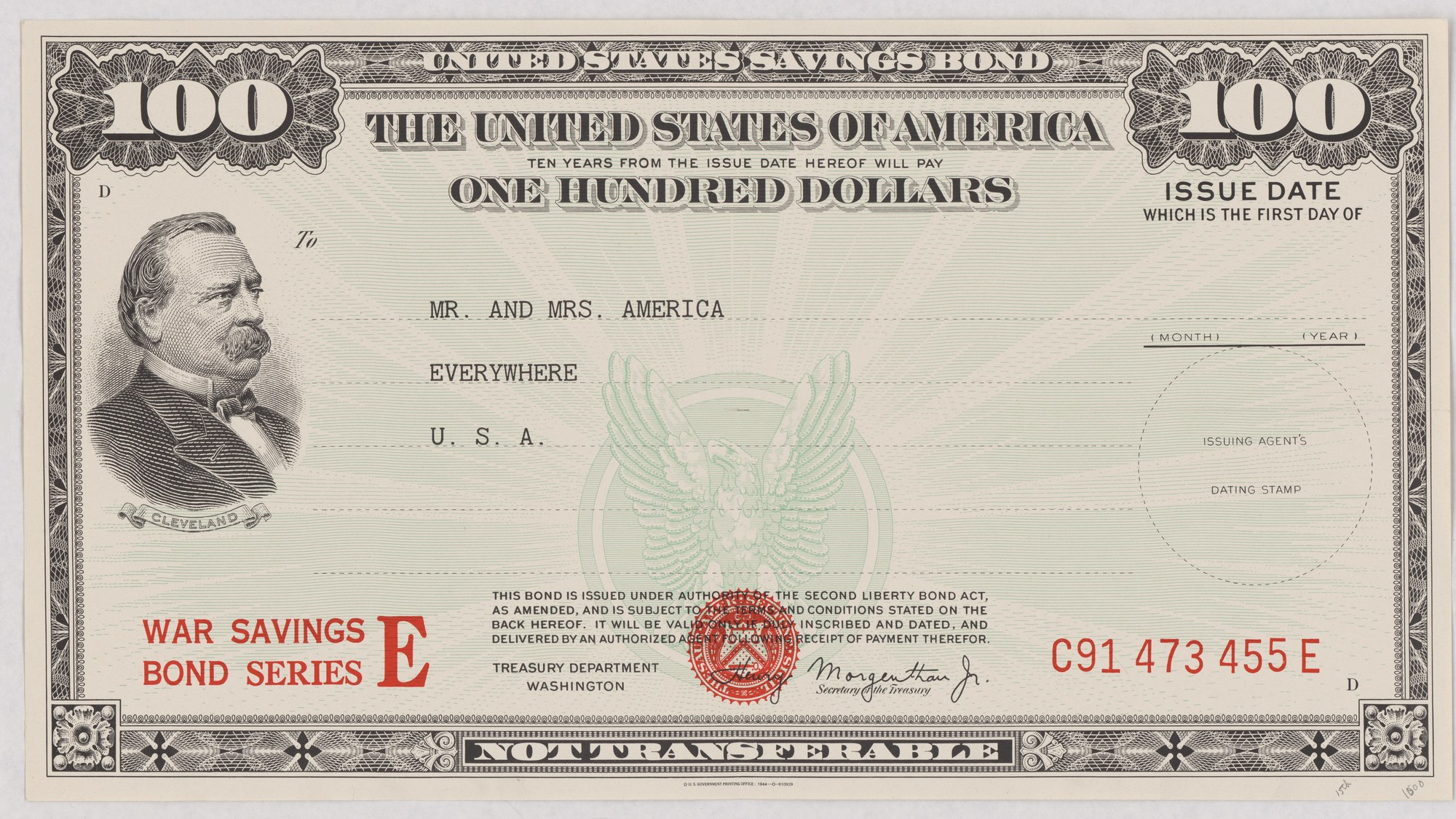
A Series I savings bond pays interest built from two separate pieces: a fixed rate that never changes for as long as the bond is held, and an inflation-linked rate that resets twice a year. Sold only through the federal government’s TreasuryDirect system, the bonds carry a feature that sets them apart from a bank certificate of deposit paying a similar rate: none of the interest is ever taxed by a state or local government, no matter where the bondholder lives.
How the Composite Rate Combines a Fixed Rate With Inflation
Every I bond earns what the Treasury calls a composite rate, and the math behind it is fixed by regulation rather than by market trading. Half of the formula is a fixed rate that is locked in on the day a bond is purchased and stays the same for up to 30 years. The other half is an inflation rate that the Treasury recalculates every six months, using the change in the Consumer Price Index for All Urban Consumers over the prior period. The two pieces are added together to produce the composite rate that actually applies to the money for the following six months, then the inflation piece resets again while the fixed piece stays untouched.
For bonds issued from May 1, 2026 through October 31, 2026, the Treasury set the composite annual rate at 4.26 percent, combining a 0.90 percent fixed rate with a 3.34 percent annualized inflation component, according to the rate table posted on TreasuryDirect’s I bonds page. Because the fixed portion is locked at purchase, a bond bought during a stretch with a higher fixed rate keeps that edge for the life of the bond even after future inflation readings fall. A bond purchased in an earlier window with a lower fixed rate keeps that lower fixed rate for its entire life as well, which is why the purchase date, not just the interest rate advertised at any given moment, determines the bond’s long-run return.
Free retirement updates: Want plain-English help keeping more of your money in retirement? The free Retirement Shield newsletter covers the benefits, deadlines, and money mistakes that cost retirees, a couple times a week. Subscribe free.
Purchase Limits, Minimums, and the Five-Year Rule
Electronic I bonds are bought directly through a TreasuryDirect account for as little as $25, with purchases capped at $10,000 per calendar year for each Social Security number. An additional $5,000 in paper bonds can be bought each year using a portion of a federal tax refund, a detail confirmed in TreasuryDirect’s own savings bond FAQ. A bond must be held for at least 12 months before it can be cashed at all, and redeeming one before the five-year mark costs the holder the three most recent months of interest as a penalty. After five years, a bond can be cashed with no penalty at any point up to its 30-year final maturity.
Because the purchase limit resets each calendar year and applies per Social Security number, a married couple who each hold a separate TreasuryDirect account can buy up to $20,000 combined in electronic I bonds annually, plus the paper allotment tied to a joint tax refund. A trust, a business, or an estate can also open its own TreasuryDirect entity account with a separate $10,000 annual limit, a detail that matters for a household managing money through more than one legal entity.
Why the Interest Never Faces State or Local Tax
Interest earned on Treasury securities, including I bonds, is taxable at the federal level but is exempt from state and local income tax under federal law governing obligations of the United States. That exemption applies automatically and does not require any special filing; a bondholder simply does not report the interest on a state return. Federal tax on the interest can also be deferred until the bond is cashed, stops earning interest at final maturity, or is transferred, whichever happens first, rather than being paid annually as it accrues the way a bank account’s interest typically is.
A separate provision, the Education Savings Bond Program, allows some bondholders to exclude I bond interest from federal income tax entirely if the proceeds are used to pay qualified higher-education expenses in the same year the bonds are redeemed, subject to income limits and other conditions detailed on TreasuryDirect’s education-bond page. That benefit is separate from, and in addition to, the standing state and local tax exemption that applies to every I bond regardless of how the money is eventually spent.
Where I Bonds Fit Next to a Bank CD
For a retiree comparing a bank CD against an I bond paying a similar headline rate, the after-tax outcome can look different once state income tax is factored in. A CD’s interest is taxed by most states that levy an income tax, while an I bond’s interest is not, which can widen the effective gap between the two products in high-tax states even when the advertised rates are close. The tradeoff is liquidity: a CD can often be broken early for a set penalty, while an I bond cannot be touched at all for the first 12 months under any circumstance, a restriction that makes the product better suited to money that will not be needed within a year than to a household’s core emergency fund.
The purchase and redemption limits also mean I bonds work best as one layer of a retirement cash reserve rather than the whole of it, since the $10,000 annual cap per person restricts how quickly a large sum can move into the program even for someone who wants to shelter more of it from state tax.
How the Rate Compares With Ordinary Savings Accounts
A standard bank savings account carries no fixed floor and can be lowered by the bank at any time as broader interest rates shift, while an I bond’s composite rate is set by formula and known in advance for each six-month window a bond is held. That predictability, paired with the state tax exemption, is part of why financial educators frequently mention I bonds as a companion to a bank emergency fund rather than a replacement for one, since the 12-month lockout period rules the bonds out for money that might be needed on short notice. A household building a longer-term cash cushion inside a broader retirement plan can treat the annual purchase window as a recurring opportunity, buying up to the limit each calendar year rather than trying to move a large lump sum in all at once.
This article was produced with AI assistance and reviewed by The Financial Wire editorial team.
More Financial Reading
- How many CDs can you park at 1 bank? FDIC rules you must know
- What really happens to your joint savings account when you die?