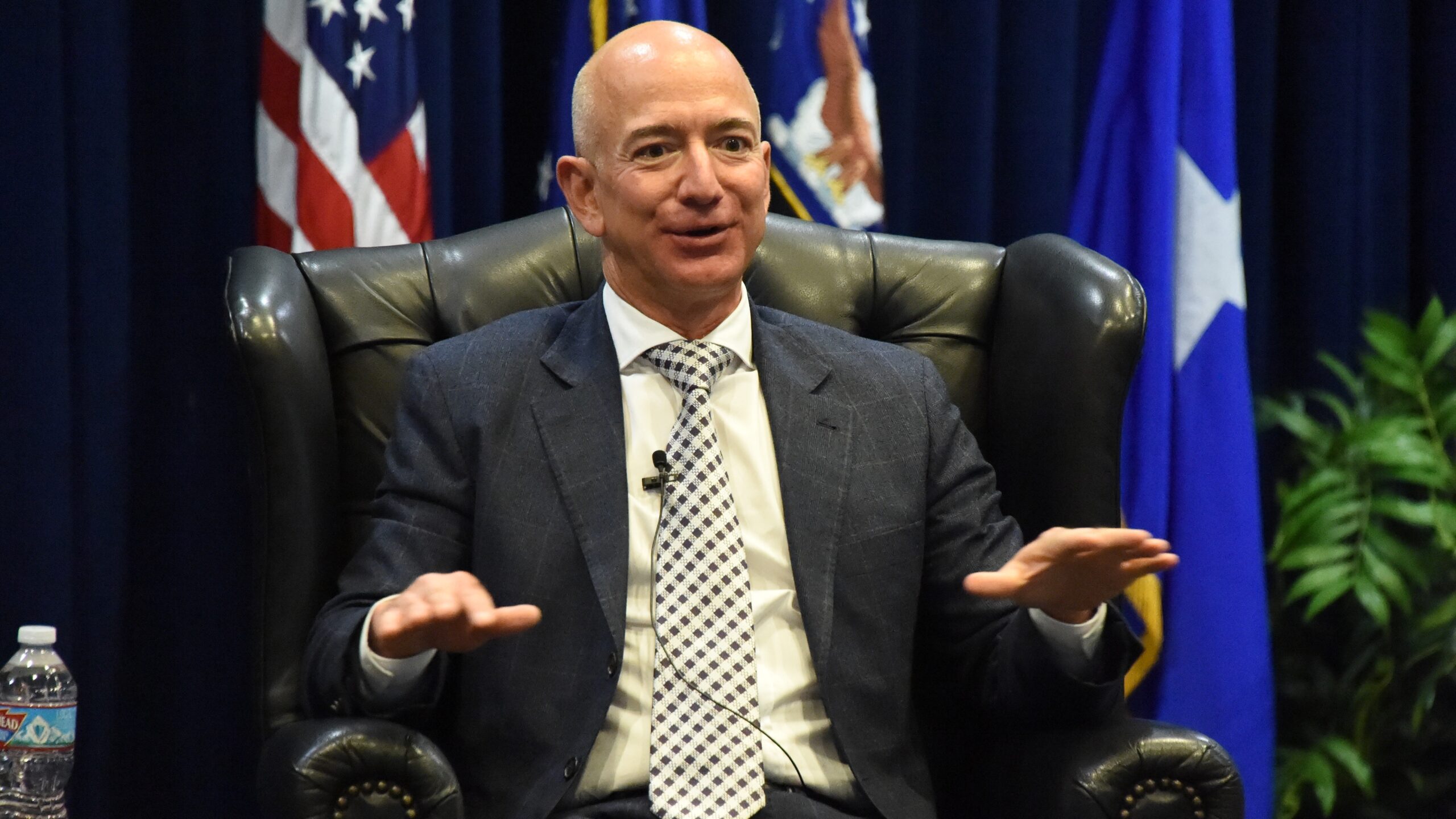
For years, Jeff Bezos trailed Elon Musk in the satellite race. SpaceX’s Starlink constellation grew into the dominant force in broadband from orbit while Amazon’s Project Kuiper struggled to get off the launchpad. Now Bezos is trying to close the gap in a single move. According to the terms of the merger agreement filed with the SEC, the deal is valued at roughly $1.2 billion in Amazon stock.
Amazon’s pending acquisition of Globalstar, the satellite communications company that powers Apple’s Emergency SOS feature on iPhones, gives Bezos something Musk does not have: a direct contractual relationship with the world’s most valuable device maker. It also hands Amazon a working satellite fleet, licensed spectrum in the S-band and L-band, ground stations across six continents, and a foothold in the direct-to-device connectivity market that analysts project could be worth tens of billions of dollars within the next decade.
The deal does not make Amazon an overnight equal to SpaceX. But it transforms the competitive landscape from a one-horse race into a genuine rivalry between the two wealthiest people on the planet.
What Amazon is actually buying
The merger agreement, filed as Exhibit 2.1 to Globalstar’s 8-K with the SEC, confirms Amazon will absorb the company’s full asset base: a constellation of low-Earth orbit satellites, internationally coordinated spectrum licenses, and a ground gateway network spanning more than 19 countries. Amazon already held approximately 20% of Globalstar’s equity before the deal was announced, a stake built through earlier infrastructure investments tied to Project Kuiper.
The most strategically valuable piece, though, may be Globalstar’s relationship with Apple. According to Globalstar’s 10-K annual report for the year ended December 31, 2024, Apple accounts for the vast majority of Globalstar’s service revenue. Apple has committed more than $1.5 billion to Globalstar’s infrastructure to support the Emergency SOS via Satellite feature introduced on the iPhone 14 in late 2022 and expanded across subsequent models. That feature allows users to send distress messages from locations with no cellular coverage and has been credited with real rescues in remote wilderness areas.
Globalstar was, in many ways, a willing target. The company had grown heavily dependent on Apple’s revenue stream and carried significant debt. For Amazon, the acquisition means inheriting paying customers and proven hardware integration rather than building demand from zero. It also means gaining spectrum already coordinated for satellite-to-handset communication, a regulatory advantage that typically takes years and considerable expense to secure independently.
The Starlink factor
This acquisition lands squarely in territory SpaceX has been staking out aggressively. Starlink, which operates a constellation that has grown well beyond 6,000 broadband satellites, partnered with T-Mobile in 2022 to develop direct-to-cell service. That program entered beta testing for text messaging in early 2025 and received FCC approval under the agency’s supplemental coverage from space framework. SpaceX has signaled plans to expand the service to include voice and data.
Until now, Amazon’s satellite ambitions centered on Project Kuiper, a broadband constellation that launched its first prototype satellites in October 2023. As of spring 2026, Kuiper has not yet begun commercial service but remains on a path toward initial deployment, with Amazon continuing to build out the constellation and ground infrastructure. Kuiper was designed to compete with Starlink on internet access, not on the handset-level connectivity that carriers and phone makers increasingly view as a must-have feature. The Globalstar deal changes that equation entirely.
By layering Globalstar’s spectrum and device partnerships on top of Kuiper’s planned broadband network, Amazon could offer carriers and device manufacturers a single platform covering both traditional internet service and the emergency or messaging features baked directly into phones. That is the kind of bundled proposition that no other satellite operator, including SpaceX, currently offers.
SpaceX has not issued a public statement addressing the Amazon-Globalstar combination as of May 2026. But the competitive pressure is structural: two rival satellite-to-phone ecosystems, each backed by different carrier and device alliances, each funded by founders with the resources and stubbornness to sustain a long fight.
Open questions that will shape the outcome
Several unresolved variables are significant enough to determine whether this deal becomes transformative or merely expensive.
Apple’s commitment. Globalstar’s 10-K documents a phased service agreement with Apple, but it does not clarify whether a change of control triggers renegotiation rights. Apple has historically preferred to diversify its supply chain rather than depend on a single partner, and the company has not publicly commented on how the merger affects its satellite plans. If Apple decides to spread its bets or build its own infrastructure, Amazon could find itself holding costly spectrum and hardware without the anchor customer that justifies the acquisition price.
Regulatory approvals. Globalstar’s spectrum licenses and satellite authorizations were granted under existing ownership. Transferring control to Amazon will require sign-off from the FCC and potentially from regulators in other jurisdictions where Globalstar operates ground stations. Conditions could be attached, particularly if regulators view the combination as concentrating too much spectrum in the hands of a single technology conglomerate that already dominates cloud computing and e-commerce.
Integration complexity. Amazon must merge Globalstar’s legacy satellite operations with Kuiper’s next-generation constellation. These are two systems built on different architectures, serving different use cases, and operating on different timelines. The investor presentation filed alongside the merger agreement describes the strategic rationale in broad terms but offers little detail on integration timelines or capital requirements. Satellite mergers have a mixed track record; the technical and organizational challenges of combining fleets should not be underestimated.
A two-player race with no finish line in sight
Before this deal, the satellite connectivity landscape had a clear front-runner. Starlink dominated broadband from orbit and was building momentum in direct-to-cell through its T-Mobile partnership. Kuiper was years behind on deployment and had no handset-level play at all.
The Globalstar acquisition compresses that gap considerably. Amazon now controls commercially proven spectrum, an operational satellite fleet, and a relationship with the company that puts more phones in more pockets than anyone else on Earth. It does not yet have Starlink’s scale or SpaceX’s launch cost advantages, but it holds a card Musk cannot easily replicate: a direct contractual tie to Apple’s device ecosystem.
Whether that advantage holds depends on execution, regulatory outcomes, and Apple’s own strategic calculus. The SEC filings establish the framework of the deal with legal precision. The competitive consequences will unfold over years, driven by engineering decisions, carrier negotiations, and the unpredictable choices of a company in Cupertino that has never been comfortable letting someone else control a critical piece of its product experience.