You paid $4.43 a gallon for regular gasoline last week, according to the U.S. Energy Information Administration’s weekly retail tracker for the week ending April 28, 2026. Exxon Mobil, the largest publicly traded oil company in the country, just reported that its own profits got cut nearly in half. Those two facts sound like they should be connected. They are not, at least not in the way most people assume.
Exxon disclosed in a regulatory filing with the Securities and Exchange Commission on May 1, 2026, that it earned $4.2 billion in the first quarter, down roughly 45% from approximately $7.7 billion in the same period a year earlier. The company pointed to weaker crude oil prices and softer margins in its exploration and production business as the primary causes.
For a household filling a 15-gallon tank once a week at the current national average, that works out to about $66 per trip and roughly $290 a month, before any premium or diesel surcharges. For comparison, the EIA’s weekly series shows national averages first climbed above $4.00 in mid-March 2022 and peaked near $5.00 by mid-June of that year. The current price sits squarely in that historically painful range.
Wall Street is already looking past the weak quarter. Consensus estimates compiled by LSEG, formerly Refinitiv, as of late April 2026 project Exxon’s second-quarter profit above $9 billion, more than double the Q1 figure. The number of individual analyst estimates behind that consensus figure is not specified in the LSEG compilation. The expected drivers: seasonal demand gains, firmer crude benchmarks, and wider refining spreads heading into summer. Those forecasts are not guarantees. They hinge on assumptions about oil prices, OPEC-plus output decisions, and global economic momentum that can shift in a matter of weeks.
A 45% drop, explained
Exxon’s 8-K filing and its accompanying investor relations data lay out the damage. Lower benchmark prices for both oil and natural gas cut revenue per barrel across the company’s upstream segment. Some key production regions also saw higher operating costs, compounding the squeeze. Chemical and specialty product margins offered little help, showing modest pressure of their own.
The company still generated positive cash flow. It continued returning capital to shareholders through its buyback program and maintained its quarterly dividend, which stood at $0.99 per share as of the Q1 declaration. But the overall picture is of a company earning substantially less per unit of output than it did 12 months earlier.
Exxon’s results are not an outlier. Chevron reported a similar year-over-year earnings decline in its Q1 results, and Shell flagged weaker upstream realizations in its own quarterly update. Across the integrated oil sector, the pattern was consistent: softer commodity prices and tighter upstream margins made this an industry-wide downturn, not a problem unique to one company.
Why gas prices have not followed profits down
If Exxon’s earnings fell because crude got cheaper, why are drivers still paying $4.43? Because the price on the gas station marquee is only loosely tethered to what an oil producer earns per barrel.
Retail gasoline pricing involves a chain of actors and costs between the wellhead and the pump. Refining margins, often called the “crack spread,” measure the gap between the cost of crude oil and the wholesale price of finished gasoline. When crude drops faster than wholesale gasoline, refiners capture wider spreads, and that margin gets baked into what consumers pay. Federal and state fuel taxes, which as of early 2026 together average about 57 cents per gallon nationally according to the American Petroleum Institute, add a fixed layer that does not budge when crude falls. Distribution, blending, and retail markup account for the rest.
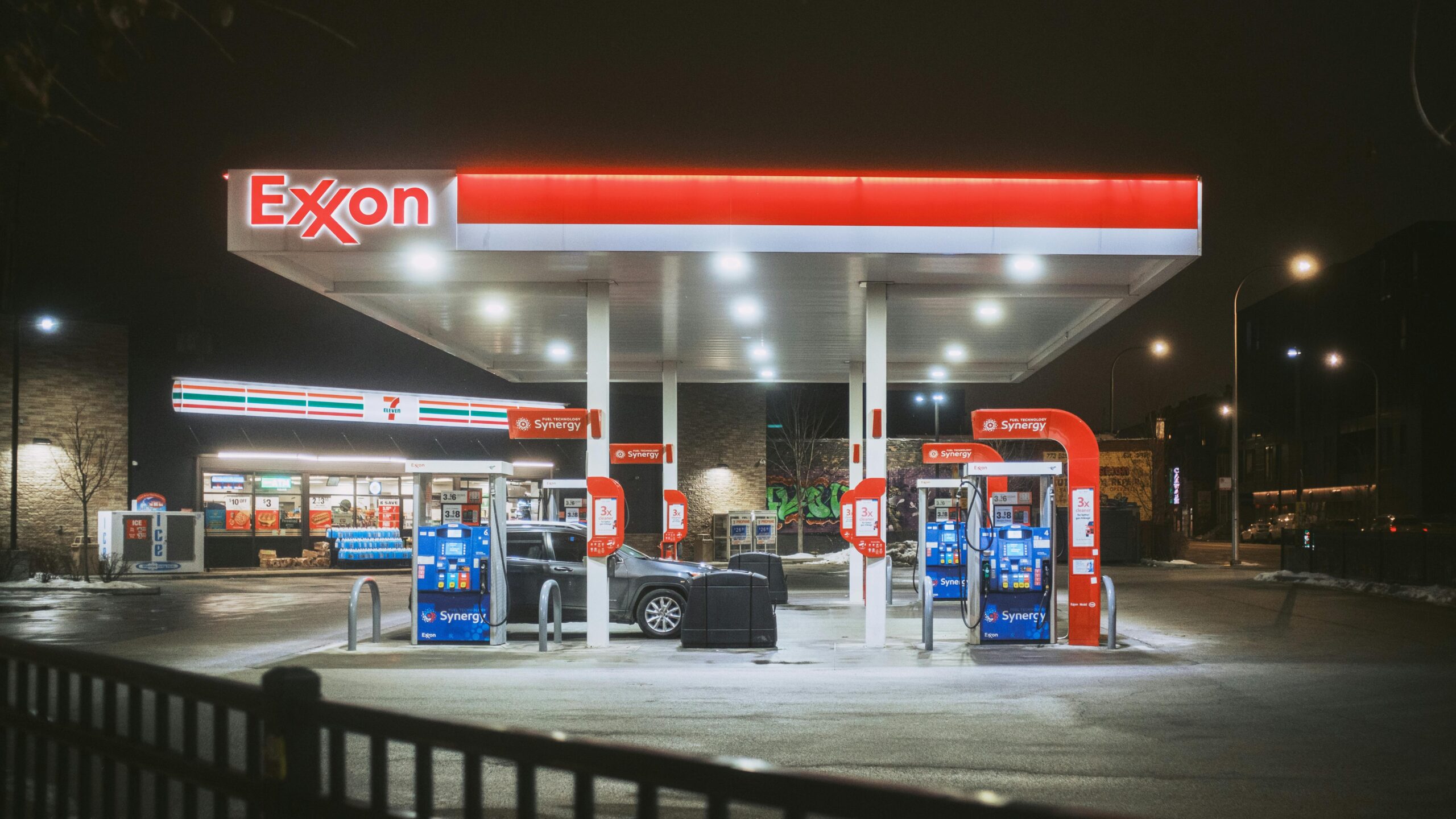
Exxon operates across this entire value chain, from production to refining to the branded stations that carry its name. In Q1 2026, its upstream division absorbed the hit from lower commodity prices while its downstream refining operations partially offset the blow with healthier crack spreads. That internal tug-of-war left overall profit lower but did not translate into cheaper gasoline for consumers.
Regional variation makes the national average even less useful as a personal benchmark. California drivers routinely pay well above $5 a gallon because of stricter fuel-blend requirements, higher state taxes, and limited local refinery capacity. Motorists along the Gulf Coast and in parts of the Midwest often pay 50 to 80 cents less than the national figure, thanks to proximity to refineries and lower state levies.
What the profit rebound forecast actually depends on
The analyst consensus pointing to a second-quarter surge above $9 billion rests on several assumptions, each carrying its own risk.
Crude prices. Brent and WTI benchmarks would need to firm up from their Q1 levels. Seasonal demand patterns typically support that as summer driving and cooling demand pick up in the Northern Hemisphere. But a global economic slowdown, particularly in China, could cap any rally.
Refining margins. Summer traditionally brings wider crack spreads as gasoline demand peaks. If refinery outages or maintenance delays tighten supply further, margins could exceed expectations. A mild driving season or a surge in imports could narrow them.
OPEC-plus discipline. The producer group’s output decisions remain a wildcard. Any surprise increase in supply could push crude prices lower and undercut the earnings rebound thesis.
Exxon’s own portfolio. The company has been ramping production in Guyana’s Stabroek block, where it operates alongside Hess and CNOOC. Higher volumes from low-cost barrels could boost earnings even if prices stay flat, but execution risk on new offshore projects is never zero.
None of these variables appear in Exxon’s SEC filing, which is backward-looking by design. The company did not issue formal forward earnings guidance in its Q1 disclosure.
When a profit surge and expensive fill-ups point in the same direction
There is no mechanical link that guarantees pump prices will fall when an oil major’s profits drop, or rise when they recover. The factors that compressed Exxon’s Q1 earnings, primarily lower crude benchmarks, did not flow through to the pump because refining spreads, taxes, and distribution costs held retail prices up.
If analysts are right and Exxon’s profits surge in Q2, the most likely driver would be a combination of firmer crude and wider refining margins. Both of those forces would, if anything, push gasoline prices higher, not lower. The scenario in which Exxon’s bottom line recovers is largely the same scenario in which filling your tank stays expensive, or gets worse.
Exxon’s next quarterly filing is expected in late July or early August 2026. Until then, the tension between shrinking corporate profits and stubborn pump prices is unlikely to resolve in drivers’ favor. The EIA updates its gasoline tracker every Monday; the next data point that matters to your wallet arrives before the next one that matters to Exxon’s shareholders.