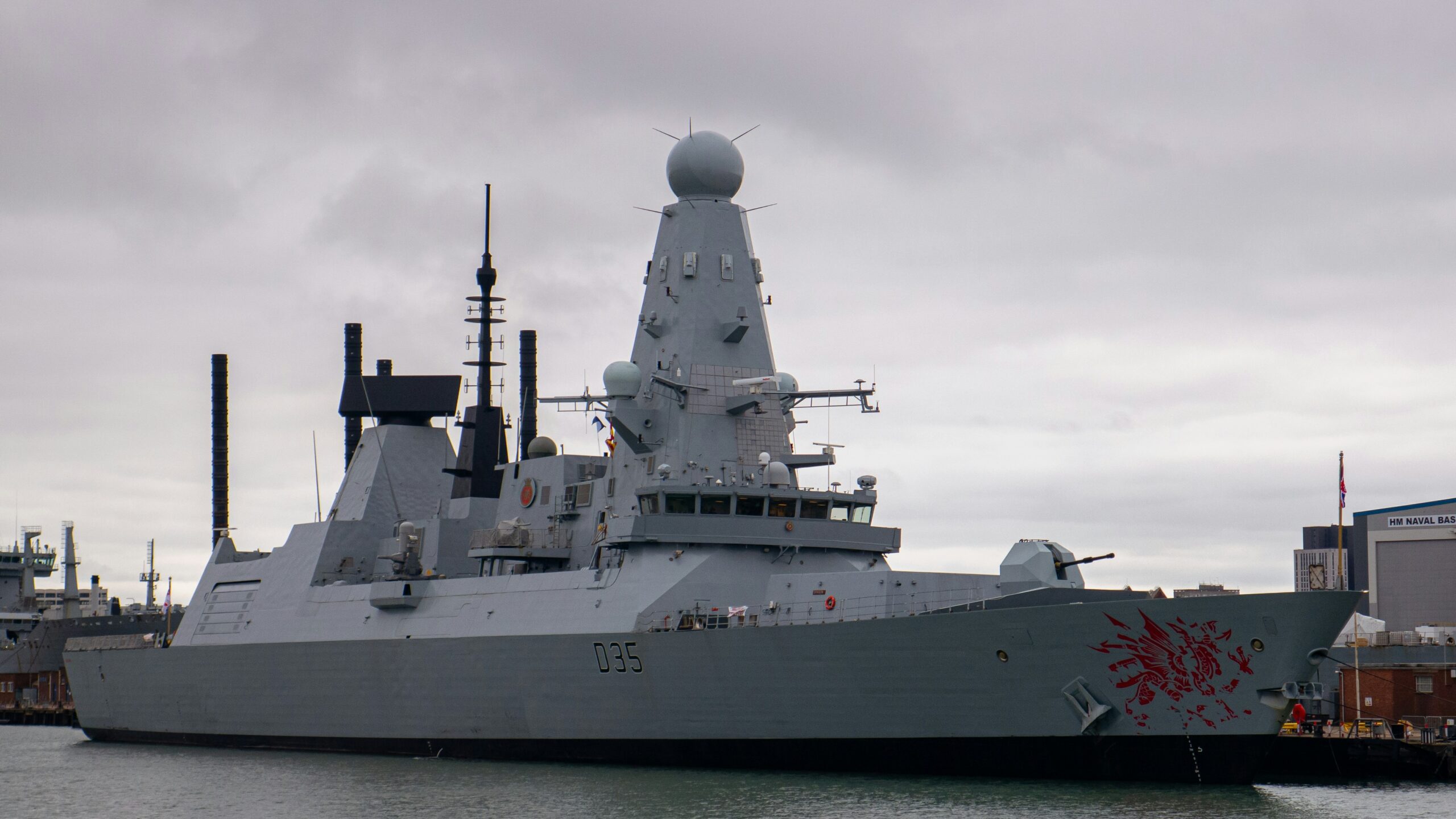
Britain is sending one of its most powerful warships, a squadron of Typhoon fighter jets, and a flotilla of unmanned patrol boats into the Persian Gulf, joining a multinational force of more than 40 countries assembling to break open the Strait of Hormuz to commercial shipping.
Defence ministers from the participating nations gathered on May 13, 2026, and issued a joint declaration: the strait must remain open to all commercial traffic. The formal statement released by Australia’s defence minister confirmed the coalition’s scope and its unified commitment to restoring freedom of navigation through the 21-mile-wide waterway that connects the Gulf to the open ocean.
The deployment is shaping up to be one of the largest coordinated naval operations in the Middle East in years. Approximately 21% of global petroleum liquids consumption passes through the Strait of Hormuz, according to 2023 estimates from the U.S. Energy Information Administration, making it the single most important chokepoint in the global petroleum supply chain. When that flow is threatened, the consequences are not abstract: insurance premiums for tankers spike, oil futures surge, and the cost of fuel, petrochemicals, and consumer goods climbs worldwide.
What Britain is sending
The centerpiece of the UK contribution is HMS Dragon, a Type 45 air-defence destroyer purpose-built to shield naval task groups from missile and aircraft attack. Dragon carries the Sea Viper missile system and the Sampson radar, widely considered one of the most advanced air-defence suites afloat. UK government documents released under the Open Government Licence confirm that the destroyer will be joined by RAF Typhoon fast jets and unmanned surface vessels, giving the British contingent layered capability across the surface, the air, and the fast-growing domain of autonomous maritime surveillance.
The drone boats deserve particular attention. Unmanned surface vessels have shifted from experimental curiosities to operational tools over the past several years, used for mine detection, intelligence gathering, and persistent patrol in waters too dangerous or too vast for crewed ships to cover alone. Their presence in this deployment signals that the coalition plans to maintain constant awareness of activity in and around the strait without stretching crewed warships thin.
Why the Strait of Hormuz matters
The strait sits between Iran to the north and Oman and the United Arab Emirates to the south. At its narrowest point, the shipping lanes compress into two one-mile-wide corridors separated by a two-mile buffer zone. Every tanker leaving Saudi Arabia, Iraq, Kuwait, Qatar, or the UAE must pass through this bottleneck to reach global markets.
History shows what happens when the bottleneck tightens. In the summer of 2019, a series of tanker seizures and limpet-mine attacks in the Gulf of Oman, attributed by Western governments to Iran, sent oil prices lurching upward and prompted the creation of the International Maritime Security Construct, a U.S.-led coalition that established escort patrols through the strait. Iran’s Islamic Revolutionary Guard Corps Navy seized the British-flagged tanker Stena Impero that July, holding the vessel and its crew for more than two months in a confrontation that tested London’s willingness to protect commercial shipping in the region.
The Houthi campaign against Red Sea shipping that began in November 2023 reinforced the lesson. A determined non-state actor managed to disrupt a major maritime corridor for months, forcing commercial vessels to reroute around the Cape of Good Hope at enormous cost. That precedent sharpened awareness among coalition governments that threats to chokepoints demand rapid, large-scale responses rather than incremental escalation.
From the JCPOA collapse to confrontation
The current standoff did not appear overnight. Tensions in the Gulf have followed a long arc that accelerated after the United States withdrew from the Joint Comprehensive Plan of Action, the 2015 nuclear agreement with Iran, in 2018. That withdrawal reimposed sweeping sanctions on Iranian oil exports and set off a cycle of escalation: Iran gradually exceeded the deal’s enrichment limits, Washington expanded its maximum-pressure sanctions campaign, and maritime incidents in the Gulf multiplied. The 2019 tanker attacks, the Stena Impero seizure, and repeated drone and missile strikes on Saudi oil infrastructure all unfolded against that backdrop.
Washington’s exact role in the current coalition has not been formally detailed in the primary documents available as of late May 2026. The United States has maintained a continuous naval presence in the Gulf through the Fifth Fleet, headquartered in Bahrain, and has led or co-led every major maritime security initiative in the region since the 1980s Tanker War. Whether the U.S. is serving as the operational backbone of the 40-nation force or participating as one contributor among many will shape the mission’s political dynamics and its reception in Tehran.
A coalition wider than NATO
The 40-plus-nation figure, drawn from the Australian defence minister’s statement, is significant because it extends well beyond the usual Western alliance structures. Australia’s statement references French participation alongside its own, indicating the mission draws contributors from both Atlantic and Indo-Pacific security networks. That breadth suggests a substantial diplomatic effort, pulling in countries that do not always align on Middle Eastern security but share a common interest in uninterrupted energy flows.
How the force will actually operate remains an open question. No published defence document has spelled out whether the coalition will function under a single combined command, rotate leadership among contributing navies, or coordinate parallel national deployments through a joint headquarters. Command arrangements matter enormously in a contested environment: they determine how quickly the force can respond to a provocation and who bears legal responsibility if weapons are fired. The existing Combined Maritime Forces headquarters in Bahrain, which has coordinated multinational patrols in the region for more than two decades, is a natural framework, but no government has confirmed that arrangement.
What Iran has and has not said
The precise nature of Iran’s interference with shipping in the strait has not been fully detailed in any primary government record or independent shipping-industry analysis available as of late May 2026. No Iranian government statement confirming the scope, start date, or legal rationale for its actions has surfaced publicly. That makes it difficult to determine whether the multinational force is responding to a full naval blockade, selective boarding and inspection of certain vessels, or a broader campaign of harassment against commercial traffic.
Iran has historically justified its naval activity in the strait as enforcement of its territorial waters and exclusive economic zone, though international law, specifically the United Nations Convention on the Law of the Sea, guarantees the right of transit passage through straits used for international navigation. Tehran had not, at the time of writing, issued a formal public response to the coalition’s announcement.
Different characterizations of Iran’s actions, whether from coalition governments, Iranian state media, or shipping-industry sources, may reflect political framing as much as operational reality. The clearest picture will emerge as more primary documents surface: formal deployment orders, alliance communiques, independent shipping-tracker data, and any statements from Iran itself.
How HMS Dragon and 40 allied navies could reshape Gulf security
A coalition larger than most recent military alliances has publicly committed to keeping the world’s most important oil chokepoint open. Britain is contributing front-line military hardware, not just diplomatic support. And the political consensus behind the mission spans continents and alliance blocs, a scale of response that underscores how seriously participating governments view the disruption.
What remains unknown is nearly everything operational: when HMS Dragon will arrive on station, how the coalition’s rules of engagement will handle Iranian naval vessels, whether the unmanned boats will patrol autonomously or under direct human control, and how Tehran will respond to a force of this size assembling off its coast. The stakes, measured in barrels of oil, shipping insurance rates, and the risk of miscalculation between armed navies in a narrow waterway, are as high as anything the Gulf has seen since the Tanker War of the 1980s.
The 40-nation figure rests on the Australian ministerial statement alone. No government has contested it, and the scale of the response is consistent with the severity of the disruption, but a second primary source confirming the exact participant count has not yet appeared. Specific operational figures circulating in secondary reporting, such as patrol schedules, rules of engagement, or force disposition maps, should be treated with caution until official deployment notices are released.