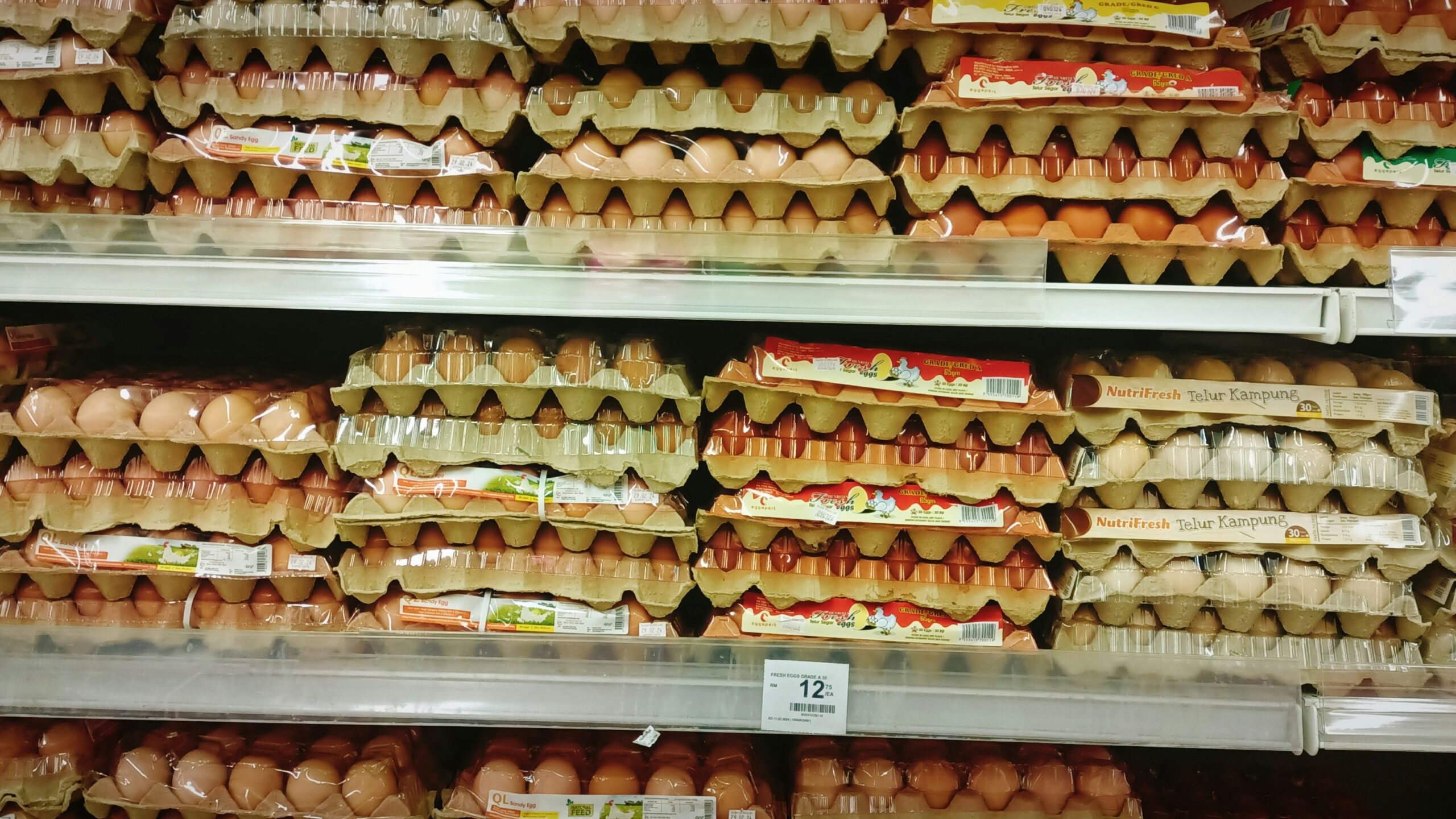
At the start of 2025, a dozen eggs cost an average of $4.95 at the supermarket, the highest price most Americans had ever paid. By mid-2026, that number has already fallen sharply, and the federal government expects the full-year decline to be historic. Meanwhile, beef keeps getting more expensive at a pace that shows no sign of slowing. The result is a grocery aisle that feels like two different economies: one where relief is finally arriving, and another where the pain is deepening.
The egg forecast: a record-setting reversal
The USDA Economic Research Service’s May 2026 Food Price Outlook projects that retail egg prices will fall 29.8% over the full calendar year. Because 2026 is not yet over, this is a projected decline, not a final measured result. If that midpoint estimate holds, it would mark the largest projected single-year decline in the agency’s records, which stretch back to 1974, according to the Food Price Outlook historical tables.
The projected drop follows two years of extraordinary price spikes driven by highly pathogenic avian influenza, or HPAI. Outbreaks that began in early 2022 killed tens of millions of egg-laying hens across the country, slashing supply while demand barely budged. Prices surged past records in early 2023, eased modestly through that summer, then spiked again in late 2024 and into 2025 as new waves of the virus swept through commercial flocks.
ERS now says HPAI pressures have eased enough for producers to rebuild their laying flocks with replacement pullets, and that improved bird availability is the primary driver behind the projected relief. For shoppers, the practical translation is straightforward: a dozen eggs that cost nearly $5 a year ago could average closer to $3.50 by the end of 2026, though the exact savings will vary by region and retailer.
The 29.8% figure is a central estimate, not a guarantee. ERS frames it within a prediction interval, meaning the actual decline could land meaningfully higher or lower. The biggest wildcard remains avian influenza itself: a fresh outbreak wave during fall bird migration could force new culling, tighten supply, and stall or reverse the recovery.
Beef keeps climbing: 14.8% and counting
While eggs are getting cheaper, beef is moving sharply in the other direction. The Bureau of Labor Statistics reported in its Consumer Price Index release covering April 2026 data that beef and veal prices that month were 14.8% higher than in April 2025. Readers should note that BLS publishes CPI data on a monthly schedule, and the April 2026 report was the most recent release available at the time of this article’s publication. Unlike the egg forecast, this is not a projection. It is a measured statistic drawn from thousands of retail price quotes collected across the country each month.
The cause is structural. The U.S. cattle herd has been shrinking for years, squeezed by prolonged drought across major ranching states that forced producers to send breeding cows to slaughter rather than maintain them. The USDA’s January 2026 cattle inventory report confirmed the national herd remains near its smallest size in decades. Rebuilding takes time: a cow bred today will not produce a market-ready steer for roughly two years, which means tight supplies and elevated prices are likely to persist well into 2027 or beyond.
Feed costs, trade policy, and weather all add uncertainty. If drought conditions improve and ranchers begin retaining heifers for breeding, the herd could start growing again, but the effects would not reach grocery store coolers quickly. For now, consumers paying $7 or more per pound for ground beef are unlikely to see meaningful relief soon.
Why eggs can recover fast and beef cannot
The divergence between these two proteins is not random. It reflects a fundamental difference in how quickly each industry can respond to a supply shock.
Poultry operations can scale up relatively fast. A pullet reaches laying age in about five months, and modern egg farms can add capacity in under a year when disease pressure lifts and the economics justify expansion. That biological speed is what makes a nearly 30% price swing plausible within a single calendar year.
Cattle operate on a much longer cycle. Cows carry calves for nine months, and those calves spend another 12 to 18 months on feed before reaching slaughter weight. When drought or poor economics push ranchers to liquidate breeding stock, the supply hole takes years to fill. That is why beef prices can stay elevated long after the original trigger has passed.
For household budgets, the divergence creates a partial offset. Eggs are a staple protein source for lower-income families in particular, so a sharp price drop delivers outsized relief to the people who felt the HPAI-driven spikes most acutely. But beef’s continued climb means total meat spending for many households may not fall much, especially for families that rely on ground beef as a weeknight staple. Chicken and pork, which the USDA projects will see more modest price changes in 2026, offer a middle path for shoppers looking to stretch their dollars.
Key signals for egg and beef prices through the rest of 2026
Several factors will determine whether the egg forecast plays out as projected. USDA APHIS tracking of HPAI detections in commercial flocks is the most important leading indicator: any uptick in confirmed cases during the fall migration season could slow flock rebuilding and narrow the projected price decline. Retailers’ willingness to pass wholesale savings through to shelf prices also matters, and historically that pass-through has lagged by several weeks.
On beef, the key data point is the next USDA cattle inventory report, expected in mid-2026, which will show whether ranchers have begun retaining heifers in meaningful numbers. If retention rates tick up, it would signal the start of a herd-rebuilding phase, though price relief at the retail level would still be a year or more away. Import volumes from Australia, Brazil, and other major beef exporters could provide a shorter-term cushion if trade flows remain stable.
One broader caveat worth noting: the ERS forecasting model relies on Consumer Price Index and Producer Price Index inputs, and the agency has acknowledged periodic data disruptions that can add uncertainty to its projections. That does not invalidate the 29.8% forecast, but it is one more reason to treat the number as a strong directional signal rather than a precise prediction. The direction, though, is clear: eggs are headed meaningfully lower, beef is not, and the gap between them is shaping up to be one of the most striking splits in grocery prices in decades.