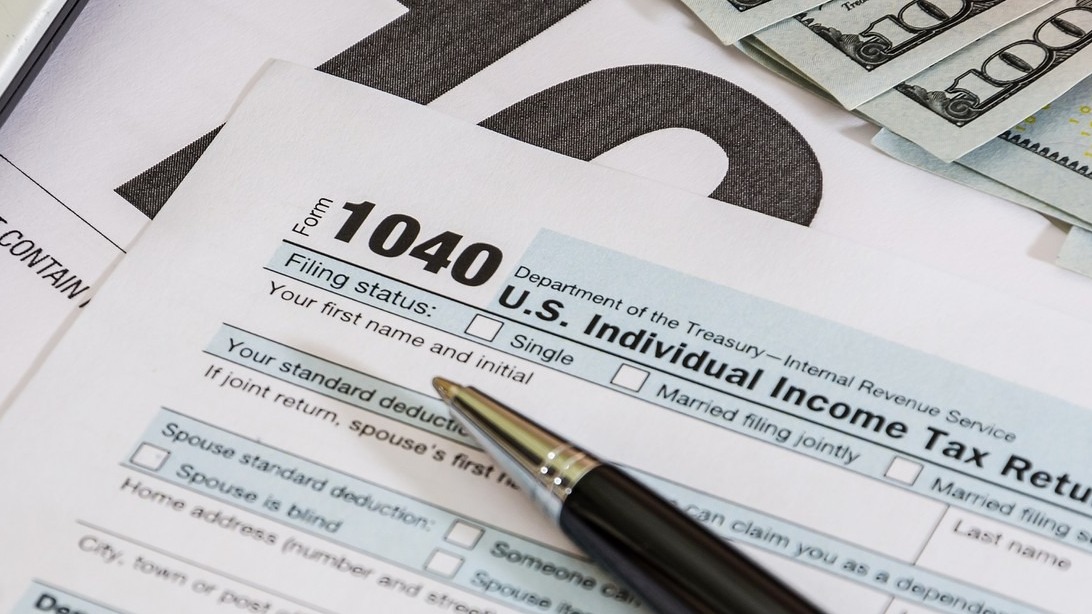
Most Americans will never fill out a Schedule A for their 2026 taxes. The IRS has set the standard deduction at $32,200 for married couples filing jointly, $16,100 for single filers, and $24,150 for heads of household, increases that push the threshold even further beyond what typical households spend on mortgage interest, state taxes, and charitable gifts combined. The numbers, published in IRS announcement IR-2025-103 in May 2025, apply to income earned in 2026 and returns filed in early 2027.
For a married couple, that is $2,200 more sheltered income than in 2025, when the standard deduction was $30,000. Single filers gain $1,100 over last year’s $15,000, and head-of-household filers gain $1,650 over $22,500. None of it requires a single receipt.
How much bigger the deduction got, and why
These increases are not discretionary. They are annual inflation adjustments required by the tax code, calculated using the chained Consumer Price Index. The One, Big, Beautiful Bill Act, signed into law in 2025, made permanent the near-doubling of the standard deduction that the 2017 Tax Cuts and Jobs Act first introduced. The formal legal authority for the 2026 figures is Rev. Proc. 2025-32, published in Internal Revenue Bulletin 2025-45.
Here is how the 2026 figures compare to the prior year:
- Married filing jointly: $32,200 (up from $30,000 in 2025, a $2,200 increase)
- Single / Married filing separately: $16,100 (up from $15,000, a $1,100 increase)
- Head of household: $24,150 (up from $22,500, a $1,650 increase)
Filers 65 and older or those who are blind get an additional standard deduction on top of these base amounts. For tax year 2026, Rev. Proc. 2025-32 sets that add-on at $1,600 per qualifying individual for married filers and $2,000 for unmarried filers. A married couple where both spouses are 65 or older would start with a combined standard deduction of $35,400 before accounting for any itemized expenses at all.
The updated amounts are already embedded in the estimated-tax worksheets inside IRS Publication 505, so workers and retirees can adjust withholding or quarterly payments now rather than waiting for the 2027 filing season.
How payroll withholding tables will update for W-2 workers
For the tens of millions of Americans who receive a W-2, the most immediate real-world effect of the higher standard deduction will show up in payroll withholding. The IRS is expected to release updated withholding tables reflecting the 2026 standard deduction and bracket changes before the start of the 2026 tax year. Once employers adopt those tables, slightly less federal income tax should be withheld from each paycheck, because the larger deduction reduces the amount of income subject to tax. Workers who want to get ahead of the change can submit a revised Form W-4 to their employer and use the IRS Tax Withholding Estimator, referencing the 2026 figures already available in Publication 505, to fine-tune the amount withheld per pay period.
Why itemizing keeps shrinking
Before the 2017 overhaul, roughly 30 percent of filers itemized, according to IRS Statistics of Income data for tax year 2016. After the standard deduction jumped, that share collapsed. SOI tables for every filing year since show itemizers as a small and shrinking minority, which is the basis for the widely cited estimate that about nine in ten filers now take the standard deduction.
The arithmetic explains why. To benefit from itemizing, a filer’s combined deductible expenses must exceed the standard deduction. The three biggest itemized categories are mortgage interest, state and local taxes (still capped at $10,000 under federal law), and charitable contributions.
Consider a single renter in a moderate-tax state who gives $2,000 a year to charity and carries no mortgage. That person’s itemized total falls far short of $16,100. Even a married couple with a $350,000 mortgage at 6.5 percent interest pays roughly $22,000 in annual interest during the early years of the loan. Add the $10,000 SALT cap and $3,000 in charitable gifts, and the total lands around $35,000, only modestly above the $32,200 joint threshold. A smaller mortgage, a lower rate, or a few years of principal paydown can easily flip the math.
Itemizing in 2026 will remain concentrated among higher-income households, owners of expensive homes, and residents of high-tax states like New York, New Jersey, and California, where property and income taxes push deductible totals well past the standard amount.
What the new numbers do not settle
No official IRS projection pins the exact itemization rate for tax year 2026. The actual share will not be calculable until 2027 returns are processed and tabulated, likely sometime in 2028. Mortgage rates, state tax policy changes, and shifts in charitable giving could all nudge the number.
State conformity is another open question. Many states piggyback on the federal standard deduction, but others set their own thresholds or require itemization on the state return regardless of the federal choice. Nothing in IR-2025-103 or Publication 505 addresses state rules. A filer could claim the federal standard deduction while still itemizing on a state return, or the reverse. Checking state-specific instructions remains essential.
Worth clarifying: tax credits, such as the child tax credit or the clean-vehicle credit, reduce tax liability directly and work the same way whether a filer itemizes or not. The standard-versus-itemized choice affects only deductions, not credits.
Why you should keep receipts even if you never itemize
As more households default to the standard deduction year after year, there is a real risk that people stop tracking deductible expenses entirely. That can backfire. A major surgery, a federally declared disaster loss, or a spike in property taxes after a reassessment could temporarily push a filer’s costs above the standard amount in a single year. Without receipts and contemporaneous records, capturing that benefit becomes difficult or impossible.
Financial planners sometimes call this the “bunching” strategy: concentrating two years of charitable gifts into one calendar year, for example, to clear the standard-deduction hurdle in that year while taking the standard amount in the other. The strategy only works if the taxpayer has documentation ready when it counts.
For the vast majority of filers, the 2026 increase is straightforward good news: more income sheltered automatically, a simpler return, and one fewer decision at tax time. For the minority still close to the line, the higher bar is a signal to run the numbers early, keep every receipt, and decide before December 31 whether bunching deductions into 2026 or 2027 produces the better outcome.