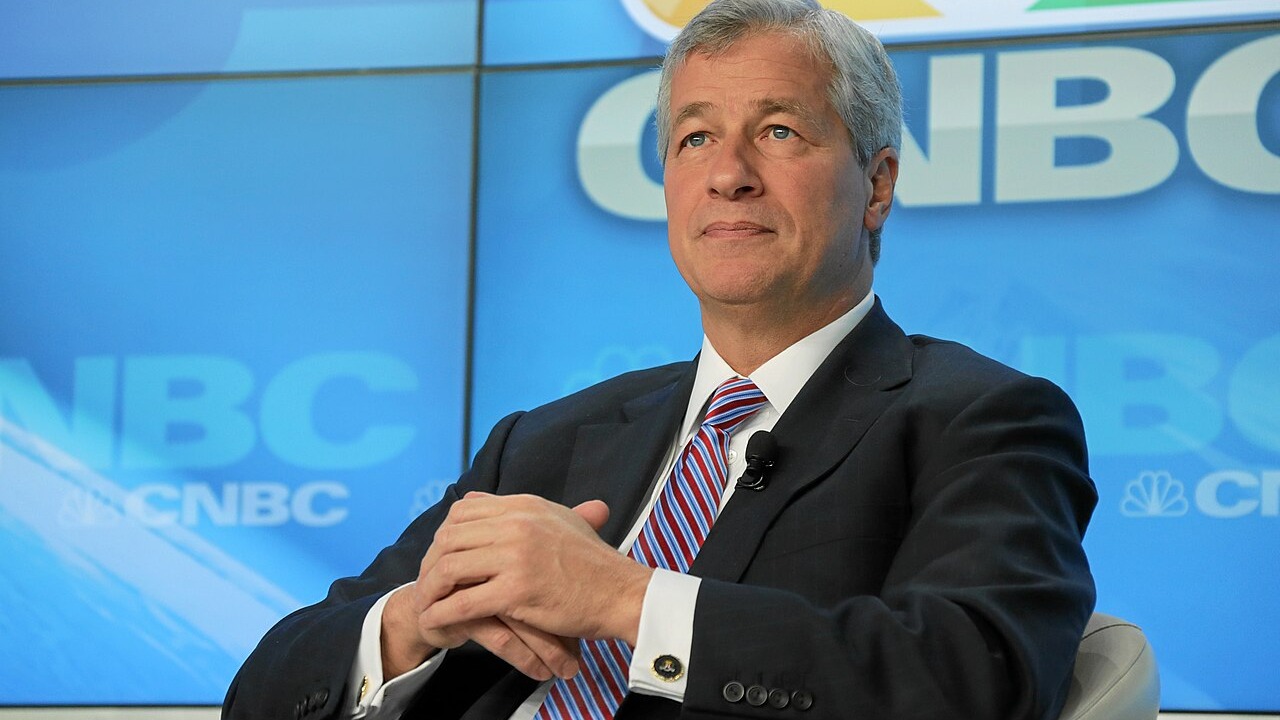
JPMorgan Chase CEO Jamie Dimon warned in his latest annual shareholder letter that higher interest rates act like gravity on stock valuations, a phrase that closely mirrors a caution Warren Buffett delivered more than two decades ago. The parallel landed on April 5, 2026, when JPMorgan Chase published its 2025 Annual Report, and it arrives at a moment when borrowing costs remain elevated and equity investors are weighing whether current stock multiples can hold.
Why Dimon’s gravity warning lands differently in 2026
Buffett first drew the gravity analogy at Berkshire Hathaway’s annual meeting in early May 2003. He told shareholders that rising interest rates pull down the value of every financial asset the same way gravity pulls objects toward the ground. The Washington Post account of that meeting, published on May 4, 2003, captured his message that investors should temper their expectations for future stock returns when rates climb. At the time, the Federal Reserve was still holding short-term rates near historic lows, and Buffett was speaking about a hypothetical shift that had not yet fully arrived.
Dimon’s echo of that language carries a different weight because the rate environment Buffett once described as a future risk is now the operating reality. The Federal Reserve’s benchmark rate has remained well above levels seen during the decade-plus stretch of near-zero policy that followed the 2008 financial crisis. When rates stay elevated, the discount rate investors apply to future corporate earnings rises in tandem, which mechanically compresses the price-to-earnings multiples the market is willing to pay. That is the gravitational force both executives identified: higher rates reduce the present value of a dollar of future profit, and stock prices adjust accordingly.
The hypothesis that sustained policy rates above 4 percent could drive a contraction of 20 percent or more in the S&P 500 forward P/E multiple by the end of 2027 rests on this same logic. If rates stay elevated and earnings growth does not accelerate fast enough to offset the higher discount rate, multiples face persistent downward pressure. The math is straightforward, but the outcome depends on variables neither Dimon nor Buffett can control, including Federal Reserve decisions, inflation trends, and corporate profit trajectories. A benign path in which inflation cools and policymakers can gradually lower rates would ease that gravitational pull; a stickier inflation backdrop would do the opposite.
Dimon’s 2025 letter and Buffett’s 2003 meeting: the evidence trail
The primary evidence linking these two warnings sits in two documents. JPMorgan Chase released its 2025 annual materials on April 5, 2026, including Dimon’s letter to shareholders. In that letter, he addressed the effect of interest rates on asset valuations, using language that directly recalled Buffett’s earlier framing about gravity and financial assets. Buffett’s original comments were captured contemporaneously in the 2003 news report that quoted him telling investors to be realistic about the returns they could expect from stocks in a rising-rate world.
The connection between the two statements is not incidental. Both executives run firms that sit at the center of American capital markets, and both chose shareholder communications to deliver the same core message: when the price of money goes up and stays up, the prices of risk assets must eventually reflect that reality. Dimon’s letter situates this warning in a post-crisis landscape defined by years of cheap money that pushed investors further out on the risk spectrum, while Buffett’s remarks came at a time when many market participants were still processing the aftermath of the dot-com bust. In each case, the audience was primed to hear a sober reminder that long-run returns are anchored not only by corporate performance but also by the level of interest rates.
What the gravity metaphor means for investors now
For today’s investors, the shared metaphor underscores three practical implications. First, valuation expansion cannot be taken for granted in an environment where policy rates remain restrictive. Index-level gains will rely more heavily on genuine earnings growth than on multiple inflation. Second, portfolios that were built during the era of near-zero rates may be misaligned with a world in which cash and high-quality bonds offer meaningfully positive yields, forcing a reassessment of the equity risk premium. Third, expectations for future stock returns need to be recalibrated: the combination of higher discount rates and already-elevated valuations leaves less room for error if profits disappoint.
Dimon’s and Buffett’s warnings do not amount to a precise forecast for the S&P 500 or any other index. Instead, they function as a framework for thinking about how sustained changes in interest rates ripple through asset prices over time. The gravity they describe is not instantaneous; markets can and often do overshoot on optimism or pessimism. But over a long enough horizon, the cost of capital exerts a steady pull. For shareholders reading Dimon’s 2025 letter in 2026, the echo of Buffett’s 2003 remarks serves as a reminder that even in an age of sophisticated models and real-time data, some of the most important investing principles can still be expressed in a simple metaphor about gravity and the weight of higher rates on future returns.