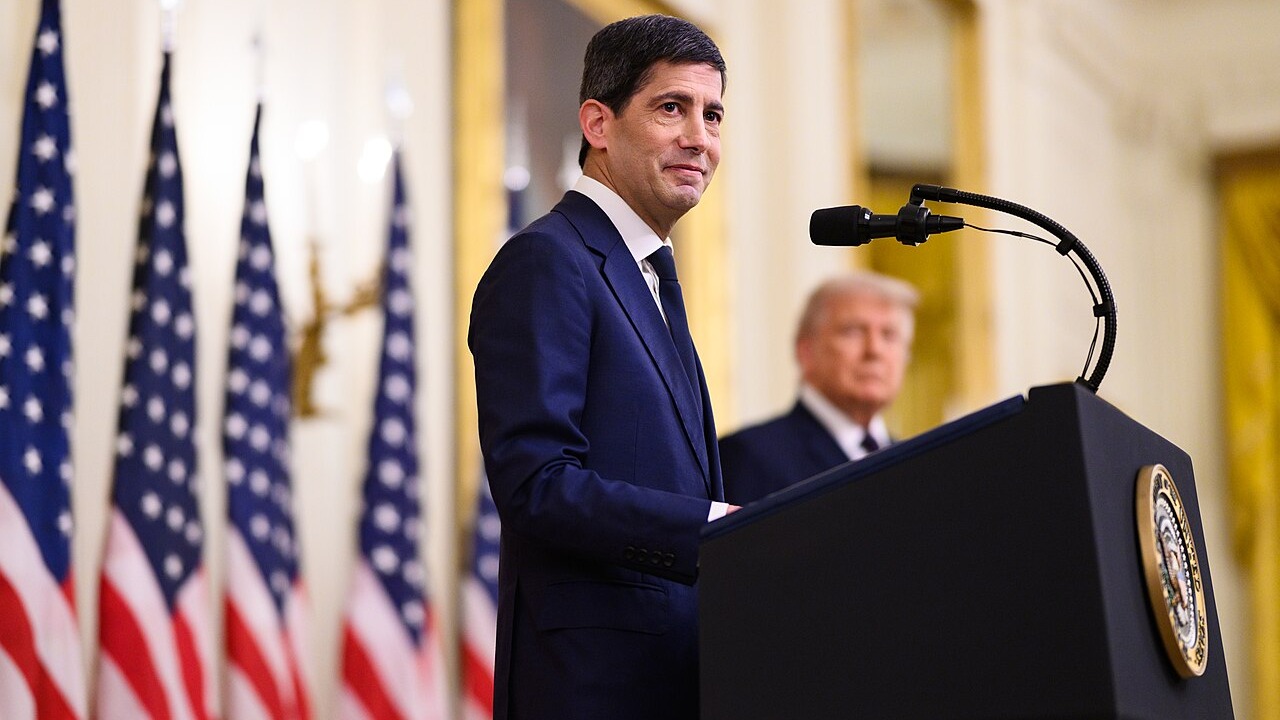
Federal Reserve Chair Kevin Warsh used his first policy meeting to strip the forward-guidance language that bond traders, pension managers, and mortgage borrowers have relied on since the 2008 financial crisis. The FOMC statement released June 17, 2026, approved by a unanimous 12-0 vote, dropped the sentence describing the expected path of the federal funds rate, a fixture in every post-meeting release for more than a decade. The decision turns Warsh’s stated skepticism of telegraphing rate moves into official Fed practice, forcing markets to price risk without the safety net of explicit central-bank signaling.
Why dropping the rate-path sentence reshapes Treasury trading
For years, the forward-guidance sentence gave fixed-income desks a baseline expectation they could trade around. Removing it means two-year Treasury yields, the maturity most sensitive to near-term rate expectations, now hinge almost entirely on incoming data and Warsh’s press-conference remarks. A reasonable working hypothesis is that day-to-day variance in two-year yields will rise by at least 15 percent over the next six meetings compared with the prior six-meeting window, because traders no longer have an official anchor for the rate path between announcements. That claim can be tested directly against the Fed’s own yield data once enough post-change meetings accumulate.
The practical effect reaches well beyond Wall Street. Adjustable-rate mortgages, corporate credit lines, and student-loan pricing all reference short-term Treasury benchmarks. Greater yield swings translate into wider bid-ask spreads and less predictable borrowing costs for households and businesses that depend on stable short-term rates. For risk managers at banks and insurance companies, the loss of a clearly stated rate path also complicates hedging strategies that were built around the assumption that the Fed would flag any major policy turn well in advance.
In the near term, dealers say the change is likely to favor firms with stronger macro research and faster data processing. Without a sentence in the statement pointing markets toward the “most likely” path, pricing around payrolls, inflation releases, and even second-tier indicators could become more violent. Over time, however, the shift may also reduce the tendency for markets to overreact to small tweaks in Fed language, because there is less language left to parse.
Warsh’s 12-0 vote and the record behind it
The June 17 FOMC statement carried no dissents, a signal that every voting member endorsed the communication shift. That unanimity is notable given that earlier 2026 statements, issued in January, March, and April according to the Fed’s own press-release calendar, still contained rate-path language. The clean break happened on Warsh’s watch, not gradually over several meetings.
Warsh has been explicit about his intentions. He has said publicly that he does not “believe in forward guidance,” rejecting the idea that central bankers should script future policy moves for markets. After the FOMC selected him as chairman and he took the oath of office, Warsh moved quickly to align the committee’s public communications with that view. The Fed’s own policy timeline shows forward guidance entering routine post-meeting statements during the crisis era and persisting through 2025, making the June 2026 omission the sharpest single-meeting communication change in that span.
Former chairs often used the guidance sentence as a compromise tool, allowing hawks and doves to agree on a carefully hedged description of the likely path for rates even when they disagreed on the exact timing of moves. By contrast, Warsh’s first meeting suggests a preference for letting the target range speak for itself and forcing any disagreements to surface in the voting record rather than in negotiated language.
What traders and borrowers still cannot see
Several gaps in the public record limit how confidently anyone can judge the full scope of this shift. The June 2026 Summary of Economic Projections, including the dot plot that charts each official’s preferred policy path, has not yet been released alongside detailed meeting minutes. Until those materials are available, outside observers cannot know whether the committee’s internal views on the appropriate rate trajectory narrowed or widened as the public guidance disappeared.
Minutes from the June gathering will also matter more than usual. In past years, markets could lean on the explicit rate-path sentence in the statement and treat the minutes as color. Now, the balance of risks, the degree of concern about inflation or employment, and any discussion of financial-stability trade-offs will have to be inferred from the narrative account of the meeting. If that account is heavily edited or delayed, the information vacuum could amplify volatility around each release.
For households and businesses, the opacity is subtler but still real. Borrowers rarely read FOMC statements, but banks and finance companies do, and they translate perceived policy certainty into the term sheets they offer. With less clarity about where short-term rates might be a year from now, lenders may demand more compensation for risk, either by widening spreads or by tightening non-price terms such as covenants and collateral requirements.
The Fed can mitigate some of that uncertainty through Warsh’s press conferences, speeches by other governors, and the projections that accompany quarterly meetings. Yet the core message of June 17 is that the central bank no longer wants its one-page statement to double as a forecast. For a generation of traders and borrowers conditioned to read that sentence as a guide, adjusting to a world without it may prove as consequential as any single rate hike or cut the committee delivers this year.