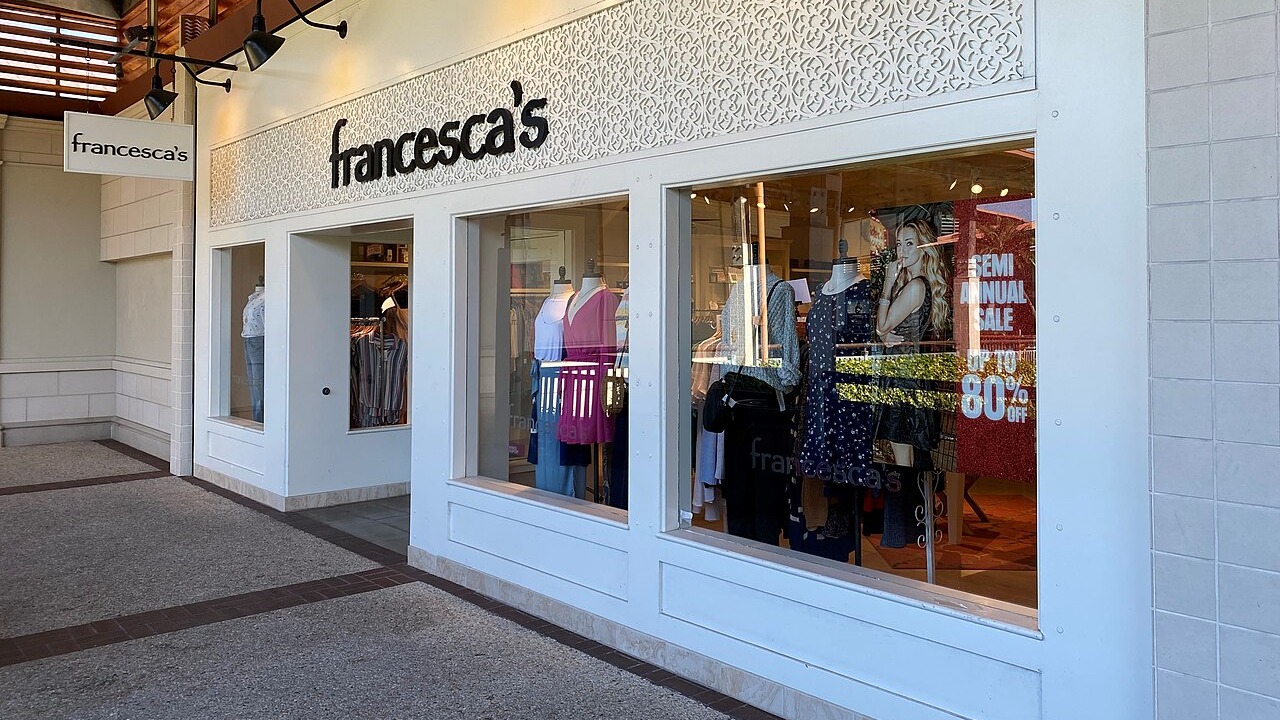
Francesca’s, the women’s apparel and accessories chain with approximately 460 locations across the United States, has voluntarily filed for Chapter 11 bankruptcy protection and launched store-closing sales at every remaining store. Three liquidation firms are managing the wind-down, and they have already injected $22 million in fresh merchandise into the closing locations to accelerate sales. The filing effectively ends the retailer’s brick-and-mortar presence after years of declining foot traffic and financial strain.
Why the $22 million inventory refresh signals a specific creditor strategy
When a retailer enters liquidation, the speed at which inventory converts to cash determines how much creditors recover. In francesca’s case, the appointed liquidation agents, Tiger Group, SB360 Capital Partners and GA Group, did not simply mark down existing stock. They announced $22 million in refreshed inventory shipped to stores nationwide. That move suggests the parties overseeing the liquidation are betting that new, desirable goods will draw shoppers who might otherwise skip a going-out-of-business sale stocked only with picked-over remnants.
Pumping fresh product into a dying retail chain is a calculated trade-off. It increases the total dollar volume available for sale, but it also means the liquidators spent capital to acquire that merchandise. The bet only pays off if the refreshed assortment moves quickly enough at discount prices to generate net proceeds above what the old inventory alone would have fetched. For creditors, this approach prioritizes short-term sales velocity. It does not preserve the francesca’s brand for a potential buyer or future relaunch. Instead, it treats the store fleet as a distribution channel for one final, high-volume clearance event.
The strategy also highlights the role of professional liquidators in modern retail bankruptcies. Rather than simply slashing prices, these firms use targeted buying, real-time sales data, and calibrated markdown schedules to maximize returns. By layering new goods into francesca’s stores, Tiger Group, SB360 Capital Partners and GA Group are effectively running a compressed, last-chance merchandising campaign designed to turn the chain’s remaining foot traffic into cash as quickly as possible.
Court filing and the scale of francesca’s store-closing sales
Francesca’s voluntarily filed for Chapter 11 protection and simultaneously began nationwide store-closing sales across its approximately 460 locations. The company did not announce plans to reorganize or seek a buyer for its operating business. Instead, the filing was paired directly with a full liquidation of its physical footprint, signaling that the Chapter 11 proceeding is being used as a controlled wind-down process.
Tiger Group, SB360 Capital Partners and GA Group were named as the appointed liquidation agents responsible for running the sales. These firms specialize in converting distressed retail inventory into cash for creditors, and their involvement from the outset confirms that the bankruptcy is structured as a wind-down rather than a restructuring. The three agents are coordinating discounts, staffing, and merchandise flow across hundreds of stores in parallel, a logistically complex operation that typically runs for several weeks until locations are emptied and leases are surrendered.
Shoppers visiting francesca’s stores during this period can expect escalating markdowns on clothing, jewelry, and accessories. Liquidation sales of this type generally start with modest discounts and deepen as inventory thins, though the $22 million inventory refresh means some locations may carry newer goods alongside original stock for a period. For consumers, the result is a mix of bargain-hunting opportunities and the final chance to shop a familiar brand in person.
Unanswered questions about employees, leases, and brand rights
While the court filing and liquidation plan answer how francesca’s inventory will be sold, they leave several broader questions unresolved. One key unknown is the fate of the retailer’s workforce. Store-closing sales typically keep locations open for a limited time, during which employees continue to work under compressed schedules and heightened uncertainty. After the sales conclude, most store-level jobs are likely to disappear, but the timing and scope of severance, benefits, and transition assistance have not been fully detailed in public disclosures.
Another open issue involves francesca’s store leases. With roughly 460 locations, the chain represents a significant footprint in shopping centers and lifestyle centers across the country. As liquidation progresses, the company and its advisors must decide whether to reject leases outright, negotiate early terminations, or potentially assign select leases to other retailers. Landlords, in turn, will be weighing how quickly they can backfill vacated spaces and at what rent levels, especially in markets where apparel tenants have already been thinning out.
The future of the francesca’s brand itself is also unclear. A Chapter 11 process focused on liquidation does not necessarily preclude a later sale of trademarks, customer lists, or e-commerce assets. Those intangible rights could attract interest from investors or operators looking to relaunch francesca’s as an online-only label or a smaller boutique concept. However, the decision to flood stores with liquidation inventory suggests that, for now, maximizing near-term cash recovery takes precedence over carefully curating brand equity for a potential revival.
More broadly, the case underscores how mid-sized specialty retailers are navigating a difficult landscape of shifting consumer habits and rising costs. Companies that once relied on mall traffic and impulse purchases now face intense competition from digital-native brands and large omnichannel chains. For industry observers tracking these developments, resources such as specialized media centers can provide ongoing access to bankruptcy announcements, transaction updates, and restructuring news that put individual cases like francesca’s into a wider context.
As francesca’s conducts its final sales, shoppers will see the most visible signs of the bankruptcy in store windows and on price tags. Behind those scenes, however, the Chapter 11 process will continue to unfold in courtrooms and conference rooms, where creditors, landlords, and other stakeholders work through the remaining questions of who ultimately bears the losses from the chain’s collapse-and whether any pieces of the brand’s legacy will survive beyond the last day of liquidation.