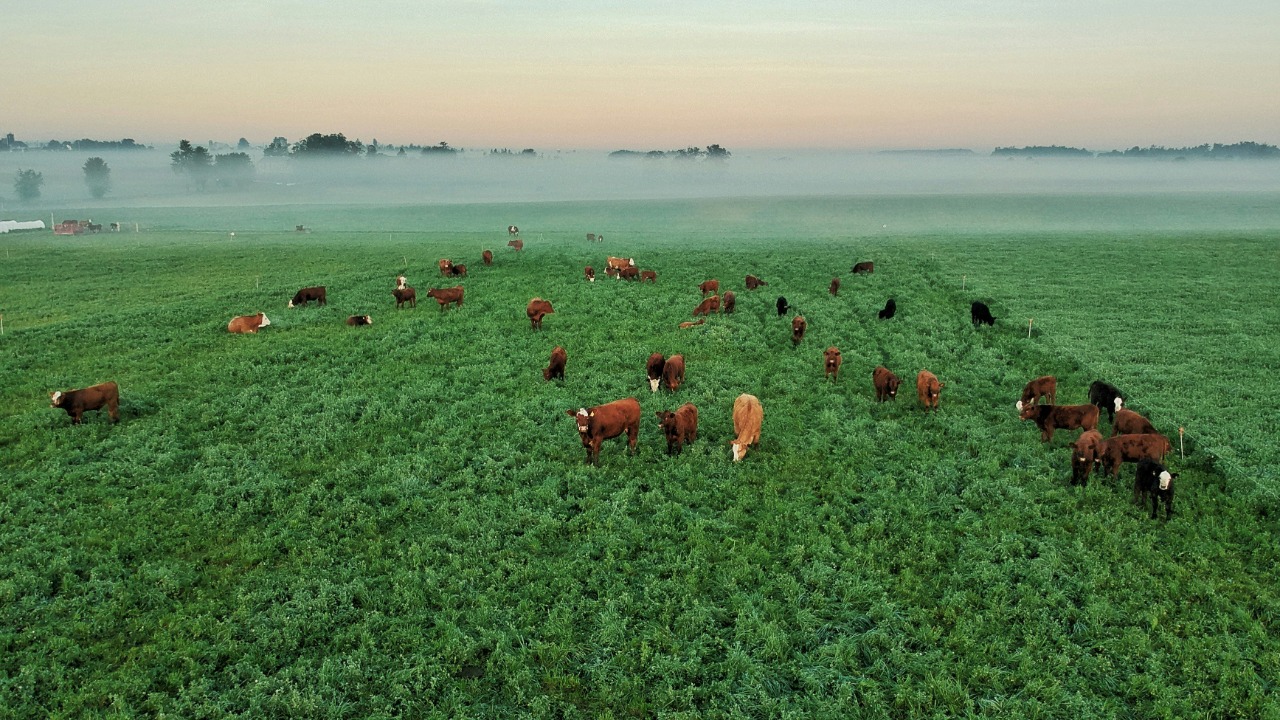
The Internal Revenue Service has given farmers and ranchers across most of the country more time to rebuild breeding and dairy herds sold off during drought, without an immediate tax bill landing on the original sale. Guidance issued September 15 covers 49 states, the District of Columbia, Puerto Rico and other reporting areas that showed exceptional, extreme or severe drought over the 12 months ending August 31, 2026. For producers who sold off draft, dairy or breeding animals because pastures and water simply ran out, the relief is a deferral of capital gains, not forgiveness of them — a timing difference that matters most to anyone nearing retirement and counting on that sale to fund a farm exit rather than a tax return.
A Two-Year Deferral Window, Doubled, Then Extended Again
Section 1033(e) of the tax code treats a forced livestock sale the same way it treats property lost to a fire or taken by eminent domain: as an involuntary conversion. A producer who sells draft, dairy or breeding animals in numbers above normal business practice, solely because of drought, flood or similar weather, can defer the capital gain on that sale by reinvesting the proceeds in replacement livestock. The baseline replacement window under the statute is two years from the end of the tax year the gain was realized. When the drought behind the sale is severe enough to draw a federal disaster designation, that window automatically doubles to four years.
Notice 2026-54 is the mechanism that extends the clock a second time. Under a 2006 administrative procedure, the IRS publishes an annual list of every county, parish, borough and island jurisdiction where drought over the 12 months ending August 31 was severe enough that the region cannot be called drought-free. A producer whose four-year window was set to close at the end of 2026 only gets pushed into the next tax year if a county in the applicable region — the county of sale, plus every county that touches it — appears on that list. For the period ending in 2026, the list Notice 2026-54 published runs to 49 states, the District of Columbia, Puerto Rico and other areas; Alaska is the only state left off entirely.
Free 2026 deadline calendar: Retirement-account, tax and Medicare deadlines don’t sit on one calendar, and a missed one can carry a penalty. Get every key date on the free calendar.
What an Unused Window Costs
The extension does not erase the tax question, it postpones the deadline for answering it. If replacement livestock is never purchased within the applicable window, the gain that was deferred at the time of the original sale becomes taxable in the year the window closes — a bill that can arrive at an inconvenient moment, including a year in which a rancher is winding operations down rather than restocking. Pushing the deadline out gives a producer more time to decide whether rebuilding the herd still makes economic and physical sense on land still recovering from drought, rather than forcing that decision, and the tax consequence attached to it, while pastures remain bare.
The practical effect shows up clearest for anyone who sold in 2022 under the four-year rule. Absent Notice 2026-54, that producer faced a December 31, 2026 deadline to either replace the herd or report the deferred gain as income on the 2026 return. For anyone whose county sits inside a listed applicable region, that deadline no longer applies; the decision — and the tax exposure that comes with it — moves into the following tax year instead. A producer can use that additional year to weigh restocking cattle, reinvesting in other qualifying farm property under the same involuntary-conversion rules, or accepting the deferred gain on a schedule chosen deliberately rather than one set by when the drought happened to end. Tax preparers handling these returns typically attach a brief statement citing the notice and the applicable county list, rather than filing a formal extension request with a local IRS office.
Eligibility Stops at the Working Herd
The relief reaches only a specific class of animals: livestock held for draft work, dairy production or breeding — the working and reproducing stock that represents years of genetic selection and cannot be replaced overnight at a sale barn. Cattle or other animals raised for slaughter, animals held for sporting purposes and poultry of any kind are excluded outright, even when the same drought forced their sale in the same year. That line follows how the tax code has always separated livestock: animals held as inventory for eventual sale are taxed as ordinary business income no matter why they were sold, while breeding and dairy stock function more like capital equipment — assets a producer would not normally liquidate, and whose forced sale earns a tax accommodation that inventory animals do not.
A County-By-County Test, Not a Blanket Rule
Whether a given operation qualifies for the extra time turns on a specific geographic test rather than a nationwide assumption. The applicable region is the county where the drought-forced sale took place plus every county that touches it, and that region only counts as drought-free if none of those counties registered exceptional, extreme or severe drought on the U.S. Drought Monitor maintained by the National Drought Mitigation Center at any point in the 12 months ending August 31. Notice 2026-54 is the IRS’s own accounting of which counties failed that test for the year ending in 2026, published so a producer does not need to comb through weekly drought maps to confirm the extension applies to a specific farm or ranch.
When a Herd Sale Becomes a Retirement Tax Question
A deferred capital gain from a drought sale still has to land somewhere, and for a rancher near retirement it often lands in the same tax year as Social Security, a pension distribution or a required withdrawal from a retirement account. Stacking that gain on top of ordinary retirement income can push a household into a higher tax bracket or a costlier Medicare premium tier without warning.
The Retirement Tax & Withdrawal Planner is a 12-page planner built around four calculators — provisional income, IRMAA tier, RMD schedule and Roth bracket fill — plus the IRMAA appeal route and the account withdrawal order.
See how the IRMAA tier calculator handles an unusual year of income in The Retirement Tax & Withdrawal Planner.
This article was researched and drafted with the assistance of AI and reviewed by an editor.