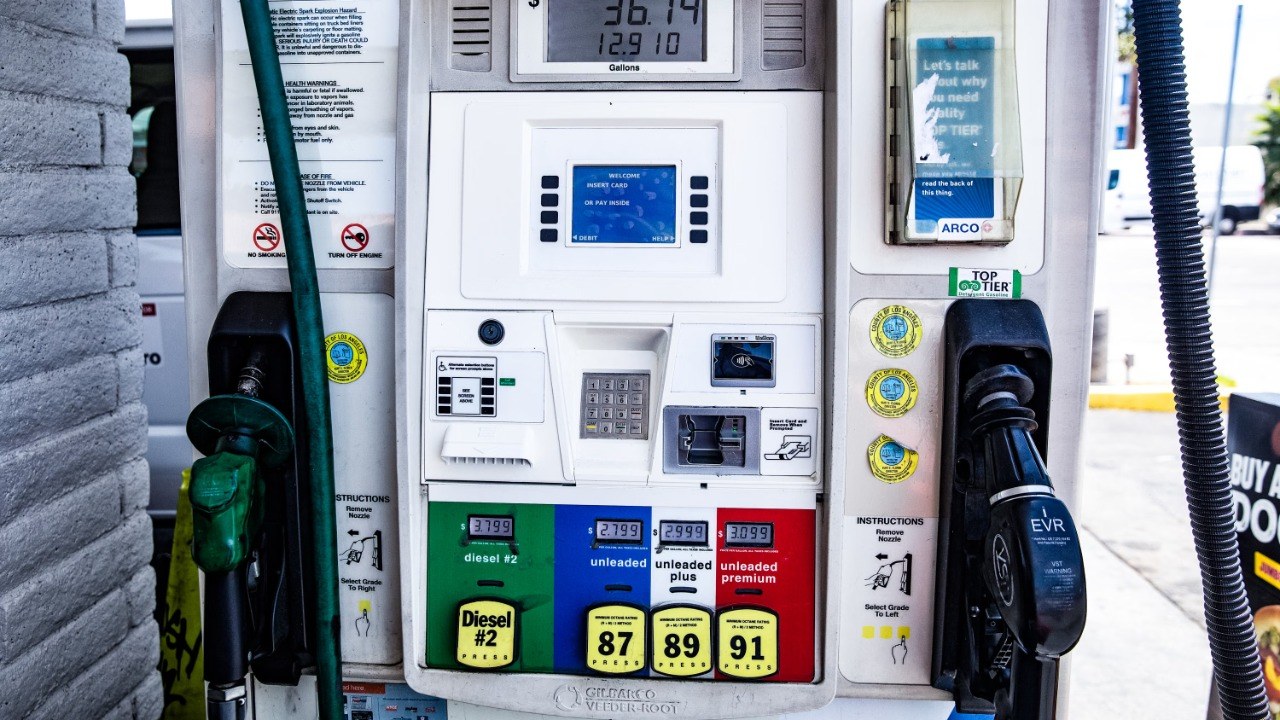
A gallon of regular cost about $6.34 in California and $5.63 in Hawaii in AAA’s October 8 state survey, while Ohio’s $3.71 was the cheapest in the country. That is a gap of $2.63 a gallon between the two ends of the map, at a time when the national average is above $4 for the first time in any October.
AAA put the national average at $4.3612 in its October 8 report, down about 5 cents in a week but $1.25 higher than the $3.1156 a year earlier. The association said gas prices are “the highest they’ve ever been for this time of year.”
The most and least expensive states
After California and Hawaii, the priciest states in AAA’s survey were Washington at $5.46, Nevada at $5.45, Alaska and Oregon at $5.02, Idaho at $4.92, Utah at $4.89, Arizona at $4.71 and Illinois at $4.64.
The cheapest list is mostly the South and the Midwest. Ohio led at $3.71, followed by Indiana at $3.72, Georgia at $3.84, Texas at $3.87, Mississippi and Louisiana at $3.94, Tennessee at $3.97, Alabama at $3.98, Arkansas at $3.99 and Missouri at $4.03.
The federal Energy Information Administration’s weekly survey shows the same split by region. Its price for the week of October 12 was $4.331 a gallon nationally, down 2.3 cents on the week and $1.27 above a year earlier. The Gulf Coast was the cheapest region at $3.851, and the West Coast the most expensive at $5.639. Without California, the West Coast average was $5.071, according to the EIA’s gasoline page.
For anyone on a fixed income who drives, the question is how much of a monthly budget a tank now takes and what can be cut or covered elsewhere. A car with a 15-gallon tank costs about $39 more to fill in California than in Ohio at AAA’s prices, by simple arithmetic, and about $19 more than it did a year ago at the national average. Because the checks do not rise with pump prices, the squeeze lands on other bills.
A national average of $4.36 a gallon, up $1.25 in a year, pulls money away from groceries, heat and medicine for people on Social Security. The Benefits Checklist covers 11 benefit programs retirees most often miss, with the 2026 income limits for each.
Go through the 11 benefit programs and 2026 income limits in the Benefits Checklist →
Regional prices and diesel
The EIA’s regional table fills in the middle of the map. Regular gasoline averaged $4.118 on the East Coast, $4.145 in the Midwest and $4.439 in the Rocky Mountain states, up $1.17, $1.33 and $1.39 from a year earlier. The agency’s separate California survey put the state at $6.104, down 12.3 cents on the week but $1.647 above a year ago. Diesel, the fuel that moves freight and groceries, averaged $6.179 a gallon including taxes, up $2.514 from a year earlier.
What is driving the price
AAA said West Texas Intermediate crude settled at $88.28 a barrel, after dipping into the $80 range for several days and then rising back above $90. U.S. crude inventories fell 3.2 million barrels to 424.1 million barrels, which AAA said is 1% above the five-year average.
The EIA data AAA cited showed gasoline demand rising from 8.68 million to 8.76 million barrels a day in the week, while production slipped from 9.46 million to 9.34 million barrels a day. Total gasoline supply rose slightly from 204.4 million to 204.7 million barrels.
The month-by-month path matters to a household budget. AAA’s national average was $4.1514 a month before the report and $4.4137 a week before it. The figure on AAA’s price page for October 14 was $4.3333, a bit under the October 8 number, so the trend over the past week has been slightly down from a high price.
Charging an electric car costs more in some states too
AAA also tracked public charging. The national average was 41 cents per kilowatt-hour, down 1 cent in a week. Hawaii was the most expensive at 54 cents, then West Virginia at 52 cents, and Louisiana and Alaska at 49 cents. Kansas was the cheapest at 31 cents, followed by Missouri at 32 cents and Iowa at 33 cents.
Help with other bills when fuel costs rise
The free routes are federal and state programs that pay other household costs. The Low Income Home Energy Assistance Program, known as LIHEAP, helps with heating and cooling bills, energy crises and shutoffs, weatherization and minor repairs to heating equipment, according to the Administration for Children and Families. Households apply at Energyhelp.us or call the National Energy Assistance Referral hotline at 1-866-674-6327, weekdays from 9 a.m. to 7 p.m. Eastern.
LIHEAP does not give grants directly to individuals and does not charge a fee, the agency says. Anyone asked to pay for a LIHEAP grant can report it to the HHS Fraud Hotline at 1-800-447-8477.
For groceries, SNAP’s gross monthly income limit for a one-person household is $1,729, and $2,345 for two, with savings capped at $3,000, or $4,750 when someone is 60 or older or disabled, according to USDA’s SNAP eligibility page. Most states use broader rules that can allow higher limits, so the state office has the final number.
The EIA releases its next weekly gas price on October 20. That is the next date to watch for whether the national average keeps sliding from its record for the month.
Gas at $4.36 on a fixed income
When pump prices stay high, the benefit programs that could offset the cost are easy to overlook, and each has its own 2026 income limit. The Benefits Checklist scans 11 benefit programs, including Medicare Savings Programs, Extra Help, SNAP and heating help, and adds a 50-state phone directory and a printable application tracker.
Check the 2026 income limits for 11 programs with the Benefits Checklist →
This article was produced with AI assistance and reviewed by The Financial Wire’s editorial team.


