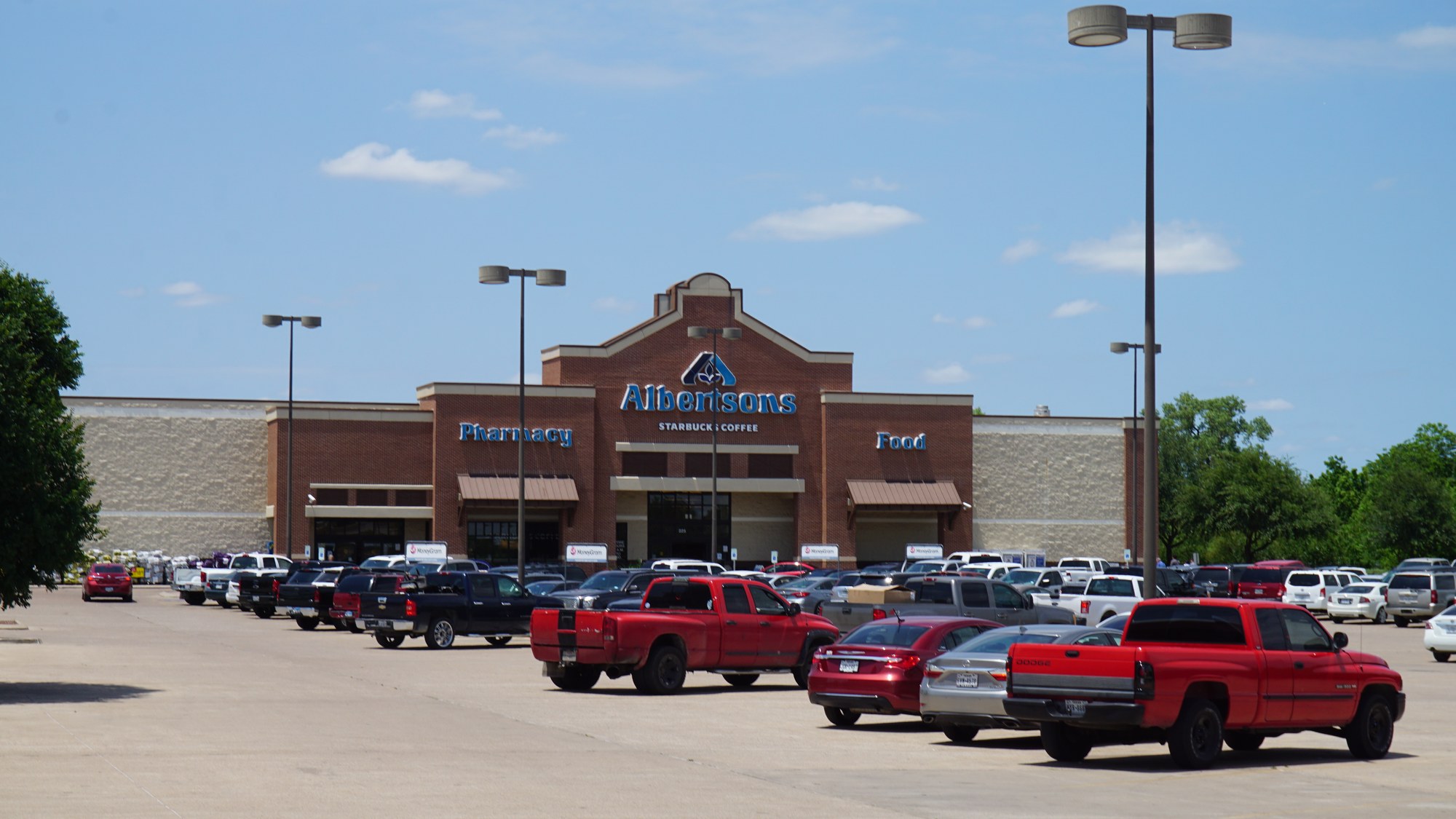
Albertsons Companies, the parent of Safeway, Vons and Jewel-Osco, earned $51.5 million in its fiscal second quarter, down from $168.5 million a year earlier. The grocer also told investors it is no longer giving a full-year outlook while it reviews its business. Shoppers kept spending nearly the same amount, so the squeeze came from what the company kept, not from what it took in.
The figures come from the earnings release Albertsons filed on October 13. Susan Morris, the chief executive, said in it that the results fall short of the company’s potential.
Profit fell by about two-thirds on flat sales
Net income was $51.5 million, or $0.11 a share, against $168.5 million, or $0.30 a share, in the same quarter last year, according to the company’s release. Adjusted earnings per share, which strip out certain items, came to $0.36 against $0.44. Adjusted EBITDA, a measure of operating profit, was $784.0 million, or 4.1% of sales, down from $848.4 million, or 4.5%.
Net sales and other revenue were $18,894.7 million, off just 0.1% from $18,915.8 million. Identical sales, which compare the same stores with last year, fell 0.8%. Digital sales grew 11%. The grocer rang up almost the same total and still kept far less of it.
The adjusted EBITDA gap is $64.4 million for the quarter, small beside $18.9 billion in sales. Net income fell by $117.0 million, nearly twice as much, so other items between operating profit and the bottom line widened the gap. The release does not break those items out in its headline figures.
Will the slump change prices or stores near you?
The release announces no store closures and no price changes. Albertsons ended the quarter with 2,240 stores, down from 2,257 a year earlier, a drop of 17, or under 1% of the store base. It also reports impairment losses on retail stores, an accounting charge that appears when a location earns less than expected. People who shop at a Safeway, Vons or Jewel-Osco will see nothing new at the register today.
What changed this year: Social Security and Medicare change every year, and nobody sends you a memo. The Retirement Money Brief breaks down what changed and what to do. Bonus when you subscribe: our 2026 Government Check Reality Tracker.
Get the Brief and the check tracker →
We may earn a commission from links on this page.
Why Albertsons pulled its outlook
The release says the company is “no longer providing a fiscal 2026 outlook.” It plans to update investors after a comprehensive business review, which it expects to finish in its fourth quarter. The stated reason is to complete the review, set clear priorities and evaluate the financial model before issuing new guidance. With no full-year outlook on the table, shareholders have no company target to measure the next two quarters against.
Morris said “our results do not reflect the potential of the Company.” Cody Perdue, the interim chief financial officer, is listed as co-hosting the earnings call. The release lays out no new strategy yet, and it does not name the banners or regions the review covers.
It does describe “incremental investments in its customer value proposition,” funded by productivity initiatives. That line is one of the few clues about where the margin went. The release does not say whether those investments mean lower shelf prices, bigger promotions or something else.
Grocery prices are rising more slowly than everything else
Albertsons is squeezed in a market where food at home is not the main driver of inflation. The Bureau of Labor Statistics reported on October 14 that the food-at-home index rose 1.8% over the 12 months ending in September, while the all-items index rose 3.7%. Groceries are climbing at about half the pace of prices overall.
The Agriculture Department’s Economic Research Service, in its September 25 food price outlook, forecasts food-at-home prices to rise 2.4% in 2026, with a range of 1.8% to 3.0%. Its forecast for 2027 is 1.8%, with a very wide range. Between July and August, food-at-home prices were unchanged. The same outlook puts all food at 2.9% for 2026, with a range of 2.5% to 3.2%, and shows all food up 0.1% from July to August.
The dividend and what comes next
For investors, the release shows the dividend continuing. A payment of $0.17 a share was paid on August 7 (the same amount as the one now coming), and the next $0.17 payment is due November 6 to holders of record on October 23. The release does not say what the dividend will be after that, and the company has tied its next outlook to the business review.
The open question for shoppers is whether “value” will show up as lower prices, fewer stores or both. The 17-store decline and the store impairment losses are the only hard numbers pointing at the footprint. Until the review finishes in the fourth quarter, profit stands at $51.5 million, the outlook is gone and the store count has slipped.
A grocery bill follows shelf prices, not quarterly earnings, and the 1.8% rise in food-at-home prices is the number that reaches a household budget. Whether Albertsons’ next move changes what a Safeway or Jewel-Osco shopper pays is a question only the company can answer once the review is done.
Watching the grocery bill at a Safeway or Jewel-Osco?
Albertsons’ bad quarter does not lower anything on a receipt, and the food-at-home index is still rising 1.8% a year. Households on a fixed income that count every grocery run can lose out on help that exists but has to be applied for.
The Benefits Checklist scans 11 benefit programs retirees most often miss, from SNAP and heating help to Medicare Savings Programs and property-tax breaks, with the 2026 income limits laid out. Part 4 covers SNAP, heating help and free weatherization, so a grocery-bill question has a place to start.
Get the 11-program checklist for trimming a grocery and heating bill →
More Financial Reading
- 21 Ways to Stretch a $2,087 Social Security Check
- 15 Places to Find Your Share of the $4.25 Billion States Give Back
- 21 Ways Retirees Can Raise $1,000 Fast Without a Job
This article was produced with the assistance of AI and reviewed by the editorial team.