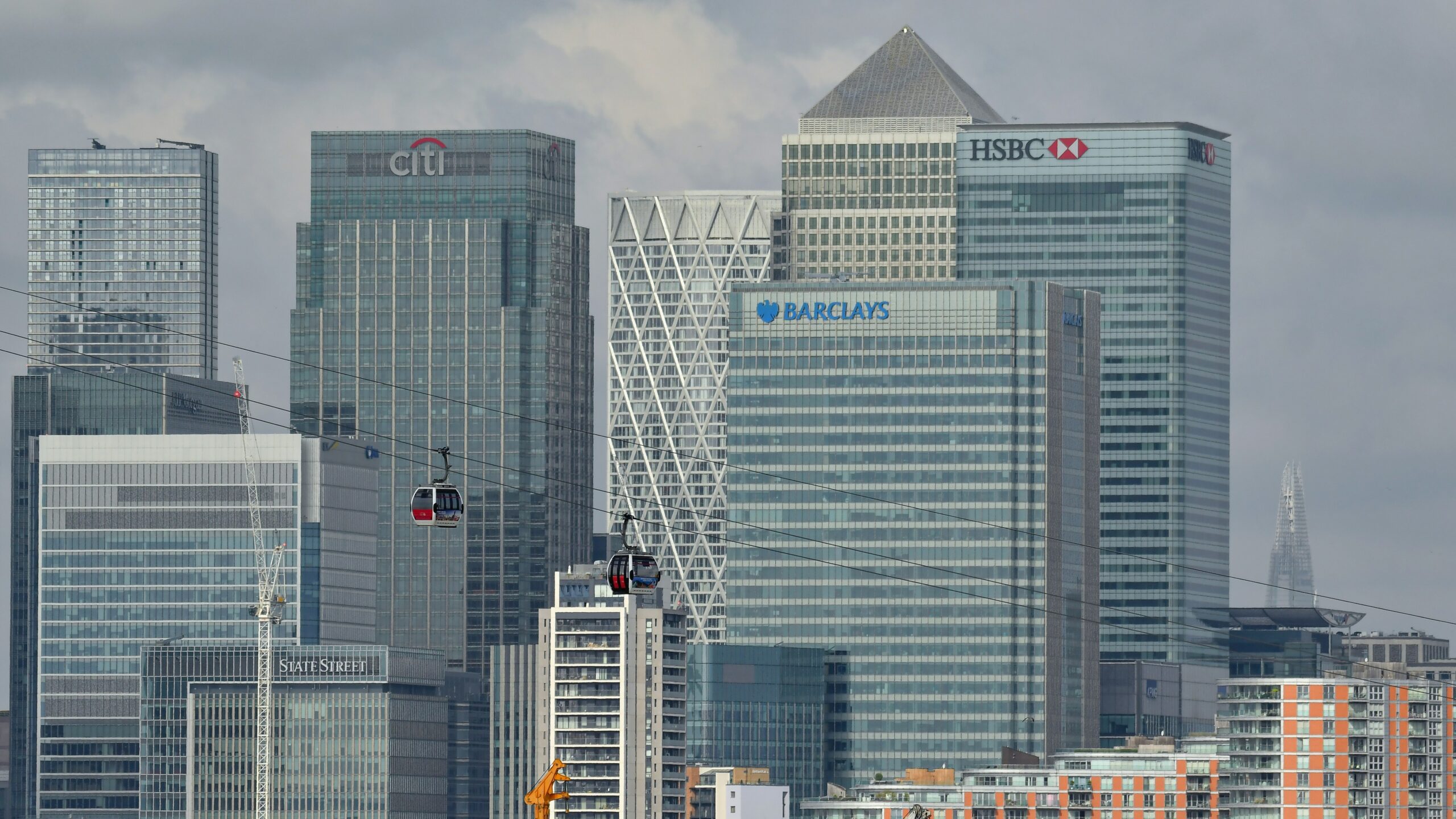
Barclays set aside roughly $1.1 billion to cover bad loans in the first three months of 2026, a 33 percent jump from the same quarter a year earlier and a clear signal that one of Europe’s biggest banks is bracing for a tougher credit cycle.
The British lender reported £0.8 billion in credit impairment charges for Q1 2026, up from £0.6 billion in Q1 2025. (The dollar figure reflects a sterling-to-dollar conversion at approximately $1.30 to the pound.) More striking than the raw number was the group loan loss rate: 74 basis points, well above Barclays’ own full-year guidance of 50 to 60 basis points and a pace the bank has not sustained in years.
That overshoot puts management’s forecasts under immediate pressure and raises a pointed question: if the first quarter alone blew past the ceiling, how realistic is the full-year target?
Investors appeared to take notice. Barclays shares fell in early trading on the London Stock Exchange following the Q1 2026 disclosure, though the stock later recovered some ground as analysts digested the role of the single-name default. The initial dip suggested the market had not fully priced in the scale of the provision increase.
A single default that rattled the numbers
About £0.2 billion of the quarterly charge traces back to one unnamed borrower inside Barclays’ Investment Bank. That single default added roughly 20 basis points to the group-wide loss rate on its own. The bank has not disclosed the borrower’s identity, the sector involved, or whether it still carries additional exposure to the same counterparty. Losses of this size within an investment banking division typically arise from exposures such as leveraged lending, counterparty credit risk on derivatives, or concentrated positions in distressed corporate debt, though Barclays has not confirmed which category applies here.
Strip out that concentrated hit and the underlying loss rate still ran at about 54 basis points, near the top of the bank’s comfort zone. The distinction matters because it shows the pressure is not just about one bad bet. Something broader is pushing losses higher across the lending book.
Macroeconomic headwinds fueling the rise
Elevated interest rates on both sides of the Atlantic have made debt more expensive for consumers and businesses alike. In the United States, where Barclays ranks among the largest credit card issuers, household delinquency rates have climbed as pandemic-era savings have been spent down. In the UK, mortgage holders rolling off low fixed-rate deals onto sharply higher payments continue to face affordability strain.
Trade policy has compounded the stress. Tariff escalations announced in early 2025 and their ripple effects on supply chains and input costs have squeezed margins for corporate borrowers, particularly in manufacturing and retail. Barclays has not specified which macroeconomic scenarios feed into its provision models, but the combination of sticky inflation, elevated borrowing costs, and trade disruption fits the rising charge-off trend visible in its filings.
A pattern, not a one-off
The Q1 figures extend a trajectory that was already clear in 2025. For the first half of that year, Barclays reported £1,112 million in credit impairment charges, up 24 percent from £897 million in the comparable prior-year period. Based on the available filings, losses appear to have trended upward across multiple recent reporting periods, making it harder to write off any single quarter as noise.
Barclays acknowledged the direction in its Q1 2026 filing, stating that the full-year group loan loss rate is expected to land “around the top” of the 50 to 60 basis point range. That language stopped short of formally raising guidance but effectively told investors to plan for the worse end of the spectrum.
How Barclays stacks up against UK peers
Barclays is not the only major UK bank building reserves. HSBC, Lloyds Banking Group, and NatWest have all reported rising credit impairment charges in recent quarters, though the drivers differ. Lloyds, heavily exposed to UK mortgages and consumer credit, has flagged higher expected losses tied to the domestic housing market. HSBC has pointed to commercial real estate stress in mainland China. NatWest, which skews toward UK retail and commercial banking, has posted more modest increases, partly because its unsecured lending book is smaller.
What distinguishes Barclays is its dual exposure: a large U.S. consumer credit operation alongside an investment banking arm capable of producing lumpy, single-name losses. That mix means its provision path can diverge sharply from domestically focused rivals, and it makes quarter-to-quarter forecasting unusually difficult.
Gaps in the disclosure
For all the numbers in the filing, significant questions remain unanswered. Barclays has not broken down how much of the rising impairment bill stems from UK consumer lending versus its U.S. credit card portfolio versus corporate and investment banking exposures. For a bank with one of the largest card books in America, that omission stands out.
Neither CEO C.S. Venkatakrishnan nor CFO Anna Cross provided direct commentary in the primary filings to explain the single-name default or the broader provision increase. One London-based banking analyst, speaking to Reuters in April 2026, described the Q1 charge as “a wake-up call that the benign credit environment is over.” That view does not come from Barclays itself, but it captures a sentiment gaining traction in the City.
The bank’s forward guidance also lacks detail on which economic assumptions underpin its projections. Without knowing what unemployment, interest rate, and corporate default scenarios are baked into the 50 to 60 basis point range, it is hard to judge how much cushion remains before the forecast breaks entirely.
Barclays has also said nothing publicly about whether the higher provisions will affect its capital return plans. The bank’s CET1 capital ratio, a key measure of financial resilience, will be closely watched when the next set of results drops. Any erosion there could force a reassessment of dividends or share buybacks.
The ripple effects beyond Barclays
When a bank of this scale sees defaults climbing, the consequences tend to spread. Lenders typically respond by tightening underwriting standards, raising rates on riskier loans, or pulling back from certain borrower segments. For households and businesses already on the margins of approval, that can mean fewer options and higher costs at exactly the wrong moment.
For Barclays itself, the arithmetic is uncomfortable. Credit costs are running above the bank’s target range, and management has signaled they will stay elevated through the rest of 2026. That eats into profitability even if revenue holds steady, especially in consumer lending businesses where margins depend on keeping defaults contained.
What the half-year results need to answer
The next critical disclosure arrives with Barclays’ half-year 2026 results, expected in late July. That filing should reveal whether the elevated loss rate persisted into the second quarter or whether the single-name default made Q1 look worse than the underlying trend. A detailed breakdown by lending segment would go a long way toward clarifying whether the stress is concentrated or spreading.
Until then, the verifiable picture is straightforward: Barclays is absorbing bad-debt costs at a pace that has already exceeded its own projections, and the bank expects that pressure to continue. Whether this turns out to be a manageable adjustment or the opening stretch of a deeper credit downturn depends on answers Barclays has not yet given.