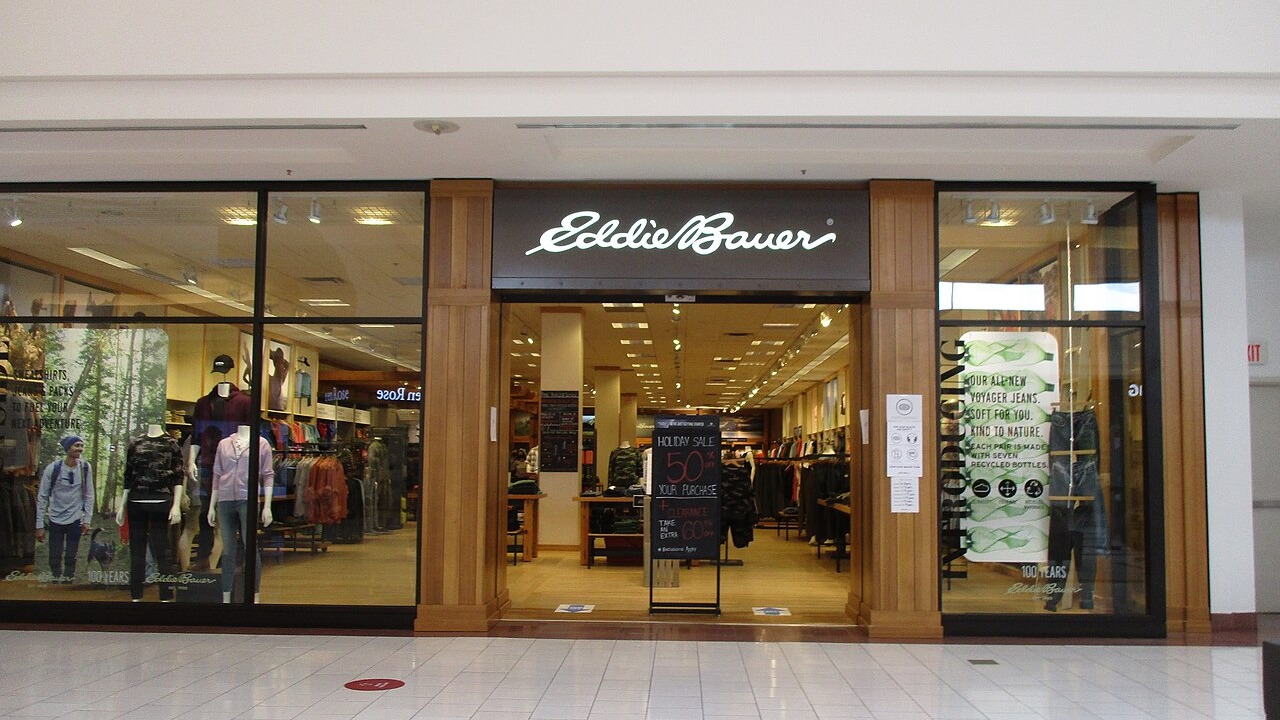
Every one of Eddie Bauer’s 174 U.S. stores will close after the company’s retail operator filed for Chapter 11 bankruptcy protection. Eddie Bauer LLC, the entity responsible for running the brand’s physical locations, submitted its petition in the U.S. Bankruptcy Court for the District of New Jersey under Case No. 26-11422-SLM. The filing separates the fate of the stores from the Eddie Bauer brand itself, which is owned by Authentic Brands Group and will continue to exist through licensing, e-commerce, and wholesale channels operated by a different company, Outdoor 5, LLC.
Why the Eddie Bauer store closures reshape the brand’s future
The bankruptcy does not kill the Eddie Bauer name. It kills the version of Eddie Bauer that shoppers could walk into. That distinction matters because it sets up a real-world experiment: can a 106-year-old outdoor brand hold its identity and revenue when it no longer controls a single storefront? Authentic Brands Group, which owns the intellectual property and licensing rights, has run this playbook before with other acquired names, stripping away costly retail leases and redirecting sales through digital and wholesale partners. Eddie Bauer now joins that pattern.
The bankruptcy filing drew a clear line between the store-level business and the brand’s broader commercial structure. Outdoor 5, LLC operates Eddie Bauer’s e-commerce and wholesale business separately from the bankrupt store operator. That split means online orders and third-party retail partnerships are expected to continue even as physical locations wind down. For shoppers, the logo will still appear on jackets, backpacks, and gear sold through digital channels and partner retailers, even though the familiar mall stores disappear.
Marc Rosen, speaking on behalf of the brand’s ownership, framed the filing as a strategic pivot. “This restructuring allows us to focus on the core strengths of the Eddie Bauer brand,” Rosen said, according to reporting tied to the filing. His comments suggest the ownership views the store network as a drag on profitability rather than a growth engine, a calculation that has become common across legacy retail. In that view, closing the stores is less a retreat than a reallocation of resources toward channels that require less fixed overhead and offer more flexible inventory management.
The shift also raises questions about how consumers experience heritage outdoor labels when they exist primarily as labels, not destinations. Eddie Bauer built its reputation on outfitting climbers and campers with gear that could be tested in person, handled, and fitted by staff who knew the product. Without stores, that tactile experience is replaced by product pages, size charts, and return labels. Authentic Brands Group is betting that the brand’s history and recognition can carry over into this lighter, license-driven model without losing the trust that made it valuable in the first place.
Court filings and corporate structure behind the closure
The Chapter 11 petition was filed under the name Eddie Bauer LLC et al. in the District of New Jersey bankruptcy court, assigned Case No. 26-11422-SLM. The “et al.” designation signals that multiple related entities are part of the proceeding, a common structure when a retailer operates through various subsidiaries for real estate, inventory, and logistics. At this stage, the docket does not yet provide a full schedule of rejected store leases, cure amounts owed to landlords, or a precise tally of employees whose jobs will disappear with the closures.
Authentic Brands Group’s ownership of the Eddie Bauer intellectual property means the brand’s trademarks, design archives, and licensing agreements sit outside the bankruptcy estate. This separation is intentional. Authentic Brands Group acquires brand names and then licenses them to operators who handle manufacturing, distribution, and retail. When one operator fails, the brand can be re-licensed to another without interruption. For Eddie Bauer, Outdoor 5, LLC already fills that role for online and wholesale sales, providing a ready channel for continued commerce once the stores go dark.
Because Eddie Bauer LLC is proceeding under Chapter 11 rather than Chapter 7, the case is structured to allow an orderly wind-down of the store fleet, potential sales of remaining assets, and negotiations with creditors over how losses are shared. Landlords, trade vendors, logistics partners, and tax authorities will line up with claims that must be reconciled under the supervision of the bankruptcy court. The absence of detailed financial schedules in the initial petition means the exact breakdown of secured and unsecured claims is not yet public, leaving unanswered how deeply each creditor group will be hit.
For workers, the early filings are equally thin. No WARN Act notices or severance terms for store employees have appeared in the initial court record. Those details are likely to surface in subsequent motions or in separate labor and state filings as the case progresses. Until then, thousands of frontline staff face uncertainty about final paychecks, benefits, and the timing of store closures. The gap between the brand’s future as a licensing asset and the immediate reality for those employees underscores the divide built into this business model.
What emerges from the case will be a leaner, more abstract version of Eddie Bauer: a name and set of designs licensed across e-commerce pages and wholesale racks, detached from the four walls that once defined the shopping experience. Authentic Brands Group and Outdoor 5, LLC are wagering that this structure can keep the brand profitable and visible without the burden of leases and in-store payrolls. Whether longtime customers follow the brand online, or drift to competitors with surviving stores, will determine if this strategy preserves Eddie Bauer’s legacy or reduces it to just another logo in a crowded digital marketplace.