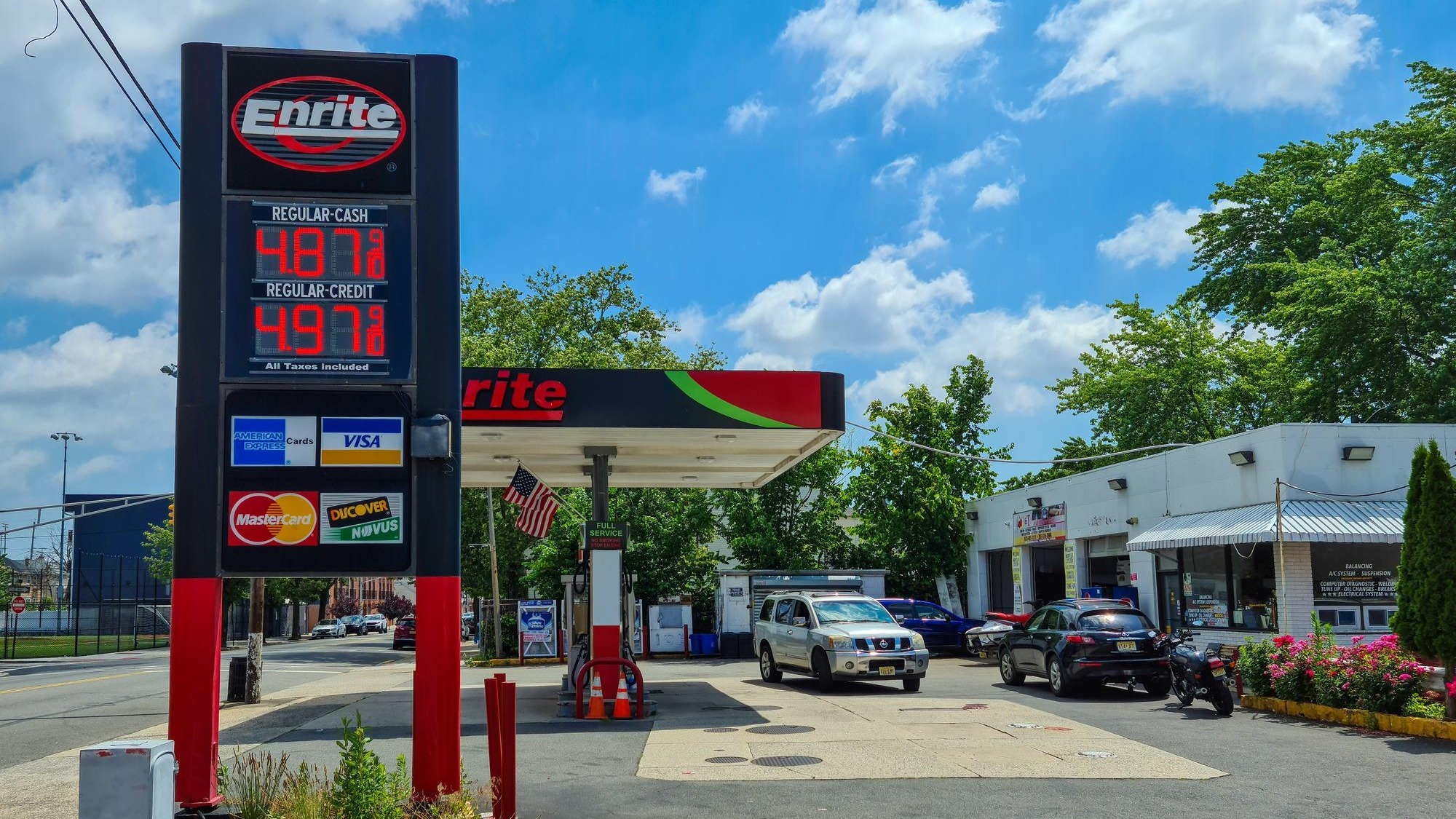
The two-week ceasefire between the United States and Iran expires today, and as of this morning neither Washington nor Tehran has signaled any intention to extend it. American drivers are paying a national average of $4.51 a gallon for regular gasoline, according to the U.S. Energy Information Administration. Crude oil has pushed above $109 a barrel on international futures markets. And on Kalshi, the CFTC-regulated prediction market, traders are pricing regular gas at $5.60 if the deal falls apart, a level the country has not touched since the summer of 2022.
That $5.60 figure is not a Wall Street forecast or a think-tank projection. It is the price implied by real-money positions on a federally regulated exchange, reflecting what hundreds of individual traders believe will happen at American pumps if hostilities resume in the Persian Gulf.
What the ceasefire actually committed to
The deal was always thin. A joint statement released through the Council of the European Union on April 8, 2026 (link points to the Council’s published PDF, dated that day), confirmed that a “two-week ceasefire” between the United States and Iran had been “concluded today.” Fourteen days from that date lands on May 14.
The text contains no enforcement mechanism, no third-party verification process, and no clause for automatic renewal. It says nothing about what happens when the clock runs out. No subsequent public statement from the White House, the Iranian government, or the EU has modified or extended the timeline. Whether back-channel negotiations are underway remains unknown, which leaves three possibilities on the table: a quiet rollover, a formal collapse, or an ambiguous gap in which neither side recommits but neither declares the ceasefire dead.
Why gas was already painful before today
The price shock did not begin with the ceasefire’s expiration. Since the U.S.-Iran conflict escalated earlier this year, retail gasoline prices have surged by more than 50 percent, based on AAA retail tracking data and analysis from S&P Global Commodity Insights cited in Associated Press reporting earlier this spring. The EIA’s own weekly series confirms that the national average has climbed well above pre-conflict levels, though the exact percentage depends on which baseline week you measure from.
The cause is not broken refineries. It is broken shipping routes. AP reporting, supported by vessel-tracking services and marine insurance filings, ties the surge to disruptions in the Strait of Hormuz, the chokepoint through which roughly 20 percent of the world’s daily oil supply passes. Tankers have been stranded, rerouted, or forced to absorb sharply higher war-risk insurance premiums to transit the area. S&P Global analysts have identified constrained tanker throughput, not refinery margins, as the primary force keeping prices elevated.
That distinction matters for what comes next. A refinery bottleneck can clear in weeks once parts arrive or maintenance wraps up. A compromised shipping lane distorts global crude flows for as long as the military threat persists and insurers keep charging wartime rates. Until tankers move freely through the Strait again, the price floor stays high.
How the Kalshi $5.60 number works
Kalshi operates as a federally regulated event-contract exchange under CFTC oversight. Its gasoline contracts allow traders to buy and sell positions on where the national average retail price will land by a specific settlement date, with payouts tied directly to EIA data. The $5.60 figure represents the implied price embedded in contracts settling at the end of June 2026 under a ceasefire-collapse scenario, derived from the bracket at which the most trading volume has concentrated in recent sessions.
That number is not a guarantee. It is a probability-weighted bet. But prediction markets have a documented track record of synthesizing scattered information quickly, often faster than traditional forecasting models update. When Kalshi traders collectively price gas more than a dollar above today’s already elevated level, they are signaling that the downside risk is substantial and that the market sees a meaningful probability of further escalation.
The $109 crude figure aligns with that anxiety. As of the May 12, 2026 trading session, the front-month Brent crude contract on the Intercontinental Exchange settled above $109 a barrel, climbing steadily as the ceasefire expiration approached and reflecting the same supply fears that Kalshi contracts are capturing on the consumer side of the equation.
What a ceasefire collapse could look like operationally
If the ceasefire lapses without renewal, the immediate risk is not a single dramatic event but a cascade of smaller ones. Military analysts tracking the conflict have outlined several plausible escalation paths: a resumption of Iranian Revolutionary Guard Corps naval patrols that shadow or harass commercial tankers, a snapback of U.S. secondary sanctions on Iranian oil exports that had been informally paused during the truce, or a return of drone and missile strikes on Gulf energy infrastructure of the kind that preceded the ceasefire. Any one of those developments would prompt marine insurers to reclassify the Strait of Hormuz as an active conflict zone, which would raise war-risk premiums and effectively blockade the waterway for all but the most risk-tolerant shippers. The result would not require a single shot to be fired at a tanker; the insurance math alone could pull millions of barrels a day off the market.
What could change the trajectory
Three developments will determine whether today’s prices hold, retreat, or get worse over the coming weeks.
Any official statement from Washington or Tehran. A public extension of the ceasefire, even a loosely worded one, would likely pull crude prices down within hours. Silence or hostile rhetoric would do the opposite. Traders on both futures exchanges and Kalshi will react in real time.
Tanker traffic through the Strait of Hormuz. Ship-tracking services and marine insurance desks will show within days whether commercial vessels are resuming normal transit patterns or pulling back. If Lloyd’s of London and other underwriters raise war-risk premiums again, that cost feeds directly into the price of every barrel that passes through the Gulf and, eventually, into every gallon pumped in the United States.
The Strategic Petroleum Reserve question. The U.S. government holds roughly 400 million barrels of crude in its emergency stockpile. Any signal that the White House is prepared to authorize a release could temporarily cap prices, though past SPR drawdowns have produced mixed results and the reserve sits well below its historical peak after releases in 2022. Congress would also face pressure to act if prices approach the $5.00 mark, though legislative timelines rarely move at the speed of commodity markets.
Why the Monday EIA report will set the tone for June
The EIA publishes updated gasoline price data every Monday. That release will be the first official snapshot of how pump prices responded to the ceasefire’s expiration and will either confirm or challenge the $4.51 average that has defined the past week.
For now, the situation is straightforward: the formal ceasefire window closes today with no announced successor, gasoline is already at levels that strain household budgets from coast to coast, and the market is bracing for the real possibility that it gets considerably worse. What happens over the next two to three days in the Persian Gulf will shape what Americans pay at the pump for the rest of the summer, and prediction-market money says the odds are tilted toward pain.