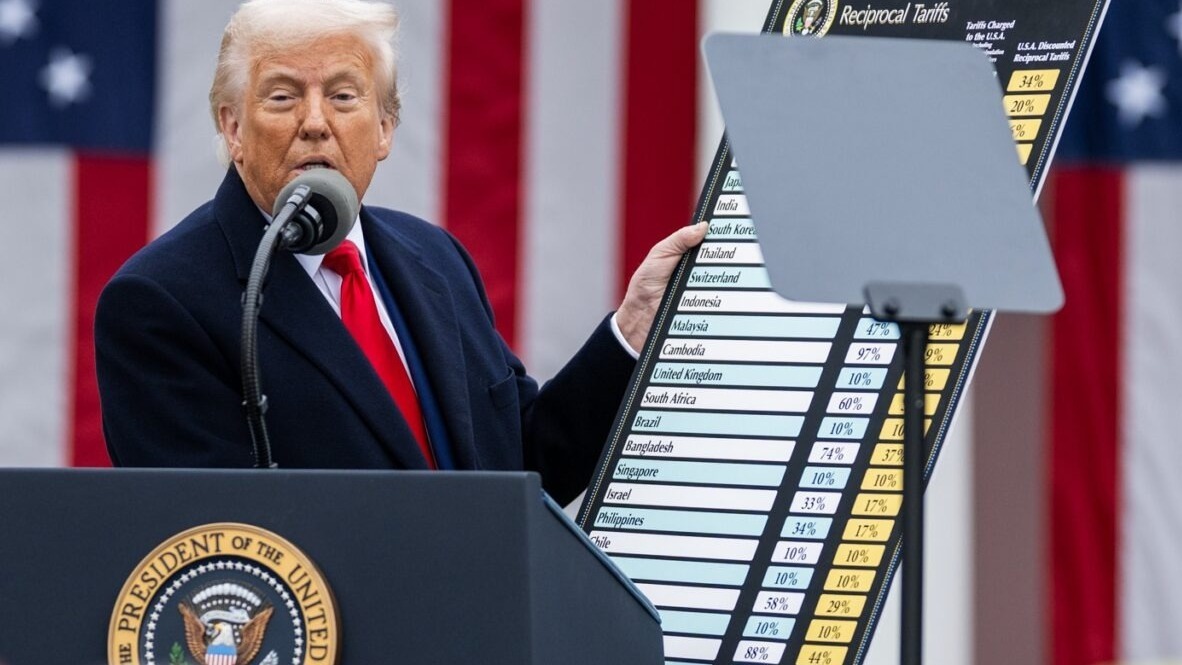
A widely publicized idea to send Americans a $2,000 check funded by import tariffs remains exactly that, an idea. Months after the president first floated the payments, no checks have gone out, no money has been authorized, and the proposal has not moved through Congress. The gap between the political promise and the fiscal reality is wide enough that households counting on a windfall are advised to keep waiting rather than spending.
What a tariff dividend would actually be
The concept is a one-time payment framed as a share of the revenue the government collects from tariffs on imported goods. The president has described sending $2,000 to Americans below a certain income level, with the money presented as a dividend on trade policy rather than a traditional stimulus check. Advisers have suggested a formal proposal would go to Congress, but the pitch has stayed at the level of statements and interviews rather than legislative text.
That distinction matters for anyone budgeting around it. A promise of a payment is not a payment, and no administering agency has published enrollment steps, eligibility rules, or a payment schedule. The absence of any official rollout is the clearest signal that the checks are not imminent.
Free retirement updates: Miss an enrollment or claim deadline and it may be gone. Our free Retirement Shield newsletter keeps readers ahead of the ones that matter. Get the free newsletter.
Why the payments are stuck in Congress
Sending money to households on this scale generally requires spending authorized by Congress, and that approval has not been granted. Even some allies of the administration have acknowledged that the payments would need lawmakers to act, and no bill authorizing them has passed. As CNBC reported, officials have talked about bringing a proposal forward, but a proposal is only the first step in a long process, and the checks face political and procedural headwinds before any could be printed.
There is also a legal cloud over the source of the money. The tariffs meant to fund the dividend have themselves been the subject of court challenges, which adds uncertainty to whether the revenue stream behind the idea will hold up. Until legislation is written, debated, and signed, the payment exists only on paper.
The distinction between a one-time rebate and a recurring benefit matters as well. Unlike Social Security or a standing tax deduction, a tariff dividend as described would be a single payment rather than an ongoing source of income, so even if it were approved it would not add to a household’s monthly cash flow beyond the one check. That limits how much a fixed-income retiree could safely build into a longer-term budget around it.
The $450 billion gap the numbers cannot bridge
The arithmetic is the proposal’s hardest obstacle. The Yale Budget Lab estimated that a one-time $2,000 payment, limited to people earning less than $100,000 a year, would cost roughly $450 billion. That figure is about twice the total revenue the administration’s tariffs are projected to raise in 2026.
In other words, the checks would cost around double what the tariffs are expected to collect, which means the payments could not be financed by tariff revenue alone. Covering the difference would require additional borrowing or offsetting cuts, a tradeoff that makes the plan far more complicated than a simple pass-through of trade receipts. That math is a central reason the idea has stalled rather than advanced.
The “dividend” label also invites a comparison the numbers do not support. A dividend is normally paid out of a surplus, yet the analysis shows the proposed payments would exceed the very revenue meant to fund them. That gap is why budget analysts treat the plan as new deficit spending rather than a distribution of money the government has already collected.
Scam texts exploiting the promise
The publicity around the checks has already drawn scammers. Fraudulent text messages and emails referencing a “tariff rebate” or “tariff dividend” have circulated, often asking recipients to click a link or hand over bank details to claim money that does not exist. Because no legitimate payment program has been created, any message claiming to process a tariff check is a red flag.
Older Americans are frequent targets of these schemes, and the safest response is to ignore unsolicited messages promising government money. No federal agency collects personal or banking information by text to release a payment, and there is no application to complete for a program that has not been enacted. Legitimate federal payments, when they exist, are announced through official agency channels and do not require a fee or a login handed over by phone.
What retirees should plan around instead
For households on fixed incomes, the practical takeaway is to treat the tariff checks as speculation rather than a line in a budget. Real, scheduled money, from Social Security cost-of-living adjustments to tax deductions already written into law, offers a far more reliable basis for planning than a payment that has cleared no vote and carries a price tag roughly double its own funding source. Should Congress ever take up the measure, the details that matter, eligibility, timing, and how the cost would be covered, would come only after legislation is actually introduced.
This article was produced with the assistance of artificial intelligence and reviewed by The Financial Wire editorial team.
More Financial Reading
- Bank statements: how long to keep them and when to toss them
- Adding someone to your bank account: tax traps and smart moves