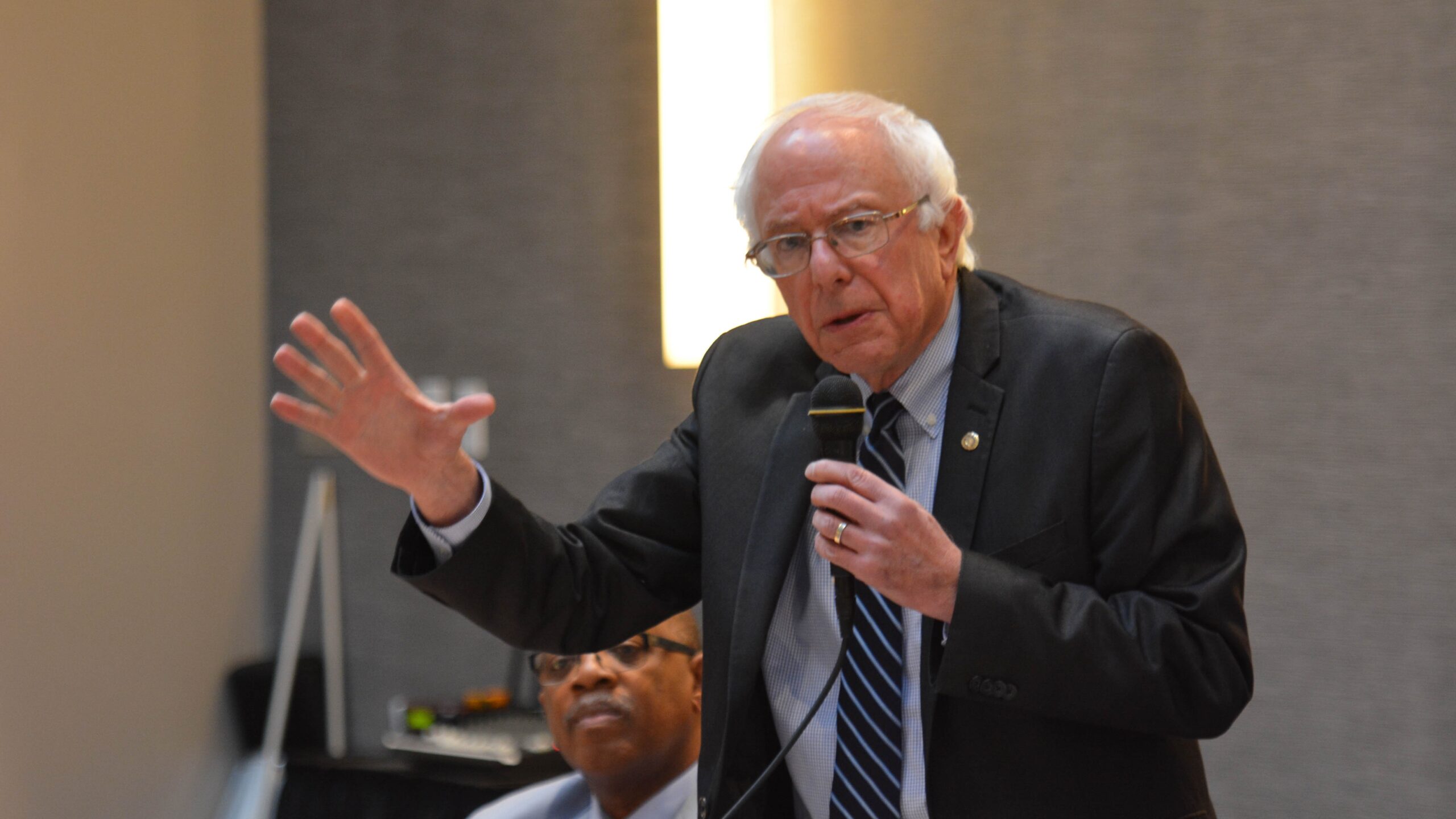
Sen. Bernie Sanders released a Senate report in April 2026 warning that artificial intelligence could eliminate nearly 100 million American jobs, anchoring his case with a striking claim: that a Verizon chief executive has predicted AI-driven automation may push U.S. unemployment to between 20% and 30%.
The warning landed during the same week Verizon confirmed plans to cut more than 13,000 positions, giving Sanders a real-time example to sharpen his argument. But the report’s most dramatic figures remain difficult to independently verify, raising questions about where political urgency ends and documented evidence begins.
“The CEOs of Big Tech companies are not just talking about modest efficiency gains,” Sanders said in a statement accompanying the report, which his office titled “Big Tech Oligarchs’ War Against Workers.” The document calls for aggressive federal intervention before automation hollows out both white-collar and blue-collar payrolls.
What the report actually says
The document is a minority staff report from the Senate Health, Education, Labor and Pensions (HELP) Committee, where Sanders serves as ranking member. That distinction is important: it reflects the analysis and policy priorities of Sanders’ staff, not a bipartisan committee finding or a peer-reviewed economic study.
The report argues that major technology firms are racing to deploy AI primarily to slash labor costs, and that without new regulation the consequences for American workers will be severe.
Its most attention-grabbing data point is the attribution of a 20% to 30% unemployment forecast to a Verizon CEO. Sanders’ office presents the figure as proof that even corporate leaders recognize the scale of the threat. But no publicly available transcript, earnings call, or official Verizon statement independently confirms the exact quote, its original context, or which executive made it. Verizon’s current chief executive is Hans Vestberg; the report does not specify whether the remark came from him or a predecessor, or whether it described a worst-case scenario rather than a baseline expectation. Sanders’ office has not responded to requests to identify the original source of the quote.
The 100 million jobs figure appears in the accompanying press release as an aggregate projection. The publicly available summary does not break it down by sector, occupation, or time horizon, and no Bureau of Labor Statistics dataset cited in the materials corroborates the number.
How these projections stack up against independent research
Sanders’ numbers are dramatically larger than the most widely cited estimates from private-sector and international researchers, and the gap is worth examining closely.
A 2023 Goldman Sachs analysis estimated that generative AI could expose roughly 300 million full-time jobs worldwide to some degree of automation, with about two-thirds of U.S. occupations facing AI-driven task displacement. “Exposure,” in that study, does not mean elimination; it means a significant share of tasks within a job could be performed or augmented by AI.
A McKinsey Global Institute report projected that up to 12 million Americans may need to switch occupations by 2030 due to automation and broader economic shifts. That estimate was published before the rapid acceleration of generative AI tools beginning in late 2022, meaning it may not fully account for the pace of change now underway. The International Monetary Fund estimated in January 2024 that about 40% of global employment is exposed to AI, with advanced economies facing the highest exposure.
None of those studies forecast a sustained U.S. unemployment rate of 20% to 30%, a level the country has not experienced since the Great Depression. Most emphasize that AI will transform jobs rather than simply destroy them, and that net employment effects depend heavily on policy decisions, retraining investments, and how quickly companies adopt the technology.
Sanders’ report does not engage with these offsetting factors, such as new jobs created by AI-related industries or productivity-driven economic growth, which limits its value as a standalone economic forecast.
What Verizon’s layoffs actually involve
Verizon’s plan to eliminate more than 13,000 positions was first reported by the Associated Press, based on an internal staff memo and company statements. Verizon described the cuts as part of a broad effort to “reorient” its business, pointing to competitive pressures, shifting subscriber trends, and capital reallocation. The company did not single out AI as the primary driver.
Sanders’ report places the Verizon layoffs alongside the CEO unemployment prediction to build a narrative about automation-fueled job destruction. The pairing is politically potent, but the available reporting does not confirm a direct causal link between generative AI deployments at Verizon and the specific roles being cut. Telecom companies have been restructuring workforces for years in response to cord-cutting, 5G investment cycles, and industry consolidation, all factors that predate the current wave of AI tools.
For the workers directly affected, the distinction between AI-driven displacement and traditional restructuring may feel academic. Verizon employees represented by the Communications Workers of America have pushed for contract-level protections, including advance notice of automation and retraining guarantees, as a buffer against job losses regardless of their cause. “We need a seat at the table before these decisions are made, not after the pink slips go out,” a CWA local representative told members at an April 2026 organizing meeting, according to the union’s public communications. The union has echoed parts of Sanders’ broader message about AI threatening jobs but has focused its lobbying on enforceable contract provisions rather than the sweeping legislative bans Sanders has proposed.
Sanders’ legislative push and the political reality
The report is not purely diagnostic. Sanders has used his HELP Committee platform to push for stronger labor protections tied to AI adoption, including proposals for federal oversight of automated hiring systems, mandatory disclosure when companies replace human workers with AI, and expanded retraining funding.
None of these measures have advanced to a full committee vote. The Republican majority on the HELP Committee has shown little interest in the regulatory framework Sanders envisions, and the White House has taken a more incremental path, relying on executive orders focused on AI safety and voluntary industry commitments.
Internationally, the European Union’s AI Act represents the most comprehensive regulatory framework for artificial intelligence enacted to date. The law, which entered into force in August 2024 with phased compliance deadlines, classifies employment-related AI systems among its “high-risk” categories and imposes transparency and oversight requirements. No comparable U.S. federal law exists, though several bills addressing AI in the workplace have been introduced in Congress without reaching a floor vote.
How to evaluate the claims as the evidence develops
The core challenge with Sanders’ report is the gap between its alarming headline numbers and the publicly available evidence supporting them. Both the 100 million jobs figure and the Verizon CEO unemployment prediction flow through a single channel: the minority staff report itself. Until the underlying methodology is published or the CEO quote is independently verified, outside analysts cannot determine whether these projections represent a plausible upper bound, a mid-range estimate, or a political warning designed to force a policy debate.
That does not make the broader concern baseless. Credible research from Goldman Sachs, McKinsey, and the IMF confirms that AI will reshape labor markets at a scale and speed that demands serious policy attention. The Verizon layoffs, whatever their precise causes, are a reminder that large-scale workforce reductions are already underway across industries experimenting with automation.
But there is a meaningful difference between what is documented, such as the existence of the Senate report and the confirmed Verizon cuts, and what remains an unverified projection being deployed in service of a legislative agenda. Readers following this debate will be better served by tracking the evidence as it develops rather than accepting any single set of numbers as settled fact.