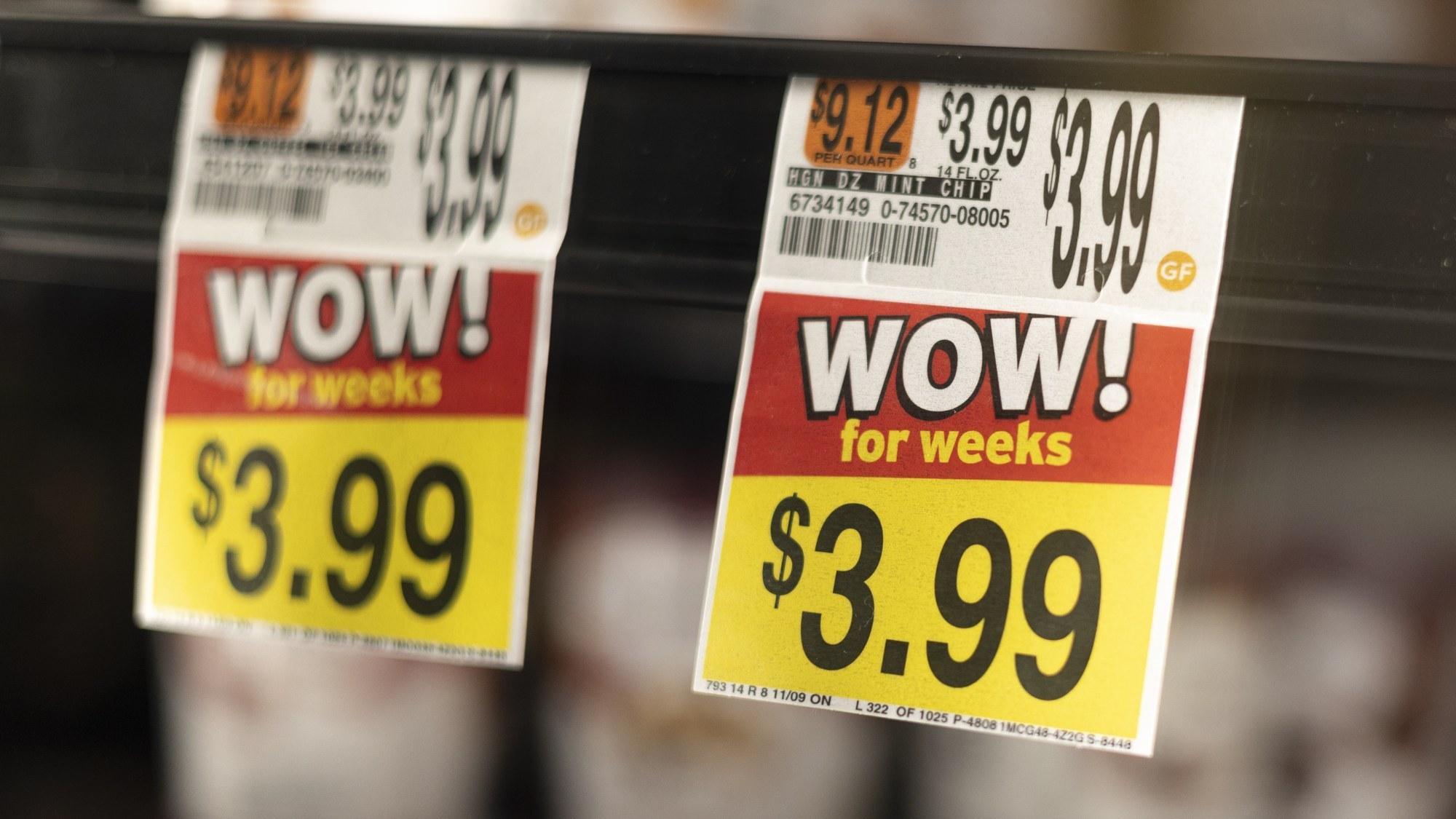
A gallon of milk costs 18% more than it did two years ago. The average credit card is charging north of 20% interest. And the 3.8% raise the typical American worker received over the past year? After inflation, it barely moved the needle. That is the math confronting households in the spring of 2026, even as the headline economic numbers continue to look passable on paper.
The Commerce Department’s advance estimate for the first quarter, released in late April, pegged real GDP growth at a 2.0% annual rate. Respectable, especially considering the economy was clawing back from a federal government shutdown that had dragged on public-sector activity earlier in the quarter. But the same report carried a much less comfortable figure: the personal consumption expenditures price index, the Fed’s preferred inflation gauge, accelerated at a 4.5% annualized rate. The core PCE measure, which strips out food and energy, ran at 4.3%. Both are more than double the Federal Reserve’s 2% target.
A separate measure told a similar story. The Bureau of Labor Statistics’ Consumer Price Index for March showed year-over-year inflation at 3.5%. The CPI and PCE use different methodologies and weight categories differently, which is why they rarely align precisely. But the direction is the same: prices are climbing faster than policymakers want and faster than most paychecks can absorb.
Growth looks solid on the surface, but cracks are forming underneath
Two percent growth is not a recession. Businesses are still hiring. Factories are still producing. But the composition of that growth matters more than the number itself.
A meaningful share of the first-quarter rebound reflected government spending snapping back after the shutdown, according to the GDP report’s breakdown of spending components. Private-sector momentum looked softer. Consumer spending, the engine behind roughly two-thirds of GDP, grew at a slower annualized pace than it did in the fourth quarter of 2025, based on the Bureau of Economic Analysis’ March personal income and outlays data.
That slowdown is not abstract. It shows up at checkout counters, car dealerships, and restaurant reservation books. Major retailers, including Walmart and Target, flagged more cautious consumer behavior in their most recent earnings calls, noting that shoppers are trading down to store brands and postponing big-ticket purchases like furniture and appliances. When two-thirds of the economy depends on people spending, even a modest pullback ripples outward fast.
What this actually means for your money
Start with borrowing costs. The Federal Reserve held rates steady after its April 28-29 policy meeting and signaled that cuts are not on the near-term horizon. The federal funds rate remains in the 5.25%-5.50% range it has occupied for well over a year, and that filters directly into the rates consumers pay.
According to Freddie Mac’s Primary Mortgage Market Survey, the average 30-year fixed mortgage rate has been hovering near 7%. Credit card annual percentage rates sit above 20% for most borrowers, per the Federal Reserve’s tracking of consumer credit conditions. Auto loan rates on new vehicles are averaging above 7%, according to Bankrate. None of that is changing soon if inflation stays sticky.
Now layer on the price increases themselves. At the CPI’s 3.5% year-over-year pace, a household earning $60,000 is losing roughly $900 in purchasing power annually compared with a scenario where inflation ran at the Fed’s 2% target. That gap, 1.5 percentage points on $60,000, may sound modest in the abstract, but it lands hardest on the categories families cannot avoid: groceries, car insurance, rent, and utilities. For workers whose raises have not cleared the inflation bar, every pay period buys a little less than the one before, and the credit used to bridge the gap is more expensive than it has been in over two decades.
Trade policy is adding another layer of uncertainty. Tariffs on a range of imported goods, from electronics to household staples, have pushed up input costs for manufacturers and retailers. How much of that reaches shelf prices depends on how aggressively companies absorb the hit versus passing it along, a process that typically plays out over several quarters.
Why these numbers could still shift
The GDP figure is preliminary. The Commerce Department will revise it twice, in late May and late June, as more complete data arrives. Past revisions have sometimes moved the growth rate by half a percentage point or more in either direction. A downward revision would suggest the economy was weaker than it appeared; an upward one would offer some reassurance that private-sector activity held up better than the initial read implied.
The inflation picture carries its own uncertainty. Whether the acceleration is broad-based or concentrated in a few volatile categories, like energy or shelter, will shape how the Fed responds. Mark Zandi, chief economist at Moody’s Analytics, has noted that shelter costs remain the single largest contributor to above-target inflation, and that a meaningful cooldown in rent growth could pull the headline numbers down faster than many forecasters expect. But a few more months of readings near 4% on the PCE gauge could push any prospect of rate relief well into 2027.
Consumer behavior is the wildcard. Households that built up savings buffers during the earlier phase of the expansion are watching those cushions thin. The personal savings rate fell to 3.9% in March, according to the BEA, well below its pre-pandemic average near 7%. Meanwhile, the New York Fed’s Household Debt and Credit Report shows total credit card balances have climbed past $1.1 trillion, with delinquency rates on the rise, particularly among borrowers under 30. Lower-income families, who spend a larger share of their budgets on food and housing, are almost certainly absorbing the most pain.
Three signals to watch through the summer
The next few months will clarify whether this is a rough patch or the start of something worse. Three data points deserve close attention.
First, the May and June CPI and PCE reports. If inflation continues to run hot, expect the Fed to stay firmly on hold and borrowing costs to remain punishing for consumers. If prices cool, the conversation shifts toward when, not whether, rate cuts arrive.
Second, the revised GDP estimates. The second estimate, due in late May 2026, will clarify whether the economy’s footing is as stable as the advance number suggested, or whether private-sector growth was even softer than it looked.
Third, consumer spending data. Monthly retail sales and the personal outlays reports will reveal whether the first-quarter slowdown was a seasonal blip or the beginning of a more meaningful pullback. Watch especially for signs that middle-income households, not just lower-income ones, are cutting back.
For now, the picture is uncomfortable but not catastrophic. The economy is growing, but not fast enough to outrun inflation. Prices are rising, but not so fast that a recession feels imminent. The Fed is watching, but not yet ready to act. That leaves American households in a position that has become painfully familiar: earning more on paper, but stretching every dollar further just to stay even. Until inflation falls closer to the Fed’s target or wages decisively pull ahead, that squeeze is unlikely to let up.