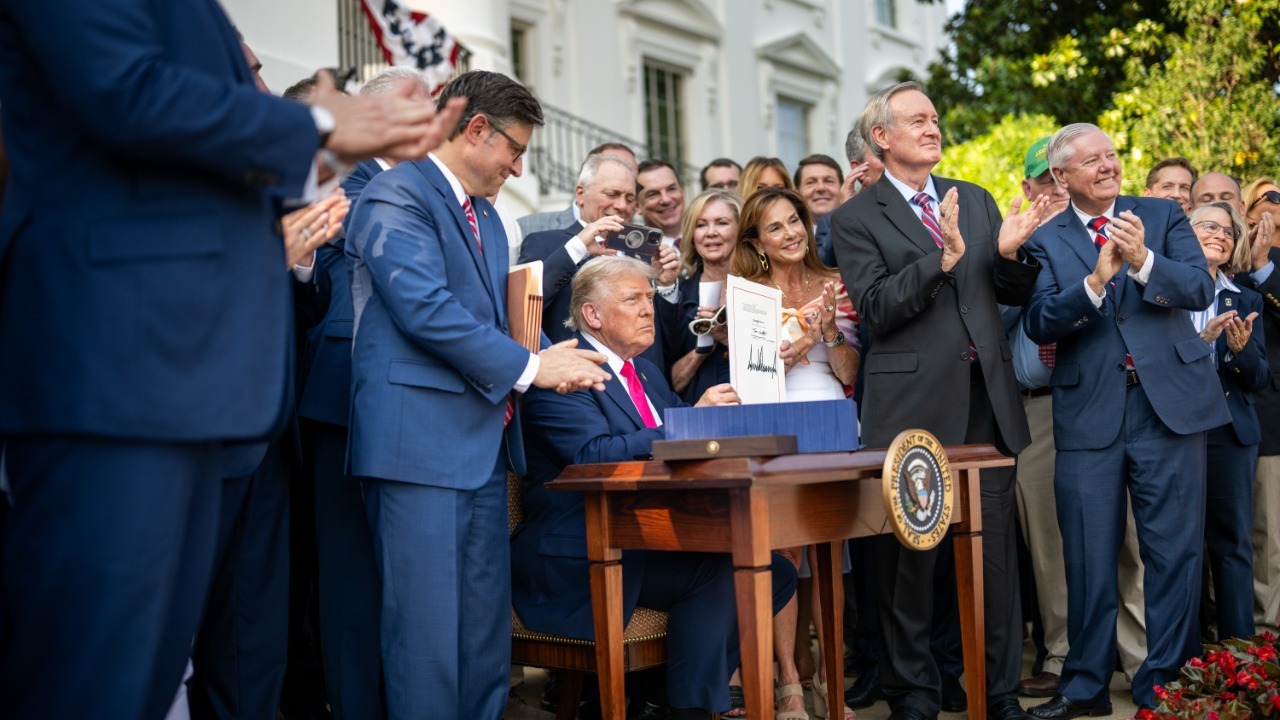
President Donald Trump stood before Congress during his 2026 State of the Union and made a promise that sounded almost too generous: open a retirement account, save a little, and the federal government will match your contribution with up to $1,000 each year. For the roughly 57 million American workers who lack access to an employer-sponsored retirement plan, the pitch landed like a lifeline. But the income rules governing the program tell a different story. For married couples filing jointly, the federal match starts shrinking once modified adjusted gross income crosses $41,000, a threshold so low that it excludes a large share of the workforce the program claims to serve.
In April 2026, Trump signed an executive order launching TrumpIRA.gov, a government portal designed to connect workers without workplace retirement plans to individual retirement accounts eligible for the federal match. The branding is new. The underlying benefit is not. The match itself was enacted by Congress in the SECURE 2.0 Act of 2022, signed into law by President Biden, and codified at Section 6433 of the Internal Revenue Code. The executive order gave the provision a presidential label, directed Treasury and the IRS to build the portal, and tasked the Department of Labor with issuing worker-protection guidance. None of that changed the eligibility rules Congress wrote.
How the match works
The Saver’s Match, the program’s statutory name, offers a 50% federal match on up to $2,000 in eligible retirement contributions per individual per year. That produces a maximum government deposit of $1,000. The money goes directly into the worker’s IRA or qualifying retirement plan as a cash contribution, a meaningful upgrade over the Saver’s Credit it replaces. The old credit was nonrefundable, which meant the lowest-income filers, the people who owed little or no federal income tax, frequently received nothing from a benefit supposedly designed for them. The Congressional Research Service noted this structural flaw when analyzing SECURE 2.0’s changes.
The match takes effect for taxable years beginning after December 31, 2026. The earliest qualifying contributions will be made in the 2027 tax year. Workers who open accounts through TrumpIRA.gov or contribute to an existing eligible IRA will claim the match when filing their federal return, and the government will deposit the funds directly into the account afterward.
The income phaseout problem
The promise narrows fast once you look at the income thresholds. IRS guidance published in Internal Revenue Bulletin 2024-39 lays out phaseout bands that determine how much of the match a filer actually receives. For married couples filing jointly, the match begins to shrink at $41,000 in modified adjusted gross income and disappears entirely at $71,000. For single filers, the phaseout window is even tighter, starting at $20,500 and ending at $35,500. Heads of household fall in between, with a range of $30,750 to $53,250.
Those numbers deserve context. The U.S. Census Bureau pegged median household income at $80,610 in 2023, the most recent year available. A joint-filing couple earning the national median would be well past the point where the match vanishes completely. Even a two-earner household where each person makes roughly $21,000 a year would already see a reduced benefit.
The squeeze is sharper in high-cost states. In Massachusetts, California, and New Jersey, where entry-level full-time wages can push a joint return past $41,000 without either earner cracking $25,000, many of the workers the program targets will find themselves partially or fully phased out. IRS adjusted gross income data by state shows that median AGI in these states runs significantly above the national figure, pushing an even larger share of filers beyond eligibility.
The $41,000 joint-filer threshold is the baseline set in the statute and is indexed for inflation, but the IRS has not yet published adjusted figures for the 2027 tax year when the match actually begins. Any adjustment is likely to be modest, not enough to dramatically widen the eligible population. Because the thresholds are written into the statute itself, only Congress can change the underlying formula. Lawmakers could raise the phaseout ceilings before the 2027 implementation date, but as of June 2026 no bill to do so has advanced in either chamber.
Who benefits most
The biggest proportional gains go to workers with low but steady earnings who can afford to set aside the full $2,000 a year. A single filer earning $28,000 annually, comfortably within the phaseout range, who contributes $40 a week to a Roth IRA through the TrumpIRA portal would receive the full $1,000 federal deposit. That is a 50% instant return on savings. Over 25 years of compounding at a moderate rate of return, that annual boost could add tens of thousands of dollars to a retirement balance that might otherwise stay dangerously thin.
Gig workers, part-time employees, and staff at small businesses without 401(k) plans are the intended audience. These workers typically lack payroll-based auto-enrollment and employer matches, two features that behavioral research consistently links to higher savings rates. For comparison, the average employer 401(k) match runs about 3% to 6% of salary. A worker earning $30,000 with a 4% employer match on a 4% contribution would receive $1,200 a year from their employer. The TrumpIRA match caps at $1,000 regardless of salary, which makes it most valuable at the lowest income levels and less competitive as earnings rise.
Income volatility complicates the picture further. A freelancer who qualifies during a slow year might lose the match entirely after landing a better-paying contract. A household that dips into eligibility during a layoff could qualify temporarily, then lose the benefit once income rebounds. That unpredictability makes it harder to plan around the $2,000 contribution target, especially for people living paycheck to paycheck who need to know the match will actually arrive before committing scarce dollars to a locked retirement account.
What remains unresolved
As of June 2026, several critical details are still missing. The executive order directed Treasury, the IRS, and the Department of Labor to produce operational guidance, but none of the three agencies has published final rules explaining how TrumpIRA.gov will function day to day.
The most pressing gap is fee protection. The Labor Department has not said whether accounts opened through the portal will be subject to fee caps, fiduciary standards, or conflict-of-interest rules. That question is urgent because many of the target users are first-time investors with small balances. A $1,000 match deposited into an account charging 1.5% in annual fees on a $3,000 balance loses $45 in the first year alone. Over a decade, high fees can consume a significant portion of the government’s contribution. Without guardrails, the portal could inadvertently steer savers into products that erode the benefit it provides.
Other open questions include how workers will verify their income eligibility before contributing (rather than discovering months later, at tax time, that they earned too much), which financial custodians will be approved to hold accounts, and how quickly match funds will be deposited after a qualifying return is filed.
No official enrollment projections have been released either. Analysts can use IRS income distribution data to approximate how many tax returns fall below the phaseout ceilings, but the administration has not published its own estimate of how many workers the program will reach or what the match will cost the Treasury over a 10-year budget window.
A real benefit wrapped in an oversized promise
For the lowest-income savers who can afford to contribute, the direct deposit match is a genuine improvement over the old Saver’s Credit. Replacing a nonrefundable tax credit with cash in a retirement account is the kind of structural fix that policy researchers have recommended for years. That part of TrumpIRA deserves credit regardless of which administration’s name is on it.
But the gap between the marketing and the eligibility rules is wide enough that millions of workers who hear “up to $1,000 a year” will discover they fall on the wrong side of the income line. A joint-filing couple earning $50,000 gets a reduced match. A couple earning $72,000, still below the national median, gets nothing. The program is narrower than the pitch, and workers considering whether to contribute through TrumpIRA.gov should check their modified adjusted gross income against the published phaseout thresholds before assuming the full match is theirs.
Formal regulations from Treasury and the IRS are expected in the coming months. Until those rules are final, the most important number in the TrumpIRA conversation is not $1,000. It is $41,000.