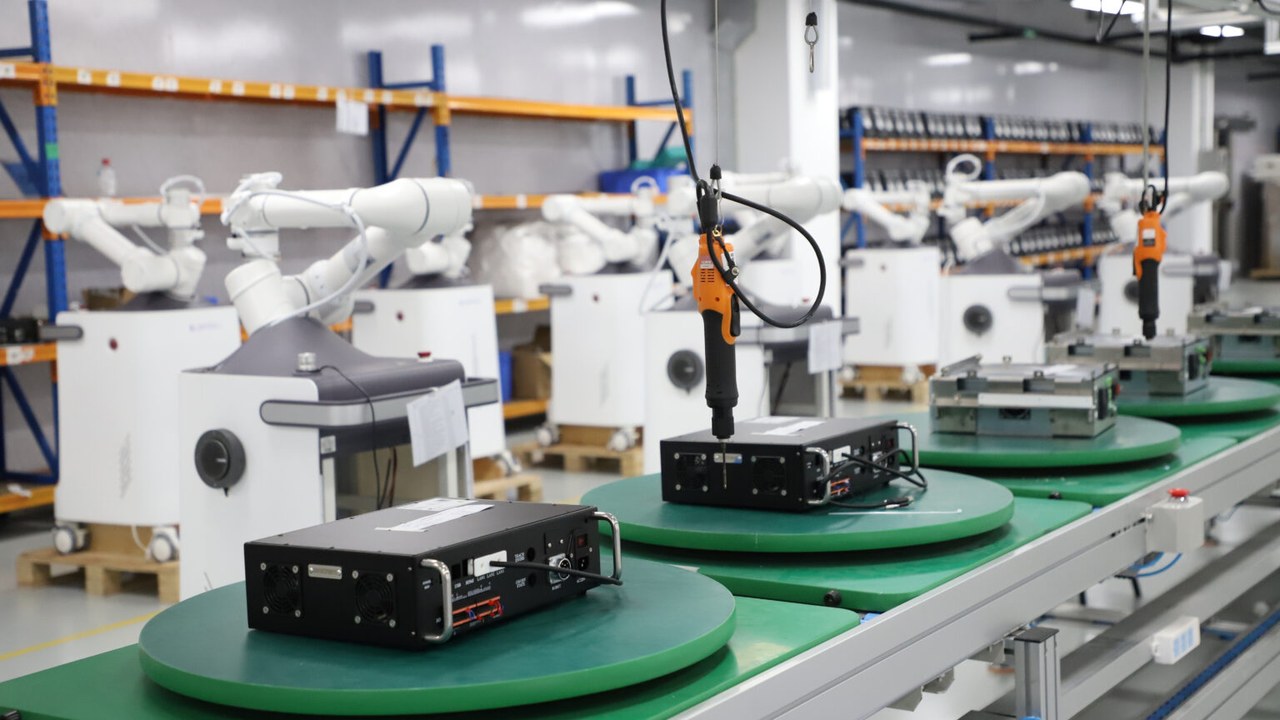
Ford Motor Company spent years and billions of dollars trying to become a major EV battery manufacturer. That chapter is over. The Dearborn automaker has launched Ford Energy, a wholly owned subsidiary that will build shipping-container-sized battery storage systems in the United States, targeting data centers, electric utilities, and large industrial operations. The goal: 20 gigawatt-hours of annual production capacity, a figure that would make Ford one of the largest stationary storage producers in North America almost overnight.
The pivot follows Ford’s decision to walk away from its $11.4 billion BlueOval SK joint venture with South Korean battery maker SK On, a partnership that was supposed to anchor Ford’s electric vehicle supply chain with multiple U.S. gigafactories. Rising costs, softening EV demand, and shifting trade policy gutted the venture’s economics. Ford scaled back or paused construction at planned battery plants in Kentucky and Tennessee before ultimately unwinding the deal.
Now, instead of packing batteries into F-150 Lightnings, Ford wants to sell them to the facilities that train large language models and keep cloud services running around the clock.
Why data centers changed the math
The timing is deliberate. U.S. data center electricity consumption is projected to surge in the years ahead, according to the International Energy Agency, driven largely by the computing demands of artificial intelligence. Grid operators in Virginia, Texas, and other data center corridors are already struggling to keep pace. That bottleneck has created urgent demand for on-site and grid-connected battery storage that can smooth power delivery, provide backup during outages, and help facilities manage electricity costs.
Ford Energy’s product line will consist of standardized, containerized battery energy storage systems, or BESS, deployable in modular configurations. The units charge when electricity is cheap or abundant and discharge during peak demand, letting customers arbitrage power prices while improving grid reliability. According to Ford’s launch announcement, the subsidiary will serve three primary customer segments: data centers, utilities managing intermittent renewable generation, and large commercial or industrial operations that need backup power to avoid costly downtime.
At 20 GWh of annual capacity, Ford Energy would be entering a market where scale matters enormously. Tesla Energy and Fluence Energy, two of the sector’s leading players, have each built significant deployment track records in recent years. Ford is not claiming it will hit 20 GWh on day one, but the target signals the company views this as a core business, not a side project.
Repurposing the EV supply chain
Ford is not starting from scratch. The company spent years building relationships with battery cell suppliers, developing thermal management and battery management software for its EV lineup, and investing in lithium-ion manufacturing expertise. Ford Energy is designed to redirect that knowledge toward stationary storage, a product category with fundamentally different economics: longer project timelines, utility-grade procurement cycles, and far less exposure to the consumer sentiment swings that have slowed EV adoption across the industry.
The open question is which assets actually carry over. Ford has not publicly disclosed whether Ford Energy will occupy any of the factory space originally planned for BlueOval SK, or whether it will rely on new or existing Ford manufacturing facilities. The subsidiary’s battery chemistry is also unspecified. Across the storage industry, lithium iron phosphate (LFP) cells have become the dominant choice for stationary applications because of their lower cost, longer cycle life, and reduced fire risk compared to the nickel-rich chemistries common in EVs. Whether Ford Energy adopts LFP or sticks with chemistries closer to its existing EV supply chain could significantly affect its cost position against established competitors.
The Inflation Reduction Act adds another dimension. The IRA’s domestic manufacturing tax credits for battery components and energy storage systems were designed to incentivize exactly this kind of U.S.-based production. Ford has not detailed how much of a per-unit cost advantage those credits would provide, but assembling BESS domestically positions the subsidiary to capture incentives that imported systems, particularly from Chinese manufacturers like BYD and CATL, cannot access under current rules.
What Ford has not disclosed
For all the ambition in the announcement, several critical details remain missing. Ford has not disclosed the capital expenditure required to stand up Ford Energy’s manufacturing operations, nor has it released projected revenue, margins, or break-even timelines. No specific customer contracts or letters of intent have been named publicly. According to Energy Storage News, deliveries are expected to begin within the next couple of years, but Ford has not confirmed that timeline through an SEC filing or investor presentation.
There is also a gap in the public narrative connecting the BlueOval SK cancellation to Ford Energy’s creation. No Ford executive has offered an on-the-record explanation of how battery resources, personnel, or supplier contracts were redirected from one initiative to the other. The two decisions are clearly linked by timing and subject matter, but the internal mechanics, including workforce transitions and renegotiated supply agreements, remain undocumented. It is also unclear what happens to Ford’s broader relationship with SK On, which still supplies battery cells for Ford’s existing EV models.
Investors and analysts will likely press for those specifics during Ford’s next earnings call. Until then, the 20 GWh figure and the delivery timeline are company aspirations, not independently verified commitments.
Can Ford compete in a market Tesla already dominates?
Ford Energy is entering a market that is expanding rapidly but is far from uncontested. Tesla Energy, Fluence, BYD, and a growing roster of manufacturers already compete aggressively on price and scale. Tesla, in particular, has a multi-year head start and field data from thousands of deployed Megapack units worldwide.
What Ford brings is brand recognition with utility procurement departments, an established U.S. manufacturing footprint, and the financial backing of a parent company with substantial annual revenue. What it lacks is a track record in stationary storage and the operational history that gives buyers confidence in long-term system performance and warranty support.
Ford’s pivot also raises a broader question for the auto industry. If one of Detroit’s Big Three now views battery technology as a platform business that extends well beyond vehicles, others are likely doing the same calculus. GM has already signaled interest in stationary storage through its Ultium platform. The race to supply battery systems to data centers and grid operators could reshape how legacy automakers think about their manufacturing capacity for years to come. For Ford Energy, the test is straightforward: deliver 20 GWh of reliable, competitively priced storage before the window closes and the field gets more crowded.