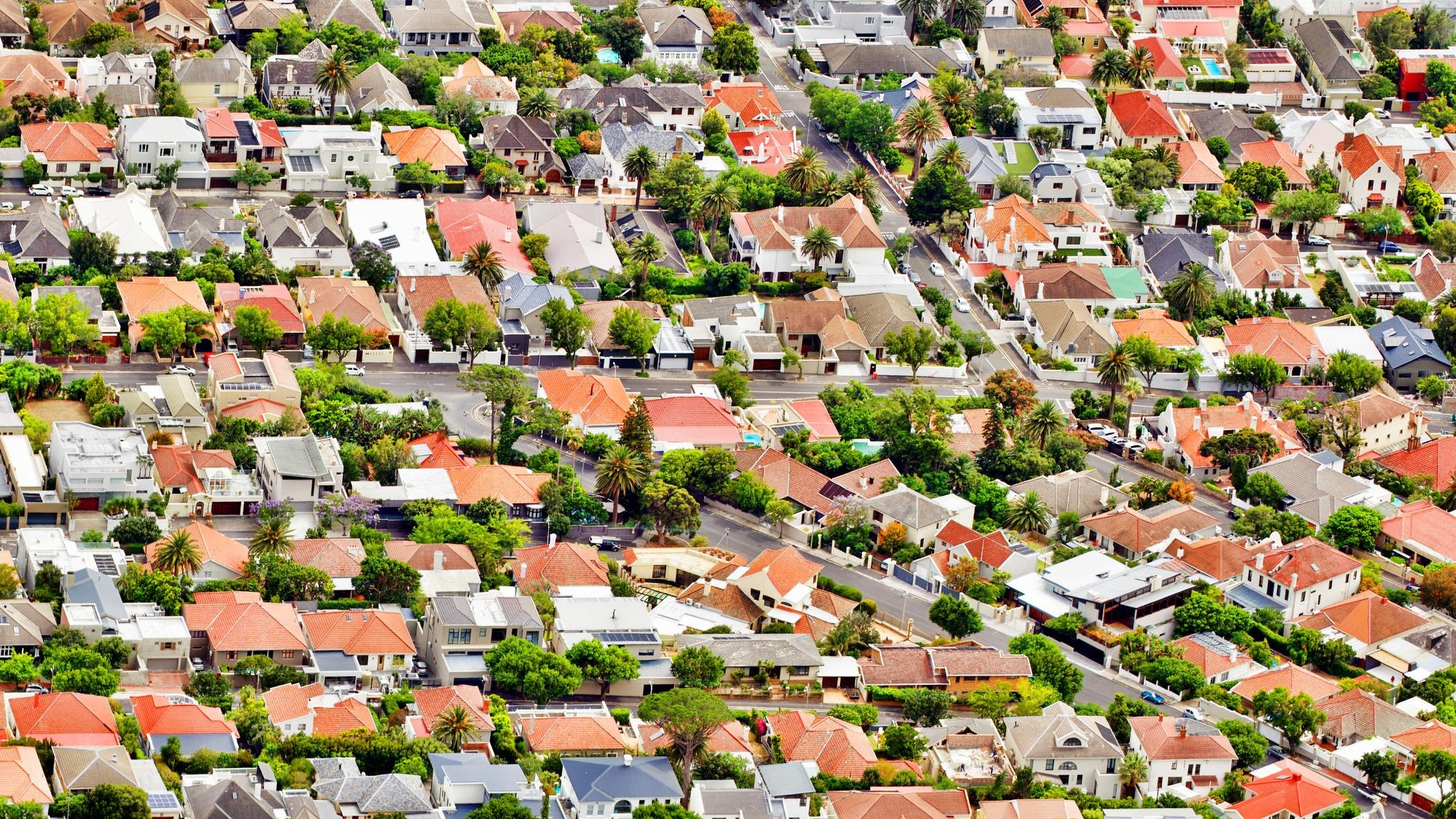
Of the 129 largest metropolitan areas tracked by the Federal Housing Finance Agency’s House Price Index, 39 lost value in the first quarter of 2025. Cape Coral-Fort Myers, Florida, posted the steepest decline among major metros, with the FHFA repeat-sales index showing a year-over-year drop of approximately 9%. Detroit posted the largest gain, with the index registering an increase of approximately 17%. The gap between those two numbers tells the story of a national housing market that no longer behaves like one.
Five years ago, nearly every metro in the country was rising in lockstep, lifted by pandemic-era mortgage rates below 3% and a flood of remote-work relocations. That era is over. The Q1 data, released by the FHFA in May 2025, reveals a market splintering along regional fault lines: oversupplied Sun Belt cities pulling back, affordable Midwestern metros pushing higher, and most of the country somewhere in between.
Cape Coral’s correction deepens
The Cape Coral-Fort Myers metro was one of the pandemic’s biggest winners. Remote workers poured into Southwest Florida, and home values roughly doubled between 2020 and early 2023. That run is now unwinding in a serious way.
The FHFA’s repeat-sales index for the metro, published through the Federal Reserve Bank of St. Louis, shows prices peaked and have entered a sustained slide. The approximately 9% first-quarter decline, as measured by the repeat-sales methodology, is among the sharpest pullbacks of any large metro in the country.
“We’re seeing the hangover from years of unsustainable price growth colliding with an insurance crisis that has fundamentally changed the cost of owning a home in Southwest Florida,” said Ken H. Johnson, a real estate economist at Florida Atlantic University, in a May 2025 analysis of the region’s housing trends.
The causes are stacking up. Homeowners insurance premiums in Florida have climbed so steeply that they now function as a second mortgage for many buyers. Citizens Property Insurance Corporation, the state’s insurer of last resort, has reported policy cost increases that have priced some purchasers out entirely. Meanwhile, builders kept breaking ground even as demand softened. U.S. Census Bureau building permit data shows the Cape Coral-Fort Myers metro consistently ranked among the top markets nationally for new residential construction through 2023 and 2024, flooding the area with inventory now competing against resale listings.
The buyer pool has also thinned. After years of population surges, Florida’s net domestic migration slowed in 2024, according to Census Bureau population estimates. Fewer arrivals means fewer offers.
Context matters here. A 9% decline after a near-doubling in value means most homeowners who bought before 2022 are still well above water. The pain is concentrated among recent buyers who purchased near the peak, not long-term residents sitting on years of appreciation.
Detroit’s surge starts from the basement
Detroit’s approximately 17% price gain, as captured by the FHFA repeat-sales index, is the largest among major metros, but it starts from one of the lowest price floors in the country. The metro’s median home value remains well below the national figure, which the Federal Reserve Bank of St. Louis placed above $400,000 as of the most recent available data in late 2024.
That low baseline means even modest dollar increases produce large percentage swings. A home going from $120,000 to $140,000 registers as a 17% gain but represents only $20,000 in actual value, a fraction of what similar percentage moves mean in coastal markets.
The demand side has real substance behind it, though. The auto industry’s pivot toward electric vehicle production has channeled billions in investment into Southeast Michigan. Ford, General Motors, and Stellantis have all announced major facility upgrades and hiring plans in the region over the past two years, creating jobs and drawing workers who need housing.
“Detroit has become the value play for the entire Midwest,” said Daren Blomquist, vice president of market economics at Auction.com, in a June 2025 interview discussing the region’s price acceleration. “When rates are near 7%, buyers go where their dollar stretches furthest, and Detroit is near the top of that list.”
Affordability itself is acting as a magnet. With 30-year fixed mortgage rates hovering near 7% through much of the past year, according to Freddie Mac’s Primary Mortgage Market Survey, buyers priced out of expensive metros have turned toward cities where monthly payments remain manageable. Detroit fits that description better than almost anywhere else.
One caveat worth noting: the FHFA repeat-sales index measures price changes by comparing successive sales of the same properties, which filters out distortions from shifts in the mix of homes sold. However, in a low-volume market like Detroit, a relatively small number of repeat transactions can produce outsized percentage swings. The direction of Detroit’s gains is clear, but the precise magnitude should be read as an approximate figure rather than a pinpoint measurement.
A national market splitting along regional lines
The 39 metros that posted declines in Q1 are not random. Most share at least one of three characteristics: outsized pandemic-era price gains, elevated new-construction pipelines, or rising carrying costs like insurance and property taxes. Sun Belt markets in Florida and Texas have been especially vulnerable. Austin, which saw some of the most aggressive pandemic-era appreciation in the country, has also been giving back gains. Phoenix and several Mountain West metros that boomed during the remote-work migration have shown similar softening in recent FHFA readings.
The 90 metros that gained ground tend to look different: tighter existing inventory, steady local job growth, and price levels that never overshot fundamentals as dramatically. Midwestern and Northeastern cities, where construction has been slower and prices never spiked as sharply, have generally held up or strengthened. Beyond Detroit, metros like Cleveland, Pittsburgh, and several smaller Rust Belt cities have posted solid gains from low bases.
Mortgage rates remain the backdrop for everything. With the 30-year fixed rate still near 7% as of spring 2026, according to Freddie Mac, affordability pressure is real everywhere. But that pressure plays out differently depending on local conditions. In a market like Cape Coral, where supply is abundant and prices had already stretched beyond what local incomes support, high rates push values down. In a market like Detroit, where supply is tighter and prices are low in absolute terms, the same rates simply slow the pace of gains rather than reversing them.
What the FHFA index captures and where it falls short
The FHFA House Price Index uses a repeat-sales methodology, comparing the sale prices of the same properties across different transactions. This filters out distortions caused by shifts in the types of homes selling in any given quarter, making it one of the more reliable tools for tracking price trends over time.
But it has blind spots. The index covers only single-family properties with conforming mortgages backed by Fannie Mae or Freddie Mac. That means it excludes jumbo-loan purchases, most government-backed loans, and all-cash deals. In investor-heavy markets like parts of Florida, cash transactions can represent a significant share of activity and go entirely uncounted. The index also cannot capture price movements in brand-new subdivisions that have not yet generated a repeat sale, which is a meaningful gap in construction-heavy metros like Cape Coral.
For homeowners trying to gauge their own property’s trajectory, the FHFA data is a useful directional signal but not a substitute for a local comparative market analysis. The percentage changes reflect broad metro-level trends, not neighborhood-by-neighborhood reality.
Insurance, interest rates, and inventory will shape the rest of 2026
The first-quarter data is a snapshot, not a forecast. Several developments in the months ahead could shift the picture in either direction.
The Federal Reserve’s next moves on interest rates will matter enormously. If the Fed begins cutting rates later in 2026, as some economists and futures markets anticipate, buyer demand could rebound quickly in markets where prices have already corrected. That could stabilize or even reverse declines in places like Cape Coral. If rates stay elevated, the correction in oversupplied markets could deepen further.
Insurance costs in Florida remain a wildcard. The state legislature has passed several rounds of reform aimed at stabilizing the property insurance market, but premiums have continued climbing for many homeowners. Whether those reforms gain traction through 2026 could determine whether Southwest Florida’s housing correction finds a floor or accelerates.
In Detroit and similar gaining markets, the open question is sustainability. A 17% annual pace is not something any market can maintain without affordability eventually becoming a constraint. If price growth moderates to single digits, that would signal a healthy market finding its footing. If it accelerates further, it could signal the kind of overheating that eventually triggers its own correction.
The clearest takeaway from Q1 is that blanket statements about “the housing market” are increasingly meaningless. A buyer in Cape Coral and a buyer in Detroit are navigating fundamentally different realities, shaped by local supply, local demand, and local costs that no national trend line can capture. The FHFA will release second-quarter data later this year. The question is whether the gap between the markets gaining ground and the markets losing it narrows or keeps widening.