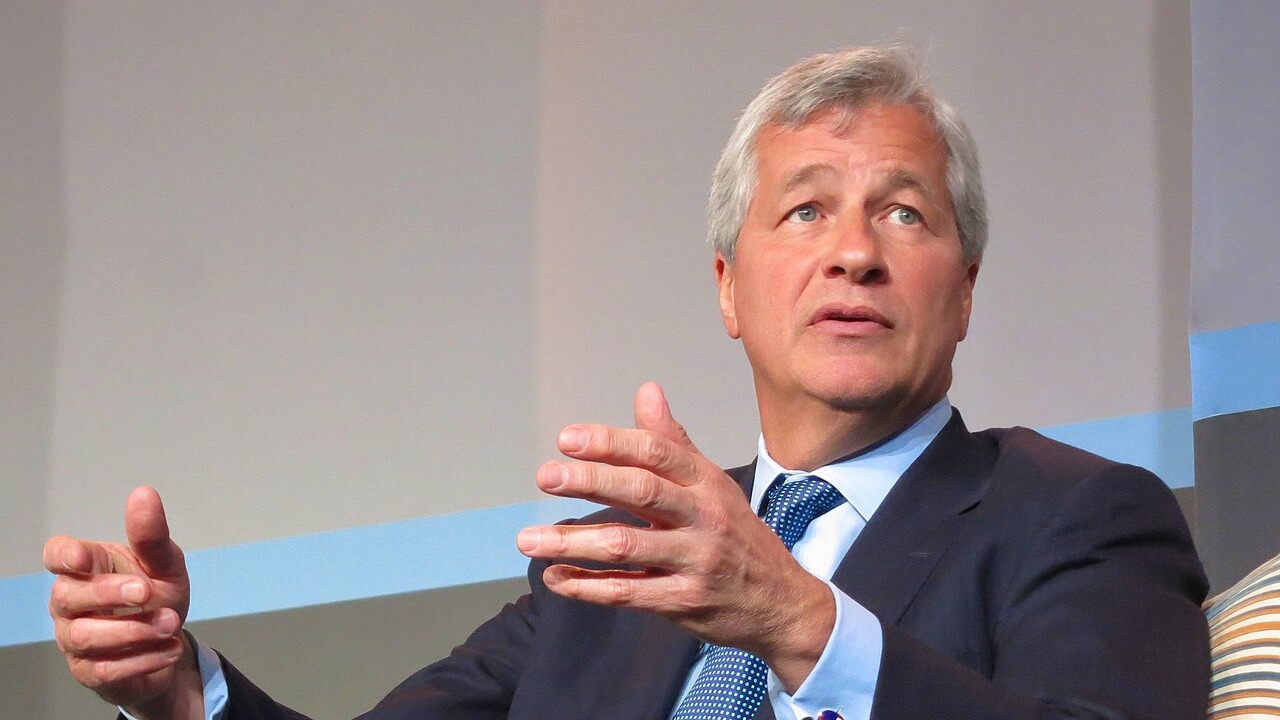
Jamie Dimon, the chief executive of JPMorgan Chase, is warning investors to stay away from both equities and long-term U.S. Treasury bonds, arguing that markets are not pricing in serious economic threats. The warning arrived alongside JPMorgan’s second-quarter 2026 earnings, which showed $21.2 billion in net income, a result that makes Dimon’s caution all the more striking: the nation’s largest bank is thriving, yet its leader says the assets most Americans hold could face sharp losses.
Why Dimon’s Dual Warning Cuts Against JPMorgan’s Own Results
A bank CEO telling the public to avoid stocks and bonds at the same time is unusual. It is even more unusual when that CEO’s institution just posted $21.2 billion in quarterly net income, filed with the U.S. Securities and Exchange Commission as part of its second-quarter 2026 earnings release. The disconnect between JPMorgan’s profit strength and Dimon’s personal investment stance signals that he sees risks building beneath a surface of strong corporate earnings.
Dimon’s concern centers on federal debt levels and the possibility that both stocks and long-duration Treasuries could decline simultaneously. That scenario would be painful for traditional portfolios, which rely on bonds to cushion equity losses. If both asset classes fall together, retirement accounts, pension funds, and balanced mutual funds would all absorb damage with no built-in hedge. Gross federal debt now exceeds $39 trillion, according to the U.S. Treasury’s Bureau of the Fiscal Service, a figure Dimon has pointed to as evidence that borrowing has reached levels the market has not fully absorbed.
The hypothesis that JPMorgan’s internal stress-test models show simultaneous equity and Treasury duration losses exceeding 15 percent within four quarters cannot be confirmed from the bank’s public filings or the available reporting. The second-quarter earnings release discusses macro risks in broad terms but does not disclose specific adverse-scenario projections tied to Dimon’s personal investment advice. What the public record does show is a CEO whose prepared remarks flag geopolitical friction, deficit spending, and inflation persistence as threats that could erode asset values across categories.
Earnings Strength and Debt Data Behind Dimon’s Caution
JPMorgan’s $21.2 billion in second-quarter net income was disclosed in an EX-99.1 filing with the SEC, the standard format for earnings narratives that accompany quarterly results. That filing includes Dimon’s official commentary on conditions facing the bank and the broader economy. His remarks describe an environment where strong bank revenue coexists with structural vulnerabilities, particularly around government borrowing and the sustainability of current asset prices.
The Treasury Department’s Debt to the Penny dataset, which tracks gross federal debt on a daily basis, provides the factual anchor for Dimon’s bond-market concerns. At $39 trillion, the debt load has grown rapidly over the past several years, driven by pandemic-era spending, rising interest costs, and persistent budget deficits. For bond investors, the risk is straightforward: if markets begin demanding higher yields to compensate for fiscal risk, the price of existing long-term Treasuries falls. Dimon’s suggestion to avoid those bonds implies he expects that repricing to happen over a horizon that matters to individual savers, not just to traders.
That stance is notable because big banks like JPMorgan are central players in the Treasury market. They underwrite government debt, trade it with clients and hold it on their own balance sheets. Dimon is effectively warning about the value of an asset class his institution helps distribute, underscoring the seriousness of his view that fiscal trends are unsustainable at current interest-rate levels. At the same time, JPMorgan’s own earnings benefit from higher short-term rates, which widen lending margins even as they pressure bond prices.
Implications for Investors and the Traditional 60/40 Portfolio
For decades, financial advisers have promoted a mix of roughly 60 percent stocks and 40 percent bonds as a simple, diversified portfolio. The idea rests on a historical pattern: when stocks fall during recessions or risk-off episodes, high-quality bonds, especially Treasuries, usually rise in price, cushioning overall losses. Dimon’s warning challenges that premise. If inflation proves sticky or deficits undermine confidence in U.S. fiscal policy, both stocks and bonds could sell off together, leaving balanced portfolios exposed.
In such an environment, diversification becomes harder. Investors seeking safety might look to cash-like instruments with short maturities, which are less sensitive to interest-rate swings, or to assets whose performance is less tied to government debt dynamics. Dimon has not laid out a detailed alternative allocation in his public comments, but the thrust of his message is that investors should rethink blind reliance on long-duration assets that assume a benign inflation and interest-rate backdrop.
The tension between JPMorgan’s strong current earnings and its CEO’s cautious tone captures a broader paradox in markets. Corporate profits, bank capital levels and consumer spending all look solid in the near term, yet the foundations of that strength-cheap financing and ever-expanding public debt-may be eroding. Dimon’s dual warning on equities and Treasuries is a reminder that headline earnings numbers can mask deeper vulnerabilities, and that even in a profitable quarter, the leader of the country’s largest bank is preparing for a world in which the most familiar cornerstones of investor portfolios no longer provide the protection they once did.
Free for readers: The free Retirement Shield newsletter sends plain-English help keeping more of your money in retirement — the scams to dodge, the benefits you’re owed, and what’s changing with Social Security and Medicare, a couple times a week. Get the free newsletter.