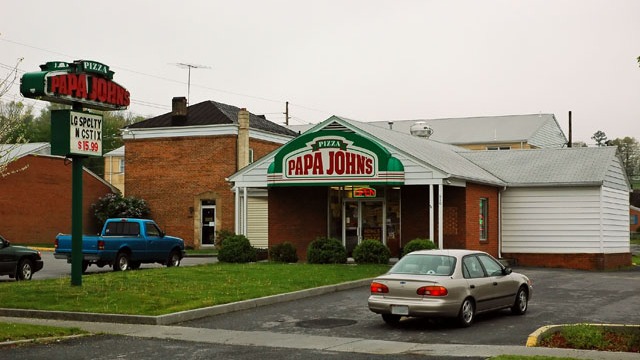
Papa John’s is closing roughly 50 restaurants spread across 17 states and cutting about 7 percent of its corporate workforce, according to the pizza chain’s latest financial disclosures. The reductions, detailed in the company’s first-quarter 2026 and full-year 2025 earnings releases, mark the sharpest contraction in the chain’s domestic footprint in recent memory. For employees, franchisees, and customers in affected markets, the changes signal a company willing to shrink its way toward better financial performance.
Why the closures and layoffs hit now, not later
The timing of these cuts raises a pointed question: were they part of a deliberate, long-range plan, or did financial pressure force the company’s hand? Papa John’s disclosed its full-year 2025 results in late February 2026, and the first-quarter update arrived in early May. That two-step disclosure pattern, with the bulk of the restructuring actions falling between the two reports, suggests the company moved quickly once year-end numbers confirmed the scale of its challenges.
One plausible reading is that lender covenants tied to same-store sales performance created urgency. Restaurant chains that carry significant debt often face financial benchmarks requiring minimum revenue or profitability at the unit level. When stores consistently miss those targets, lenders can demand corrective action, and closing underperforming locations is the fastest lever available. Papa John’s has not publicly confirmed whether covenant pressure drove the timeline, but the compressed window between disclosure and execution fits that pattern more closely than it fits a years-in-the-making portfolio review.
The 7 percent workforce reduction adds another layer. Corporate layoffs typically follow operational restructuring, not the other way around. Cutting staff at headquarters while simultaneously shuttering locations suggests the company is pulling back on both its physical and administrative footprint at once, a move that points to near-term financial discipline rather than growth-oriented repositioning. In practice, that can mean leaner support for marketing, training, and technology initiatives that might otherwise help the remaining restaurants grow sales.
What the earnings filings actually show
The two primary documents anchoring these developments are the company’s official earnings press releases. The year-end disclosure set the stage by outlining the financial conditions that preceded the restructuring, including pressure on comparable sales and margins. The first-quarter 2026 release, issued in May, confirmed the scope: approximately 50 restaurant closures spanning 17 states and a 7 percent reduction in staff.
The company framed the closures as portfolio optimization, describing them as steps to concentrate resources on locations with stronger unit economics. That language is standard in the restaurant industry when chains trim underperforming stores. But the breadth of the geographic impact, touching nearly a third of U.S. states, indicates the weakness was not confined to one region or market type. Instead, it suggests a more diffuse set of challenges, from rising labor and ingredient costs to intensifying competition in delivery and carryout.
Neither filing provided a breakdown of how many closed locations were company-owned versus franchised. That distinction matters because franchise closures affect independent operators who invested their own capital, while company-owned closures hit the corporate balance sheet directly. The absence of that detail leaves a significant gap in understanding who bears the greatest financial burden from these decisions, and how much flexibility the company retains to reverse course if conditions improve.
Unanswered questions for workers and franchise owners
Several critical details are missing from the public record. The company has not released specific addresses or closure dates for the affected restaurants, leaving employees and customers in some markets uncertain about which stores are at risk. For workers, that uncertainty complicates decisions about whether to seek transfers, look for new jobs, or wait and hope their location survives the cuts.
There is also no public guidance on severance, retraining, or relocation assistance for the corporate staff affected by the 7 percent headcount reduction. In the restaurant sector, support packages for laid-off employees vary widely, and without clear commitments from Papa John’s, it is difficult to assess how much of the cost of restructuring will be borne by workers versus shareholders.
Franchisees face their own unanswered questions. If some of the shuttered units are franchised, owners may be left with lease obligations, equipment loans, and other liabilities even after the doors close. The earnings materials do not spell out what, if any, financial relief or restructuring options are available to those operators. That silence could fuel tension between the corporate office and franchise community at a time when cooperation is crucial for stabilizing the brand.
What it means for customers and the brand
For customers, the immediate impact is straightforward: fewer locations, longer delivery times in some areas, and the possibility that familiar neighborhood stores will disappear. Over time, though, the closures could reshape how the brand is perceived. A tighter footprint focused on higher-volume, better-performing stores might improve service consistency and product quality, but it can also make the chain feel less ubiquitous than rivals with more aggressive expansion plans.
Brand perception will also hinge on how transparently Papa John’s communicates about the changes. Clear explanations of why certain markets are being exited, what will happen to affected employees, and how the remaining stores will be strengthened could reassure both customers and investors. Conversely, a prolonged information vacuum risks letting speculation define the narrative-whether that is about financial distress, strategic missteps, or eroding competitiveness.
Ultimately, the decision to close roughly 50 restaurants and trim corporate staff is a bet that a smaller, more focused Papa John’s can deliver better financial results. Whether that bet pays off will depend not just on cost savings, but on the company’s ability to stabilize same-store sales, support its remaining franchisees, and convince customers that the brand is evolving rather than retreating. For now, the filings provide a clear picture of what is happening, but far less clarity about what comes next for the people and communities behind the numbers.