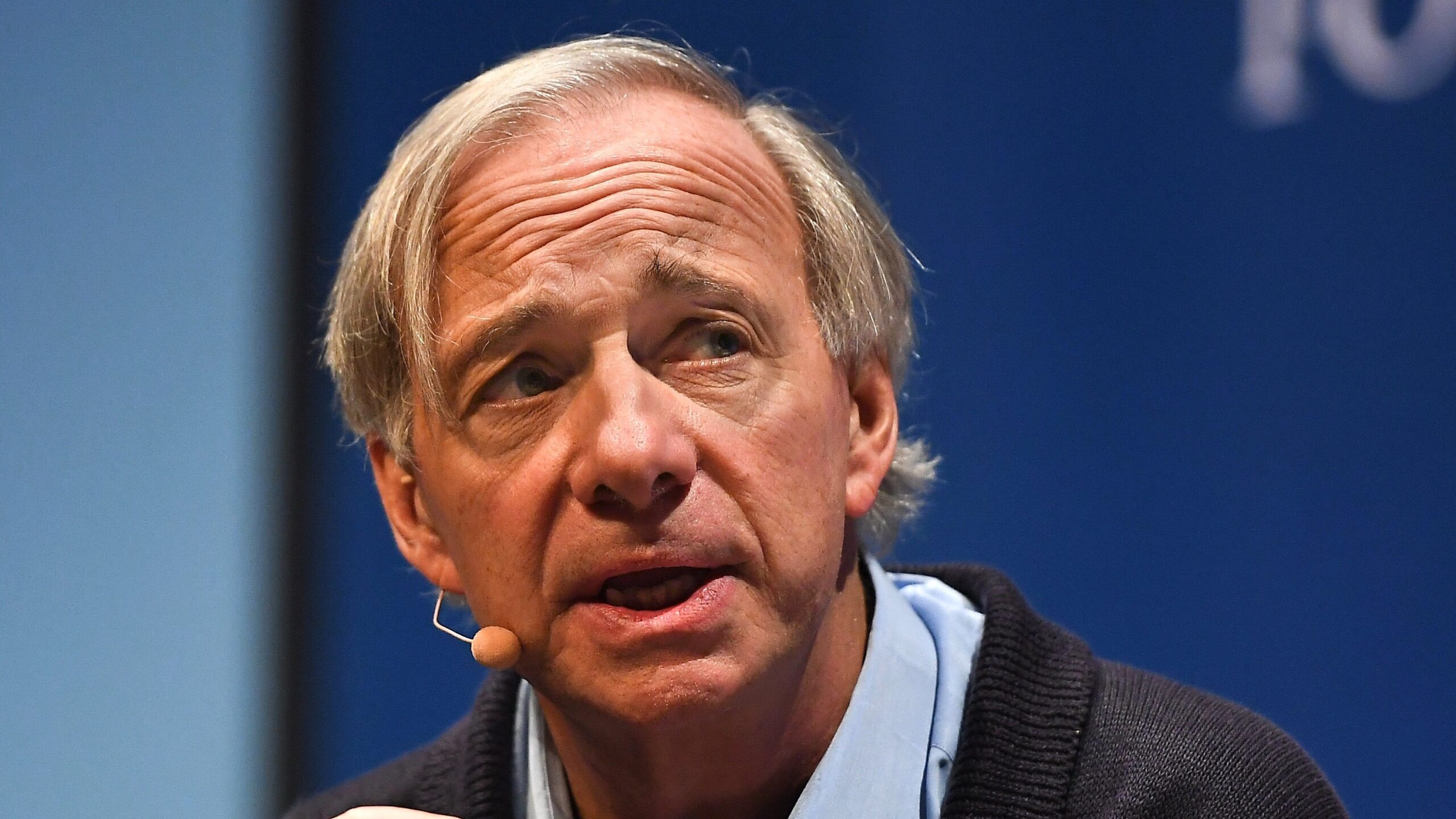
Ray Dalio built Bridgewater Associates into the world’s largest hedge fund by studying how debt cycles break. Now the billionaire investor is turning that lens on a policy fight in his own backyard: a California ballot initiative that would impose a one-time 5% wealth tax on the state’s billionaires, with the first payments due in 2027. His concern is blunt. If ultra-wealthy shareholders are forced to liquidate large blocks of stock to cover the bill, the resulting wave of selling could accelerate a broader market downturn at a moment when equity valuations are already stretched thin.
Dalio has spent years warning publicly that widening wealth gaps and rising populism make some form of wealth taxation increasingly likely, and that the consequences for financial markets could be severe. In his 2021 book Principles for Dealing with the Changing World Order, he argued that societies in late-stage debt cycles often turn to taxing the rich, and that the resulting capital flight and forced liquidations can destabilize asset prices. He has repeated versions of that argument in LinkedIn essays and television interviews, including a November 2024 appearance on CNBC where he discussed the risks of political polarization spilling into markets. California’s proposal is exactly the kind of policy trigger he has been describing in the abstract for years.
The warning carries weight because of who owns the stock market. According to the Federal Reserve’s Distributional Financial Accounts, the wealthiest 1% of U.S. households hold roughly half of all corporate equities and mutual fund shares. That concentration means even a modest round of forced selling by top-tier holders can translate into billions of dollars of supply hitting exchanges over a compressed window.
What the California proposal actually requires
The ballot initiative, introduced in the state legislature as ACA 3, is working its way through the qualification process ahead of a potential 2026 vote. It would levy a one-time 5% tax on the net worth of California residents whose wealth exceeds one billion dollars as of January 1, 2026. The nonpartisan Legislative Analyst’s Office has reviewed the measure and confirmed that real estate, pensions, and qualified retirement accounts would be excluded from the taxable base. That means the tax falls squarely on financial assets: publicly traded stocks, bonds, private business interests, and other holdings that are liquid or semi-liquid.
To put the scale in perspective, the Forbes 2025 Billionaires List counts more than 180 billionaires based in California, a concentration unmatched by any other state. Their combined taxable wealth, after the real estate and retirement exclusions, likely runs into the hundreds of billions of dollars. A 5% levy on that base would generate tens of billions in tax obligations, most of which would need to be funded by selling financial assets.
Taxpayers could elect to spread payments over five years, though at additional cost. Even with that option, the structure creates a clear incentive to sell equities. The Federal Reserve’s Financial Accounts of the United States show that most household wealth at the top of the distribution sits in marketable securities and business equity, not in bank deposits. A billionaire facing a tax bill in the hundreds of millions would, in most cases, need to convert portfolio holdings into cash to pay it.
Why Dalio sees a trigger for broader damage
Dalio’s argument connects two well-documented realities. First, equity ownership in the United States is extraordinarily top-heavy. Second, markets are sensitive to large, concentrated sell orders, particularly during periods of elevated valuations or thin liquidity. If a group of billionaires begins offloading shares on a similar timetable to meet the same tax deadline, the selling pressure could push prices lower. That decline would ripple into index funds, 401(k) plans, and brokerage accounts held by millions of everyday investors who have no connection to the policy debate.
The 2008 financial crisis offers a rough analogy. During that episode, forced liquidations by leveraged funds and margin calls on wealthy investors amplified the speed and depth of the sell-off. The mechanism here is different in origin but similar in structure: an external obligation compels asset holders to sell regardless of whether they believe the price is fair, and the resulting supply overwhelms buyers. The key difference is that a tax-driven liquidation would arrive on a known schedule, giving markets time to price it in but also giving short sellers time to position against it.
No government agency has modeled the specific market impact of the California proposal. The Fed’s distributional data describe who holds what, but they do not simulate forced-sale scenarios. Any projection about cascading sell-offs is, at this stage, an inference drawn by private analysts rather than a quantified estimate from a regulator. That does not make the risk imaginary. It means the range of outcomes is wide, and the burden of preparation falls on individual investors rather than institutions.
Legal and constitutional hurdles ahead
Even if the initiative qualifies for the ballot and voters approve it, the measure faces serious legal obstacles. The U.S. Supreme Court’s June 2024 decision in Moore v. United States upheld a narrow mandatory repatriation tax by a 7-2 margin, but the majority opinion deliberately avoided ruling on whether the Constitution permits taxes on unrealized gains or accumulated wealth more broadly. That unanswered question is precisely the one California’s proposal raises. Challengers would almost certainly argue that a state-level wealth tax violates the Due Process and Equal Protection clauses of the Fourteenth Amendment, and possibly the Commerce Clause if it captures wealth tied to out-of-state assets.
Behavioral responses add another layer of uncertainty. Wealthy residents may relocate before the January 2026 assessment date, shrinking both the tax base and the volume of forced selling. Financial advisors could structure transactions to minimize market impact, using block trades, dark pools, or borrowing against portfolios to defer sales. And markets themselves are adaptive: if investors anticipate a wave of tax-driven selling, some may step in early to buy at discounted prices, cushioning the blow. Others, of course, may front-run the selling and make it worse.
Why this is not just a California story
California’s initiative does not exist in isolation. Federal lawmakers have floated their own versions of wealth taxes in recent years. Senator Ron Wyden of Oregon introduced the Billionaires Income Tax in 2021, targeting unrealized capital gains, and has reintroduced variations since. Broader wealth-tax proposals surfaced during the 2024 presidential campaign. None have advanced through Congress, but the political appetite for taxing extreme wealth has not faded. If California’s measure passes and survives legal challenge, it could serve as a template for other states or renew momentum for a federal approach.
That possibility is part of what makes Dalio’s warning resonate beyond a single state ballot question. A patchwork of wealth taxes across jurisdictions would multiply the liquidation pressure he describes, potentially turning a localized risk into a national one. For investors with diversified portfolios tied to broad market indexes, the distinction between a California-only event and a nationwide policy shift is the difference between a manageable dip and a structural repricing of equities.
Billionaire migration, ballot deadlines, and the signals that will move markets first
The core facts are concrete enough to take seriously. A real, targeted wealth tax proposal exists in the nation’s largest state economy. It would likely compel some degree of equity liquidation by the wealthiest households. And stock ownership is concentrated enough at the top that those sales could move markets. What remains unresolved is the scale, the timing, and whether the measure will survive the political and legal gauntlet between now and 2027.
For retirement savers and individual investors, the practical step is not to panic but to pay close attention. Track the ballot qualification process. Watch for legal challenges, especially any that test the constitutional boundaries left open by Moore. Monitor whether similar proposals gain traction in other states or at the federal level. And keep an eye on whether California’s billionaires start quietly shifting residency, a migration pattern that would show up in real estate data and state tax filings long before any stock is sold.
Dalio’s track record earns his warnings a hearing. Whether this particular scenario plays out depends on decisions that voters, courts, and lawmakers have not yet made. But the plumbing of the risk, concentrated ownership, forced-sale mechanics, and stretched valuations, is already in place.