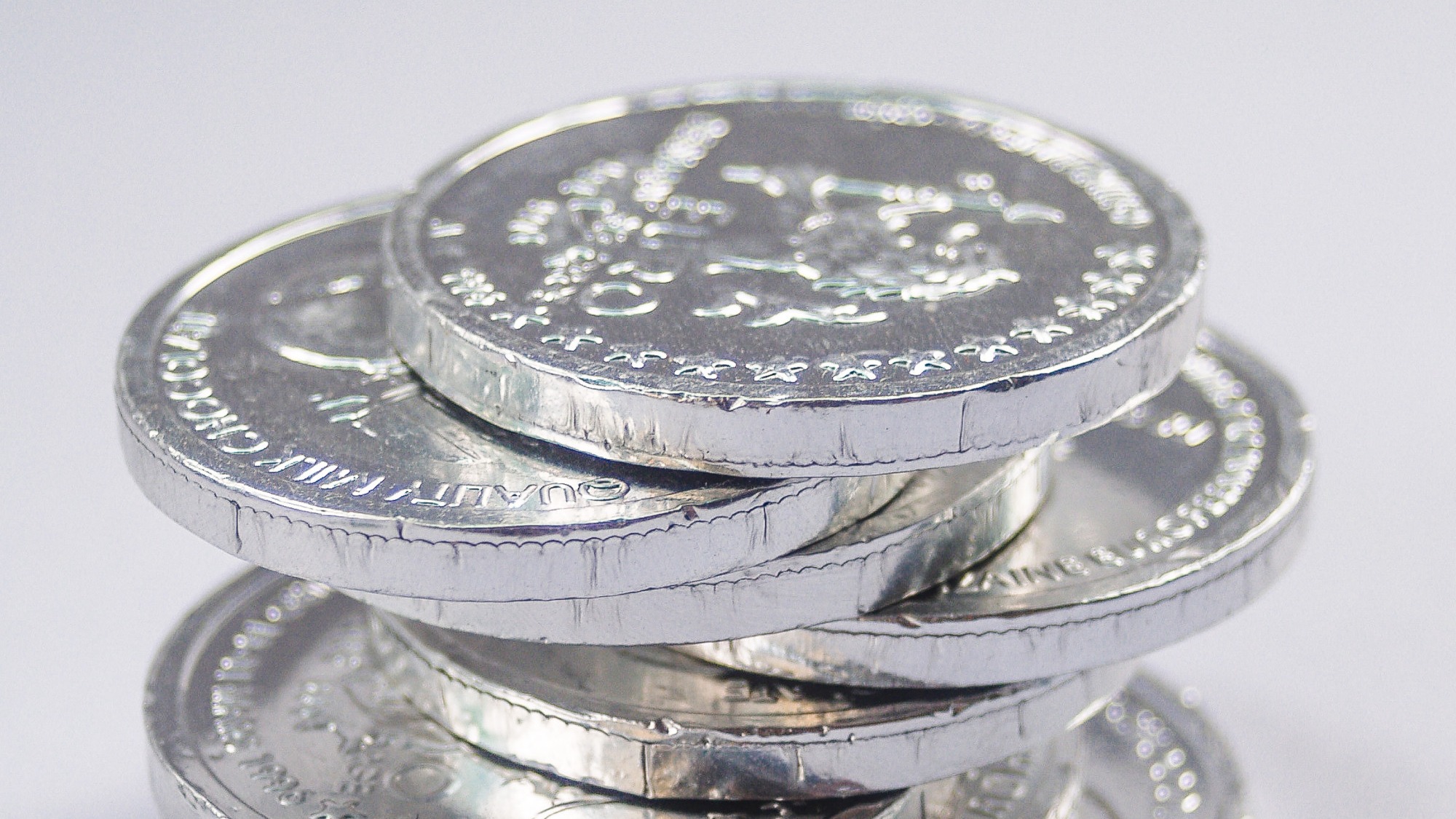
In April 2026, a tube of American Silver Eagles listed at $41.50 per coin on the price-comparison tracker at FindBullionPrices.com while one-ounce bars from Sunshine Minting and Valcambi clustered between $34 and $37 at dealers such as SD Bullion and Monument Metals. That $5-to-$8 gap per ounce sounds modest in isolation. Multiply it across 100 or 500 ounces and a buyer is leaving a meaningful stack of silver on the table.
Every new silver buyer eventually lands on the same question: coins or bars? The answer hinges on priorities, but for anyone focused on stacking the most metal per dollar, the arithmetic points in one direction.
Where the coin premium starts
The markup on American Silver Eagles begins before any retail dealer touches the product. The U.S. Mint sells Eagles exclusively through a small network of authorized bullion purchasers. According to the Mint’s published distribution terms, those firms pay the London Bullion Market Association (LBMA) silver fix plus a flat surcharge of roughly $3 per coin. At $32 spot, that single line item adds about 9% to the wholesale cost before any distributor or retailer layers on margin.
Authorized purchasers must meet minimum order thresholds to buy directly from the Mint, so smaller dealers source their Eagles one or two steps further down the chain. Each intermediary adds handling, shipping, and profit. By the time a coin reaches a retail counter or online checkout in spring 2026, the cumulative premium commonly lands between 25% and 35% above the metal’s melt value, based on listed prices at major online dealers including SD Bullion, Monument Metals, and JM Bullion during April and May 2026.
Bars skip that entire structure. Private refiners produce them without a government-mandated per-unit surcharge, and manufacturing costs for a simple stamped or poured bar run well below those for a legal-tender coin with edge lettering, detailed engraving, and anti-counterfeiting features. The result: retail premiums on one-ounce bars from well-known refiners generally range from about 8% to 15% over spot. Larger formats, such as 10-ounce or 100-ounce bars, can push that figure to 5% or lower.
A dollar-for-dollar example
Consider a buyer spending $4,000 in spring 2026. At a 30% premium, that budget buys roughly 96 ounces in American Eagles (about $41.60 per coin). The same $4,000 spent on 10-ounce silver bars at a 10% premium buys approximately 113.6 ounces ($35.20 per ounce). The difference: nearly 18 ounces of silver, worth more than $570 at spot, simply from choosing a different format.
That gap compounds. A buyer who adds $4,000 in silver each year and consistently chooses bars over Eagles could accumulate the equivalent of an extra full year’s worth of metal over a decade, purely from avoided premiums.
Why coins still command a market
If bars are cheaper ounce-for-ounce, why do Eagles remain the best-selling silver bullion product in the United States? Several factors sustain demand, and none of them are trivial.
Recognition and trust. American Eagles carry a $1 face value and the full weight-and-purity guarantee of the U.S. government. Buyers who plan to resell locally, especially to dealers or private parties unfamiliar with private-mint bars, often find that Eagles move faster and with less friction. Walk into almost any coin shop in the country with a tube of Eagles and you will get a bid on the spot. A bar stamped by a lesser-known refiner may require assay verification first.
Liquidity at small sizes. A single one-ounce coin is easy to trade, gift, or use as a fractional store of value. Selling half of a 10-ounce bar is not an option without cutting it, which destroys its premium entirely.
Collector crossover. Some Eagle buyers are not purely stacking metal. Limited mintages, proof finishes, and annual design variations create numismatic interest that can push certain coins well above their bullion premium over time. The 2021 Type 1/Type 2 transition year, for instance, generated collector demand that kept premiums elevated long after the initial release.
Other sovereign options. Eagles are not the only government-minted silver coins on the market. Canadian Silver Maple Leafs and British Britannias typically carry lower premiums than Eagles, often in the 18% to 25% range, while still offering sovereign-mint credibility and strong global recognition. Buyers who want the trust factor of a government coin but balk at Eagle pricing should compare these alternatives.
These advantages are real, but they come at a measurable cost. Buyers should be honest about whether they are paying for utility they will actually use or for comfort they could get more cheaply.
What the supply picture tells us
The U.S. Geological Survey publishes periodic Mineral Industry Surveys for silver that offer government snapshots of domestic and global silver flows. The most recently available edition, hosted on the USGS silver statistics page, covers mine production, recycling volumes, industrial consumption, and trade balances.
While the USGS data do not directly address retail premiums, they frame the physical backdrop. When mined output and recycling volumes are stable or rising, raw material for bars is broadly available from multiple refiners. Eagle production, by contrast, is constrained by Mint capacity and policy decisions about allocation. That structural bottleneck is one reason coin premiums tend to spike faster than bar premiums during periods of elevated retail demand. During the 2020 and 2021 buying surges, for example, Eagle premiums briefly exceeded 50% while bar premiums, though elevated, stayed well below that level.
Import and export figures in the survey also hint at whether the U.S. market is drawing in more foreign metal to meet demand. A sustained rise in imports can signal tightness, but the USGS does not draw a direct line between trade flows and the specific markups consumers face at checkout. Analysts who claim that rising imports automatically mean higher premiums are connecting dots that the data leave unconnected.
Gaps in the data worth noting
No government agency or industry body publishes a real-time, audited comparison of retail premiums across product types, dealers, and regions. The ranges cited in this article reflect listed dealer prices observed during April and May 2026 at sites such as SD Bullion, Monument Metals, and the FindBullionPrices.com aggregator, but they shift daily and vary by order size. A buyer purchasing a single ounce online will pay a higher percentage premium than someone ordering a sealed “monster box” of 500 coins or a pallet of 100-ounce bars.
Buyback spreads are another blind spot. Dealers typically repurchase Eagles at $1 to $2 above spot, which sounds decent until you remember they sold that same coin at $8 to $11 above spot. The effective round-trip cost of owning a coin includes both the buy premium and the sell discount. Bars from less recognized refiners can face steeper buyback haircuts, partially offsetting their lower purchase premium. Buyers who plan to hold indefinitely may not care, but anyone with a shorter horizon should factor in the exit cost before committing.
Storage and insurance also deserve a mention. Coins in protective tubes or capsules stack neatly and resist scratching, which preserves resale value. Bars, especially larger ones, are more space-efficient per ounce but can require padded storage to avoid surface damage. Neither format is dramatically more expensive to insure, but a safe full of 100-ounce bars concentrates value in fewer pieces, which some holders view as a risk if a single bar is lost or damaged.
Tax treatment adds another layer. Under IRS rules (specifically IRC §408(m)), both coins and bars are classified as collectibles and subject to a maximum 28% long-term capital gains rate rather than the standard 15% or 20% rate that applies to most investments. Some states exempt bullion from sales tax above a certain purchase threshold, but the specifics vary widely. Neither format has a clear tax advantage over the other at the federal level, though individual state rules can tip the balance.
How experienced stackers split the difference between coins and bars
The coin-versus-bar decision is not purely about premiums. It is about aligning the product with the reason you are buying silver in the first place.
If the goal is maximum ounces for a fixed budget, bars win on arithmetic alone. The premium savings are real, repeatable, and large enough to matter over time. Buyers focused on long-term accumulation, especially those purchasing 10 ounces or more at a time, will almost always get more metal by choosing bars from established refiners.
If the goal is portability, easy resale in small increments, or the reassurance of a government-stamped coin, Eagles and other sovereign coins justify at least some of their premium through practical advantages that bars cannot replicate.
Most experienced stackers end up holding both. The common approach: use bars as the core of a position and keep a smaller allocation of coins for flexibility and quick liquidity. The key is understanding exactly what each format costs, including the round-trip spread, and making that choice deliberately rather than defaulting to whichever product a dealer promotes most aggressively.