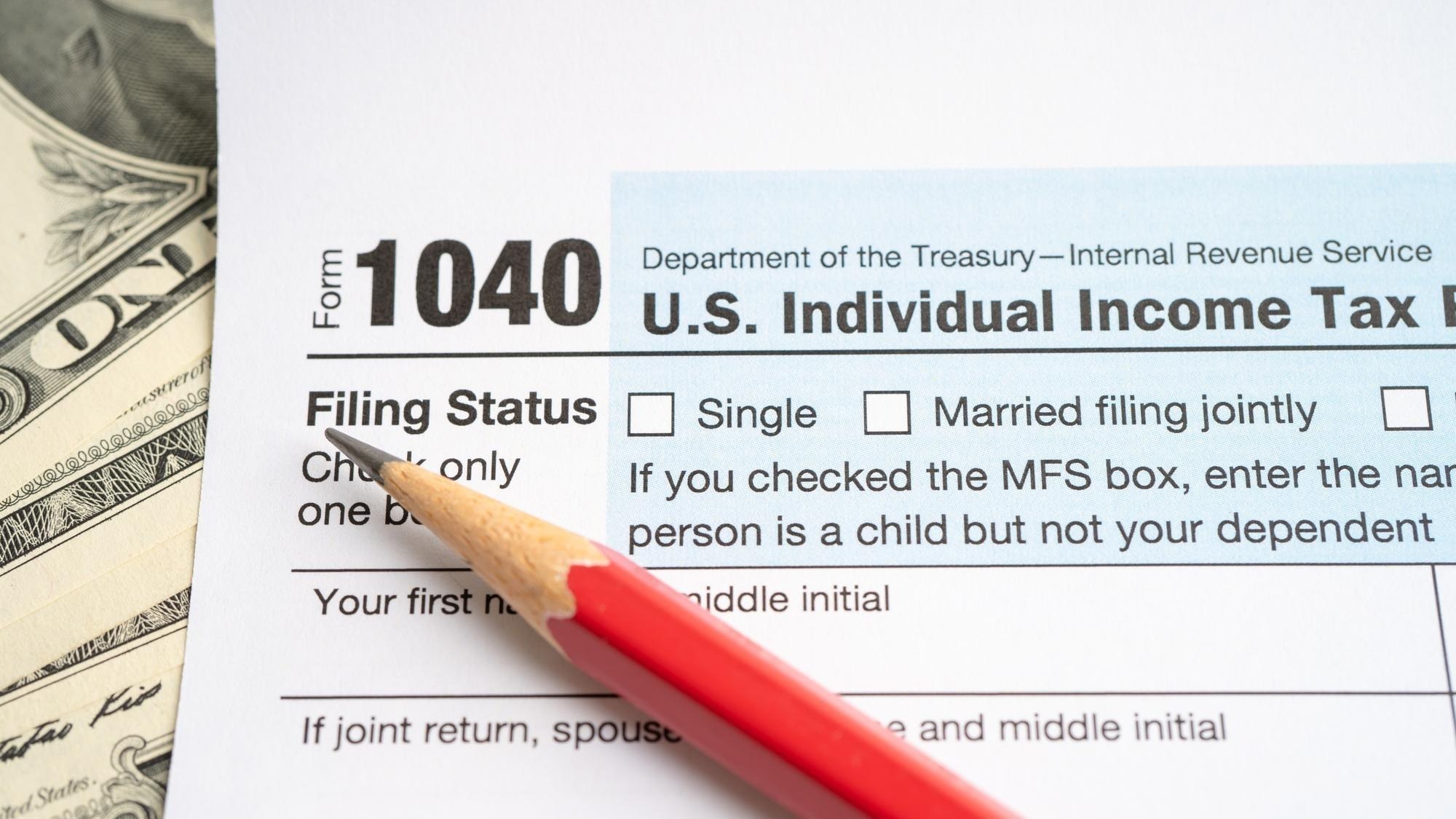
A bill introduced in the Senate this spring would send a $1,200 rebate to married couples filing jointly with income at or under $180,000, with an additional $600 added for every dependent child claimed on the return. Under that design, a two-parent household with two children earning under the income cap would see $2,400 combined. The money would come from tariff revenue the federal government has collected under President Trump’s trade actions, and none of it has been paid to anyone, because the bill has not become law.
The Per-Child Add-On Carries No Stated Limit
The bill, S.4093, the Tariff Refunds for Working Families Act, was introduced by Senator Martin Heinrich (D-N.M.) and eight Senate Democrats in March. Its structure, laid out in Heinrich’s own announcement of the bill, sets three base amounts: $600 for a single filer earning $90,000 or less, $600 for a head-of-household filer earning $120,000 or less, and $1,200 for a married couple filing jointly earning $180,000 or less. On top of any of those three base amounts, the bill adds $600 for every dependent child claimed on the return, with no ceiling on the number of children stated anywhere in the sponsor’s public materials. Heinrich’s office illustrates the math with a family of four — two parents filing jointly with two children, earning under the $180,000 cap — arriving at $2,400. Run the same formula for a household with four children instead of two, and the total would climb to $3,600 before anything else about the household changes. Nothing in the bill’s public summary suggests that multiplier has a stopping point, and whether a cap would be added during a future committee markup is unknown, because the bill has not reached that stage.
Free retirement updates: Keep more of your Social Security and savings with plain-English updates on the changes, deadlines, and costly mistakes retirees miss. Subscribe free.
Income Ceilings Are Written as Cutoffs, Not a Sliding Scale
Every income figure in Heinrich’s summary is phrased the same way: a filer qualifies if earnings are “$X or less.” That phrasing points toward a flat cutoff rather than the gradual, income-based taper used in some earlier federal rebates, where the payment shrinks progressively above a threshold instead of disappearing all at once. Under a flat-cutoff reading, a joint-filing household earning $180,000 would qualify for the full $1,200 plus any child add-ons, while a household earning slightly more would not clearly qualify for anything under the language the sponsor’s office has released. The full statutory text on Congress.gov is the place to confirm whether a phase-out formula narrows that edge before the amount disappears entirely; the sponsor’s public materials describe only the threshold, not a taper.
The Rebate Would Be Funded by the Same Tariffs That Raised Prices
S.4093 does not draw its funding from general revenue. Its stated purpose is to use money collected from tariffs the bill’s sponsors call unlawful — including duties imposed under the International Emergency Economic Powers Act — to pay for the rebate. Heinrich’s office, citing a Joint Economic Committee analysis, says those tariffs have already cost the average American family more than $1,700 in higher prices, and New Mexico families specifically an average of $1,355. The design ties the rebate’s dollar amount to the same trade policy that drove the cost increase in the first place: if tariff collections were to fall, so would the pool of money the bill designates to pay households back. The bill’s announcement came roughly two weeks after the Supreme Court struck down several of the administration’s broadest tariffs as unconstitutional, a ruling the sponsor’s release points to directly as the backdrop for the legislation.
A Retired Couple With No Dependent Children Would Land at the Base Amount
For retirees, the dependent-child add-on mostly will not apply. A retired married couple filing jointly with no dependent children and income at or under $180,000 would be eligible for the base $1,200 — no multiplier, no bonus. A single retiree under the $90,000 threshold would be eligible for $600, and a retiree filing as head of household under $120,000 would also be eligible for $600. Those figures describe eligibility under the bill’s own thresholds, not a payment anyone is currently entitled to, since the bill has not passed.
A harder question hangs over retirees whose income comes mostly from Social Security. Many of them fall below the federal filing threshold and do not file a tax return in a typical year. Because S.4093 is structured as a tax rebate, how — or whether — a non-filing retiree would claim it is not addressed in the bill’s public summary, one-pager, or FAQ document released alongside it. That is a mechanical detail with real consequences for exactly the households this bill’s title targets, and it remains unanswered in the materials available so far.
The Bill Has Not Moved Since Its March Referral to the Finance Committee
S.4093 was introduced on March 12, 2026, read twice, and referred to the Senate Committee on Finance, according to the bill’s official action record on Congress.gov. That record shows no committee hearing, no markup, and no scheduled floor vote — the standard next steps a bill needs before it can reach a vote. Independent tracking from GovTrack similarly places the bill in the earliest stage of the legislative process, the point where most introduced bills stall rather than advance. None of that means the idea is dead — cosponsors could still push for a hearing, and the same arithmetic could resurface in a future bill — but as of today, the $1,200-plus-$600-per-child rebate exists only as introduced text sitting in committee, not as a payment any household can expect.
This article was produced with the assistance of AI and reviewed by The Financial Wire editorial team.
More Financial Reading
- The ideal retirement withdrawal rate so your savings actually last
- Adding someone to your bank account: tax traps and smart moves