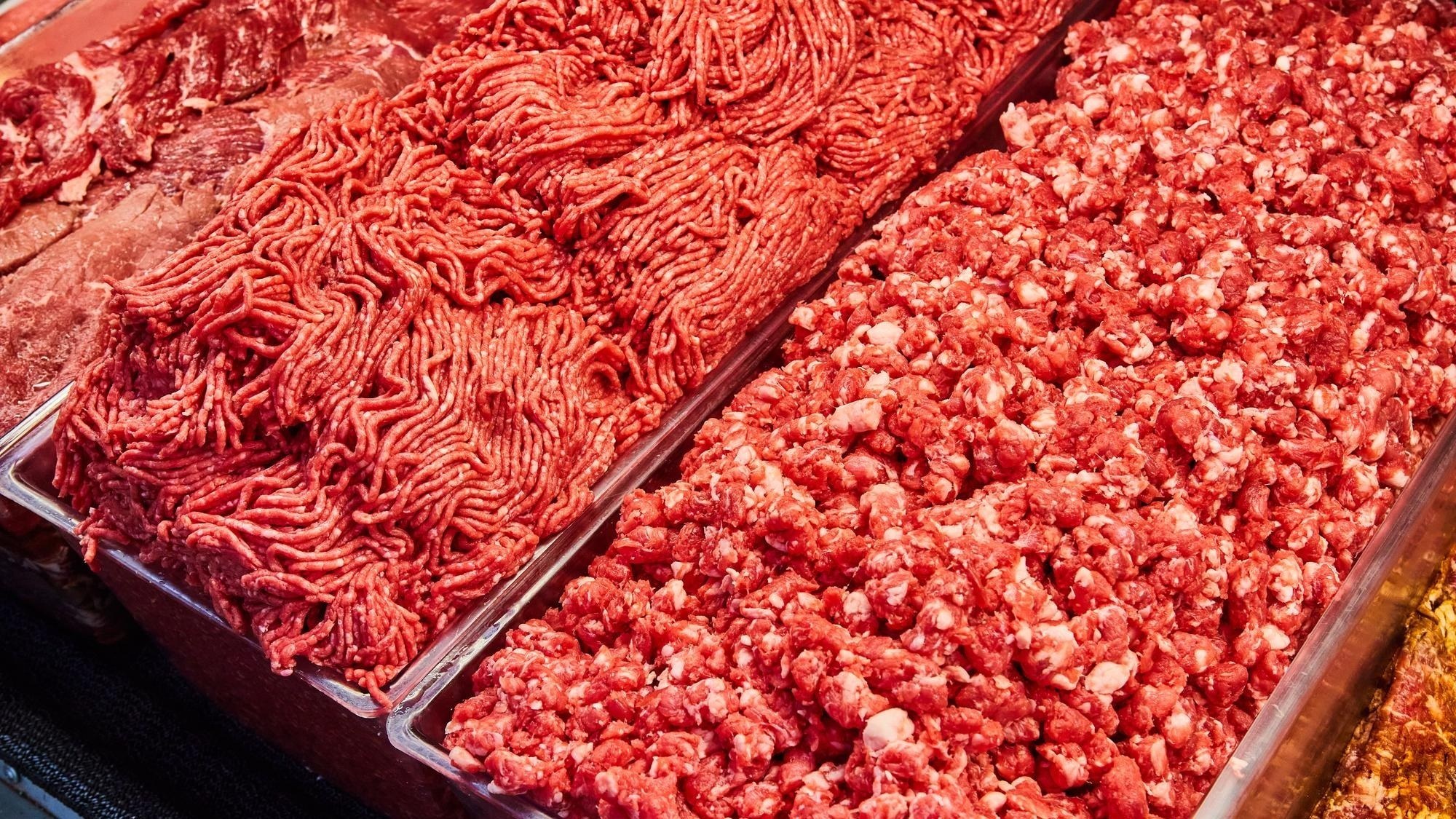
President Donald Trump has temporarily suspended the higher tariff that normally applies once imports of ground-beef trimmings exceed a country’s quota, a targeted move aimed at grocery prices that have pushed hamburger meat toward some of its highest costs in years. The change runs for a fixed window and depends on the imported beef actually reaching store shelves at a discount, so its effect on any single trip to the meat counter is not guaranteed. For a household living on a fixed Social Security check, even a temporary dip in the price of ground beef changes the math at checkout.
What the proclamation actually does
The proclamation Trump signed on August 26 temporarily raises the quantity of lean beef trimmings that can enter the country at the lower, in-quota tariff rate by 300,000 metric tons, released in three 100,000-ton blocks: the first opened September 1 and closed September 30, the second runs through the end of October, and the third opens October 31 and closes once it fills or by November 30. The additional volume is earmarked specifically for ground beef and is open to any eligible trading partner rather than a single country, moving on a first-come, first-served basis administered by U.S. Customs and Border Protection, with the U.S. Trade Representative authorized to make further technical adjustments to the tariff schedule as needed to carry it out. The proclamation text also builds in its own off-ramp: the Secretary of Agriculture and the Trade Representative are directed to monitor whether the imported trimmings are actually being sold 25 percent below the market price, and if they are not, the President may end the increased quota early rather than let it become, in the document’s own words, a \u201cwindfall to foreign producers.\u201d The action builds on a similar move in February that raised Argentina’s beef quota by 80,000 metric tons for calendar year 2026 alone; officials concluded that the additional imports since then, combined with steady demand, were not enough on their own to keep prices from staying elevated, prompting the broader August expansion open to any country rather than one trading partner. The authority for both moves comes from a 1994 trade law that lets a President temporarily expand a tariff-rate quota when domestic supply cannot meet demand at reasonable prices because of a natural disaster, disease outbreak, or major market disruption.
Free download: A seven-step ladder from rumor to payment issued, plus five yes/no tests to run before counting on any promised check. Get the free government check tracker.
Free download from RetireShield. Getting it also signs you up for the free Retirement Money Brief, a weekday email. Unsubscribe anytime.
Why the price of hamburger climbed this high
The proclamation lays out the supply problem behind the move: the U.S. cattle herd has fallen to its smallest size in 75 years, required closures of southern ports to live cattle from Mexico to stop the spread of New World Screwworm have cut into domestic beef production, and drought and wildfire have squeezed grazing land and feed supplies in cattle country. The accompanying fact sheet puts a number on the shortfall: the Department of Agriculture forecasts total U.S. beef output will fall roughly 4 percent below 2025 levels this year, even as Americans, who eat more beef per person than nearly any other country, keep demand high. The herd showed early signs of growth beginning in July, but the administration’s own estimate is that the expanded quota will add back only about 10 percent of current production forecasts, an amount officials say will compete mainly with cull cow markets rather than the fed cattle market that supplies most steaks and roasts.
Ranchers say the fix comes at their expense
Announcing the shift in a Truth Social post ahead of the formal proclamation, Trump said the arrangement would \u201creduce prices for Americans while giving space for our Great American Beef Herd to grow again,\u201d according to trade coverage from Drovers. The plan has nonetheless drawn direct pushback from parts of the cattle industry it is meant to help. National Cattlemen’s Beef Association CEO Colin Woodall warned that \u201cflooding the market with government-subsidized, below-market beef is not the way to rebuild the American cattle herd,\u201d and United States Cattlemen’s Association President Justin Tupper argued the move \u201csidelines U.S. producers\u201d just as herds are trying to recover. Iowa Cattlemen’s Association President Craig Moss said the announcement itself moved markets before any beef had crossed a border, pointing to feeder-cattle futures that had already shed more than $20 per hundredweight in the weeks before the proclamation was signed. One cattle-market analyst quoted in the same coverage estimated that the additional 300,000 metric tons works out to roughly 44 days’ worth of total U.S. ground beef consumption, a rough measure of how large a dent the temporary imports represent against ordinary demand. That price swing landed at a sensitive moment: late summer and early fall is when ranchers typically decide how many females to keep for breeding rather than sell, a decision that shapes the size of the domestic herd for years. Whether the 90-day window ends up lowering supermarket prices, discouraging that herd rebuild, or some of both, is the trade-off the administration built its own monitoring and cutoff authority to manage.
Where a 90-day price fix leaves a fixed budget exposed
The tariff pause targets one aisle, for a limited window, and only if the promised discount actually reaches the shelf. It does nothing for the dozens of other costs that already crowd a Social Security check, from prescription copays to property tax to utility bills, and many of the programs built to offset those costs go unclaimed simply because no one has ever laid them out in one place.
It is the 69-page guide with 11 benefit programs and the 2026 income limits.
See the full list of programs and 2026 income limits in The Benefits Checklist.
This article was researched and drafted with the help of AI and reviewed by The Financial Wire editorial team before publication.