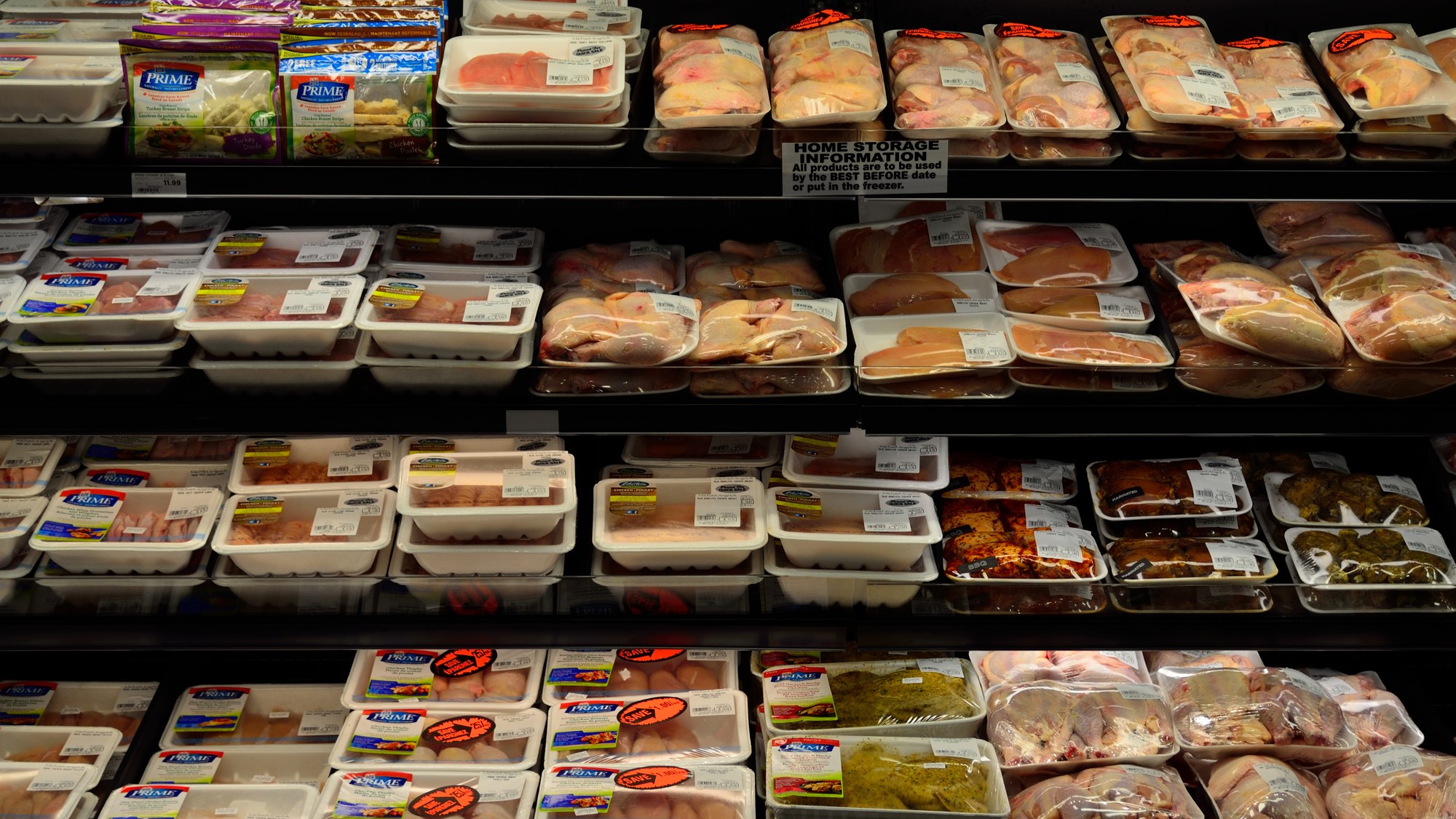
Beef is on track for a 9.4% price jump in 2026, but chicken and pork are barely moving. The U.S. Department of Agriculture forecasts poultry prices to rise 1.0% this year and pork prices 1.2%, according to the September Food Price Outlook that its Economic Research Service released Sept. 25. Dairy is forecast up just 0.1% and eggs down 29.4%. The forecasts put nearly all of the meat aisle’s inflation in one product, beef.
Two proteins under 1.3% while beef climbs 9.4%
The ERS summary findings forecast pork up 1.2% for calendar 2026, with a prediction interval from a 0.1% decline to a 2.6% increase, and poultry up 1.0%, with an interval of 0.0% to 2.1%. Beef and veal are forecast up 9.4%, with an interval of 7.4% to 11.6%, so even the low end of the beef range is more than triple the top of the poultry range. The forecasts are for the full calendar year, which is why “this year” and 2026 mean the same thing here.
Other groceries land in between. The same release projects fresh vegetables up 5.7%, sugar and sweets up 6.6%, nonalcoholic beverages up 4.2% and fresh fruits up 2.5%. For meat-eaters, the practical gap is between what a pound of beef costs and what a pound of chicken or pork costs by the end of the year.
August shelf prices already sat below the forecast
Actual prices point the same way. The summary reports that in August pork was 0.6% higher than a year earlier and poultry 0.5% higher, against 5.9% for beef, while eggs were 23.0% lower. Both meats are therefore running below their full-year forecasts so far.
The Bureau of Labor Statistics gives a broader reading in its August consumer price index release, published Sept. 11. The combined index for meats, poultry, fish and eggs rose 0.1% over the month, as the eggs index rose 2.9%, and increased 1.1% over the last 12 months. Overall consumer prices were up 3.4% from a year earlier before seasonal adjustment, so the protein aisle is inflating much more slowly than the economy as a whole.
Poultry is the largest share of American meat eating
The ERS poultry and eggs page says the United States is the world’s largest producer and second-largest exporter of poultry meat. In 2024, poultry accounted for over half of total meat consumption, representing 51% of total red meat and poultry disappearance, and about 13.6% of poultry meat produced was exported. Because poultry makes up that large a slice of the meat Americans eat, a 1.0% forecast matters more to a grocery budget than a small percentage on a niche item would.
The page lists ERS’s Livestock, Dairy, and Poultry Outlook for September 2026, dated Sept. 17, as the latest monthly analysis. Poultry and egg producers are described there as major consumers of feed grains, one of the links between crop markets and the price of a chicken breast.
Pork prices depend on export markets and a concentrated industry
The ERS hogs and pork page describes the United States as the world’s third-largest producer and consumer of pork and pork products. Since 2011, exports have consistently averaged over 20% of commercial pork production, and production is heavily concentrated in the Midwest and eastern North Carolina. The page also points to ERS’s Meat Price Spreads dataset, which tracks average price values, and the differences among them, at the farm, wholesale and retail stages.
The dataset reports prices at each of those three stages and the gaps between them, which is how ERS shows how much of a retail pork price is farm price and how much is what is added afterward. ERS says its outlook, including the 1.2% pork forecast, is built from the most recent BLS consumer and producer price index data, the latter covering farm-level and wholesale food markets.
What a 1.0% chicken forecast means beside a 2.8% raise
For older households, the useful yardstick is the Social Security cost-of-living adjustment. Benefits rose 2.8% under the most recent cost-of-living adjustment, which the Social Security Administration’s COLA page shows took effect in December 2025 for both Social Security and SSI. Set against it, the 2026 forecasts for poultry, 1.0%, and pork, 1.2%, sit well below the adjustment, while beef, at 9.4%, sits far above it. A household that shifts a share of its beef purchases to chicken or pork would see its meat costs grow more slowly than benefits, though the adjustment itself is tied to a broad index rather than to any grocery basket.
ERS typically releases its monthly forecast updates on the 25th, and its Food Price Outlook page lists the next one as Oct. 23, 2026. The September summary lists Hayden Stewart, Diansheng Dong and Wilson Sinclair as contacts for the outlook, and it notes that the forecasts come from statistical models fitted to recent trends in the data.
Heating, cooling and repair help for older homeowners
Older homeowners carry costs that a food forecast never touches, such as a property-tax bill, a heating or cooling bill and a repair to the house. Help exists for each of them, and most of it has to be applied for.
The Senior Property Tax & Home-Cost Relief Kit covers heating, cooling and home-repair help and the circuit-breaker credit that includes renters.
Open The Senior Property Tax & Home-Cost Relief Kit to compare those programs.
This article was produced with AI assistance and checked against the primary sources linked above.