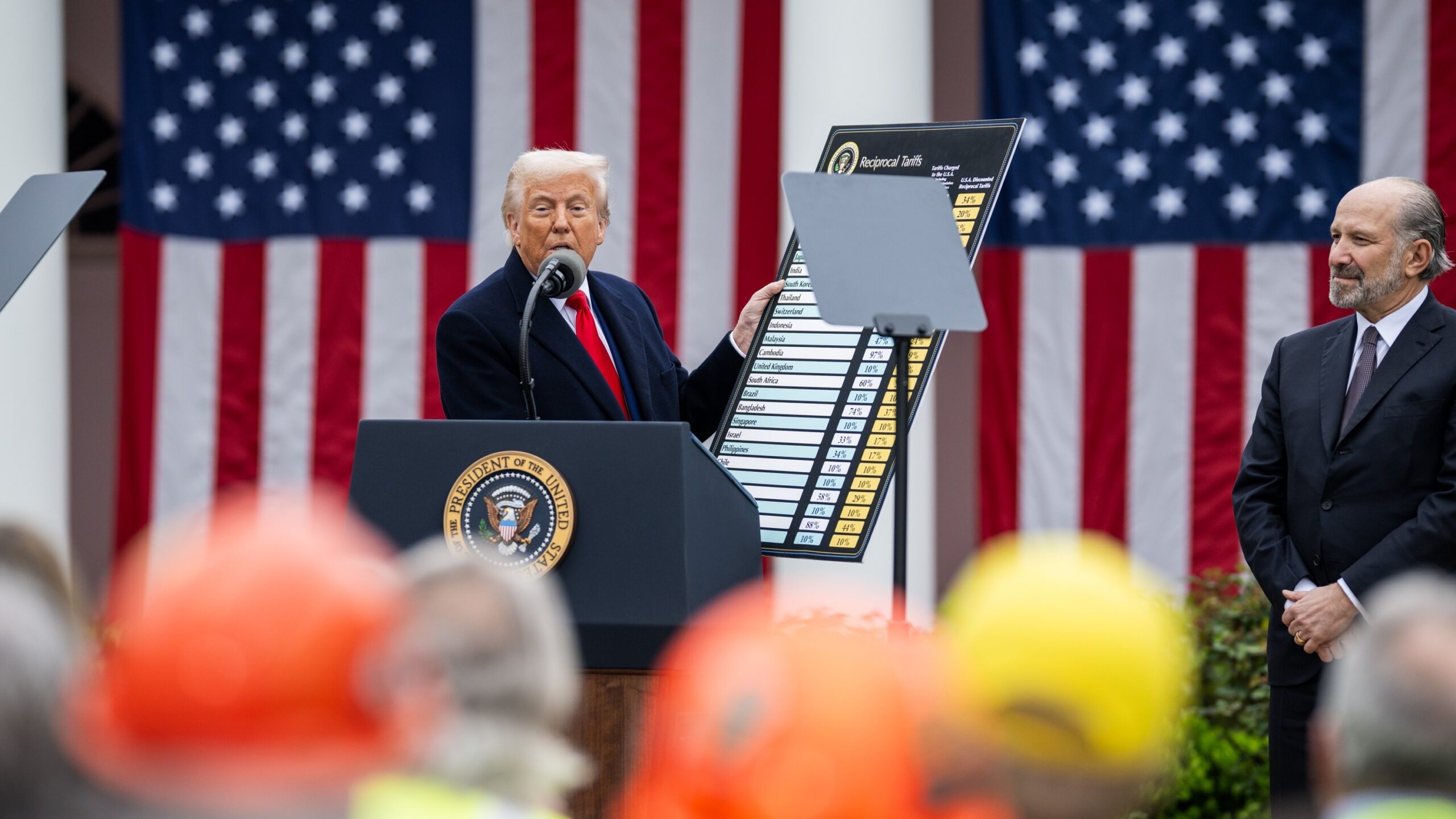
A new washing machine costs more this spring. So does a car, a laptop, and the copper wiring inside a house under construction. The reason traces back to a series of tariff actions that, taken together, now represent the largest effective tax increase on American households since President Clinton signed the Omnibus Budget Reconciliation Act in 1993.
The cumulative hit: roughly $1,500 in additional annual costs for the average U.S. household in 2026, according to the Budget Lab at Yale, which tracks effective tariff rates and models household-cost ranges. A separate analysis from the Penn Wharton Budget Model reaches a similar conclusion about the scale of the increase, calculating that effective tariff rates have surged far beyond their pre-2018 baseline.
That $1,500 does not appear as a line item on anyone’s tax return. It materializes at the register, scattered across dozens of purchases over the course of a year, which is part of what makes it easy to miss and politically difficult to reverse.
How the tariffs stacked up
The current tariff regime did not arrive in a single executive order. It accumulated through a sequence of presidential actions, each expanding the range of imported goods subject to higher duties.
In February 2025, the White House issued a proclamation restoring and broadening Section 232 tariffs on steel, reversing country-specific exclusions that had softened the original 2018 duties. A companion action extended the same national-security rationale to copper, a metal embedded in construction, electronics, and electric-vehicle production.
A subsequent presidential order targeted semiconductors, chip-manufacturing equipment, and derivative products. Because semiconductors sit at the base of nearly every modern supply chain, from smartphones to medical devices to automobiles, this action pushed tariff exposure deep into consumer markets.
By spring 2026, the U.S. Trade Representative had opened Section 301 investigations into structural overcapacity abroad, a procedural step that typically precedes additional duties. Those probes cover a broad range of industrial inputs and could result in new tariffs, negotiated settlements, or both, though Section 301 cases generally take six to twelve months to conclude.
Why the costs cascade
Tariffs on finished consumer goods, like a specific model of television, tend to raise the price of that one product. Tariffs on intermediate inputs, like steel, copper, and chips, work differently. They increase costs at multiple stages of production before a product ever reaches a store shelf.
A tariff on imported steel raises costs for the manufacturer that stamps car-body panels, the company that assembles the vehicle, and the dealer that sells it. Each link in the chain absorbs some of the increase and passes the rest forward. By the time a consumer signs the purchase agreement, the original tariff has been compounded through several markups.
This cascading effect is central to why the Yale and Penn Wharton models produce such large household-cost estimates. The current tariff regime is concentrated on exactly the kinds of goods (metals, minerals, and semiconductors) that feed into the widest range of downstream products.
The 1993 comparison, unpacked
The comparison to the 1993 tax law is striking but requires some context. The Omnibus Budget Reconciliation Act raised income-tax rates on high earners, increased the gas tax, and expanded the earned income tax credit. The Congressional Budget Office scored it at roughly $240 billion in new revenue over five years. Until the current tariff buildup, it stood as the benchmark for the largest federal tax increase in a generation.
Tariffs are not income taxes, and the comparison is not perfectly apples-to-apples. Income-tax increases are progressive by design, hitting higher earners harder. Tariffs function more like a consumption tax: they fall most heavily on households that spend a larger share of their income on goods, which tends to mean lower- and middle-income families. Economists at both Yale and Penn Wharton have flagged this distributional difference, noting that the burden of the current tariff regime is more regressive than a statutory tax hike of equivalent size.
The counterargument from tariff supporters
Supporters of the tariffs argue that the revenue comparison misses the point. The stated goal is not to raise taxes but to protect domestic industry, rebuild supply chains, and pressure trading partners into better deals. If tariffs succeed in expanding U.S. manufacturing employment and output, some of the household cost could be offset by higher wages and greater economic activity over time. How large that offset proves to be is one of the most contested questions in trade economics right now.
What the models cannot yet capture
Neither Yale nor Penn Wharton claims precision down to the dollar. The $1,500 figure reflects a modeled range, not a census of actual household spending. Several factors could push the real number higher or lower in the months ahead.
On the side of lower costs: companies may shift sourcing to countries not covered by the new duties, redesign products to use fewer targeted inputs, or accelerate investment in domestic alternatives. If those adjustments happen quickly, the long-run burden on households could ease.
On the side of higher costs: trading partners may retaliate with their own tariffs on U.S. exports, shrinking markets for American farmers and manufacturers. The Section 301 investigations could produce additional rounds of duties. And the Penn Wharton model may not yet fully reflect the impact of the most recent semiconductor-related tariff actions, meaning its estimates could understate the current effective tariff rate.
The White House has not published its own projection of household-level costs. Without an official government estimate, the Yale and Penn Wharton figures remain the most widely cited benchmarks, but they are institutional models, not settled facts.
Three trade-policy signals that will shape household costs this summer
Three developments will determine whether the $1,500 estimate holds, shrinks, or grows.
The Section 301 outcomes. If the USTR imposes broad new duties on industrial inputs, the effective tariff rate will climb again, and household costs with it. If the investigations end in negotiated agreements rather than new tariffs, the pressure could stabilize.
The pace of supply-chain adjustment. Early signals from manufacturers suggest that reshoring semiconductor and metals sourcing is a multiyear process, not a quick pivot. The longer companies remain dependent on tariffed imports, the longer elevated costs persist at the consumer level.
Retaliation from trading partners. Retaliatory tariffs on U.S. agricultural and manufactured exports could compound the domestic cost by reducing demand for American goods abroad, putting pressure on jobs and incomes in export-dependent regions.
For now, the math is straightforward even if the politics are not. Tariffs on steel, copper, and semiconductors have raised the effective tax rate on imports to levels not seen in decades. Independent models estimate that the typical American family is absorbing roughly $1,500 a year in higher costs as a result. Whether that number becomes a temporary adjustment or a permanent feature of the U.S. economy depends on decisions that have not yet been made.