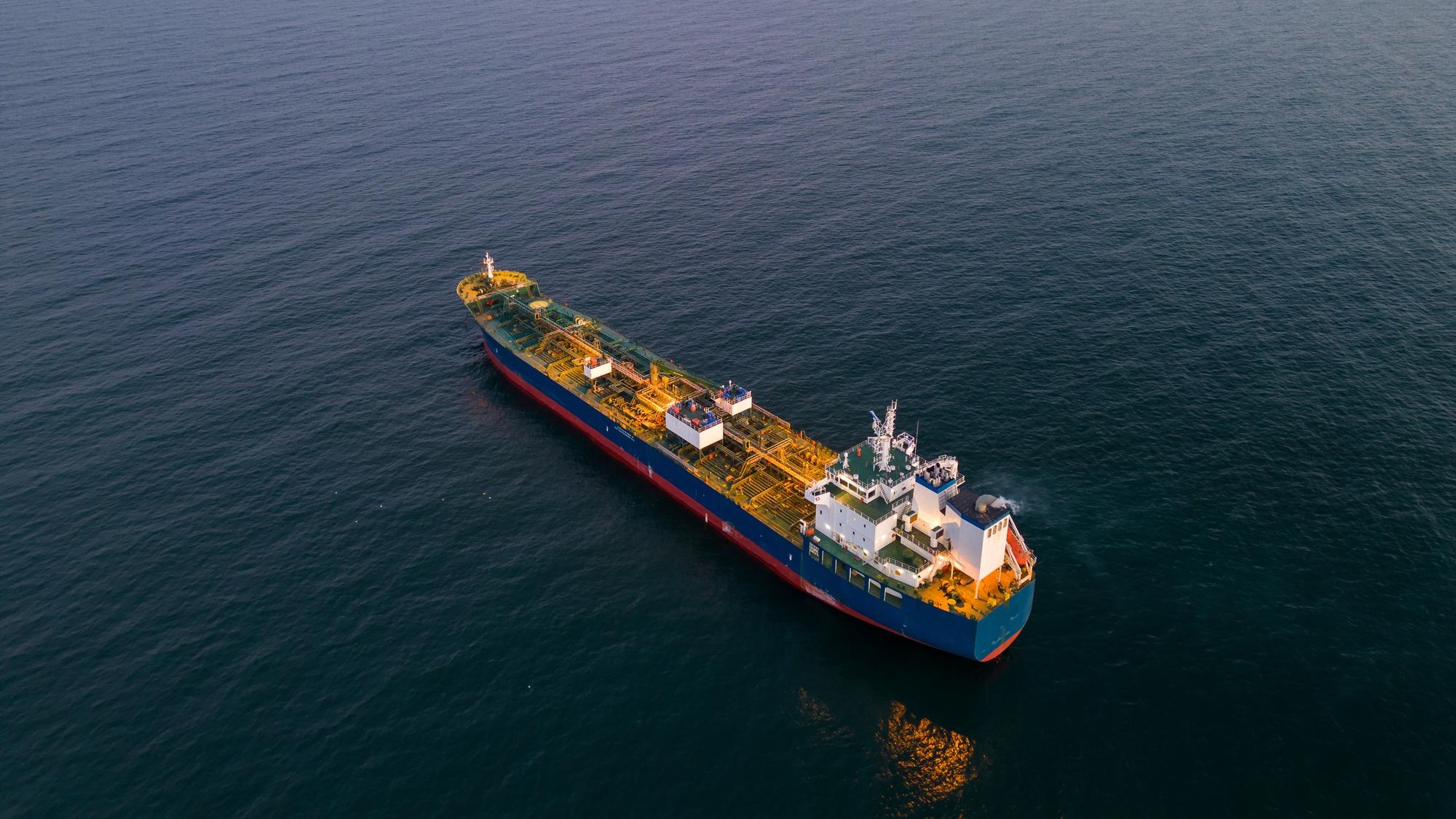
Fourteen sailors were treading water off the coast of Oman on May 14 when the Omani Coast Guard reached them. Their cargo ship, the Indian-flagged Haji Ali, had gone down in the Gulf of Oman during a routine transit from Somalia to Sharjah. Hours earlier and roughly 200 miles to the northwest, a separate commercial vessel was seized near the United Arab Emirates coast and forced toward Iranian waters. By the time both events registered on trading screens, Brent crude had surged roughly 4% to about $105 a barrel, and President Trump was on Fox News warning Tehran directly: “I’m losing patience,” he said. “I’m not going to be much more patient.”
The back-to-back disruptions struck at the most sensitive chokepoint in global energy: the Strait of Hormuz, the narrow waterway between Iran and the Arabian Peninsula through which roughly 20% of the world’s traded oil moves each day, according to the U.S. Energy Information Administration. For traders, insurers, and governments, any threat to traffic there registers immediately in price.
Two incidents, one volatile day
The United Kingdom Maritime Trade Operations (UKMTO), the Royal Navy’s real-time reporting arm for commercial shipping in the Gulf, issued an alert that a vessel had been seized off Fujairah and was being directed toward Iranian waters. UKMTO did not identify the ship’s flag, cargo, or crew. As of May 15, Iran’s government had not issued any public statement explaining the seizure.
The move fits a pattern. Iran’s Islamic Revolutionary Guard Corps (IRGC) Navy has seized foreign-flagged commercial vessels in or near the strait multiple times in recent years, including the British-flagged tanker Stena Impero in July 2019 and the Marshall Islands-flagged Advantage Sweet in April 2023. In each case, Tehran initially offered little public explanation before later citing alleged maritime violations or legal disputes.
Separately, the Haji Ali sank while transiting from Somalia to Sharjah. The Omani Coast Guard rescued all 14 crew members and brought them safely to shore. India’s shipping ministry condemned the sinking as an attack and lodged a formal protest, according to Bloomberg. The ministry stopped short of publicly naming a perpetrator, and no official forensic account has established whether the Haji Ali was struck by a projectile, hit by a drone, or suffered some other form of external damage.
Whether the two events were coordinated remains an open question. Their proximity in time and geography echoes June 2019, when two tankers were attacked in the Gulf of Oman within hours of each other. The United States attributed that episode to Iran; Tehran denied involvement. No intelligence assessment or official finding has yet linked the May 2026 incidents to a single operational order.
Trump’s warning and the Beijing backdrop
Trump’s remarks on Fox News framed the incidents as part of what he described as a broader pattern of Iranian provocation. His language, reported by Reuters, marked a notable escalation in tone from the diplomatic-pressure framing the White House had maintained during months of stalled nuclear negotiations with Tehran.
The timing added a layer of complexity. Trump made the comments as he prepared to travel to Beijing for a summit with Chinese President Xi Jinping, where Hormuz security and Iranian oil exports are expected to be central topics. In earlier remarks, Trump downplayed differences with Xi over Iran, suggesting Washington and Beijing share an interest in keeping the strait open given China’s heavy dependence on Gulf crude. He did not outline specific joint measures, but the convergence of a maritime crisis and a superpower summit in the same week illustrates how quickly shipping incidents can climb from naval risk logs to the top of diplomatic agendas.
Why markets reacted so sharply
A 4% single-session jump in oil is significant but not unprecedented for Hormuz-related scares. The combination of a physical seizure and a sinking on the same day amplified anxiety beyond what either event alone would have triggered, particularly with OPEC+ already holding production below capacity and global spare supply cushions thinner than they were a year ago.
The market mechanics are well established: when vessels are seized or damaged near the strait, war-risk insurance premiums spike, shipping companies reroute or delay cargoes, and the effective supply of oil tightens even before a single barrel is actually lost. That dynamic played out in 2019 and again during Houthi attacks on Red Sea shipping in 2024. Each episode reinforced a lesson traders have internalized: the threat of disruption near Hormuz can move prices almost as powerfully as actual supply cuts.
The U.S. Fifth Fleet, headquartered in Bahrain, has not publicly announced any change in its force posture in response to the May 14 incidents. Whether Washington moves additional naval assets into the strait, as it did during the 2019 tanker crisis and the 2024 Red Sea campaign, could shape both the security picture and the market’s next move.
What comes next depends on Beijing and Tehran
Key facts are still missing. The identity and flag state of the seized vessel remain undisclosed. Iran has not explained its rationale. The forensic details of the Haji Ali sinking are incomplete. Until investigators fill those gaps, governments and markets are operating on partial information, a condition that tends to keep risk premiums elevated and diplomatic rhetoric heated.
The Beijing summit will offer the first major test of whether the crisis accelerates or cools. If Trump and Xi announce coordinated steps to protect Gulf shipping, markets could stabilize quickly. If the summit produces only vague assurances while Iran remains silent, the price of oil will continue to reflect the uncertainty. For the 14 sailors pulled from the water off Oman, the crisis is already deeply personal. For everyone else, it is a reminder that the narrowest stretch of water in the Persian Gulf still holds outsized power over the global economy.