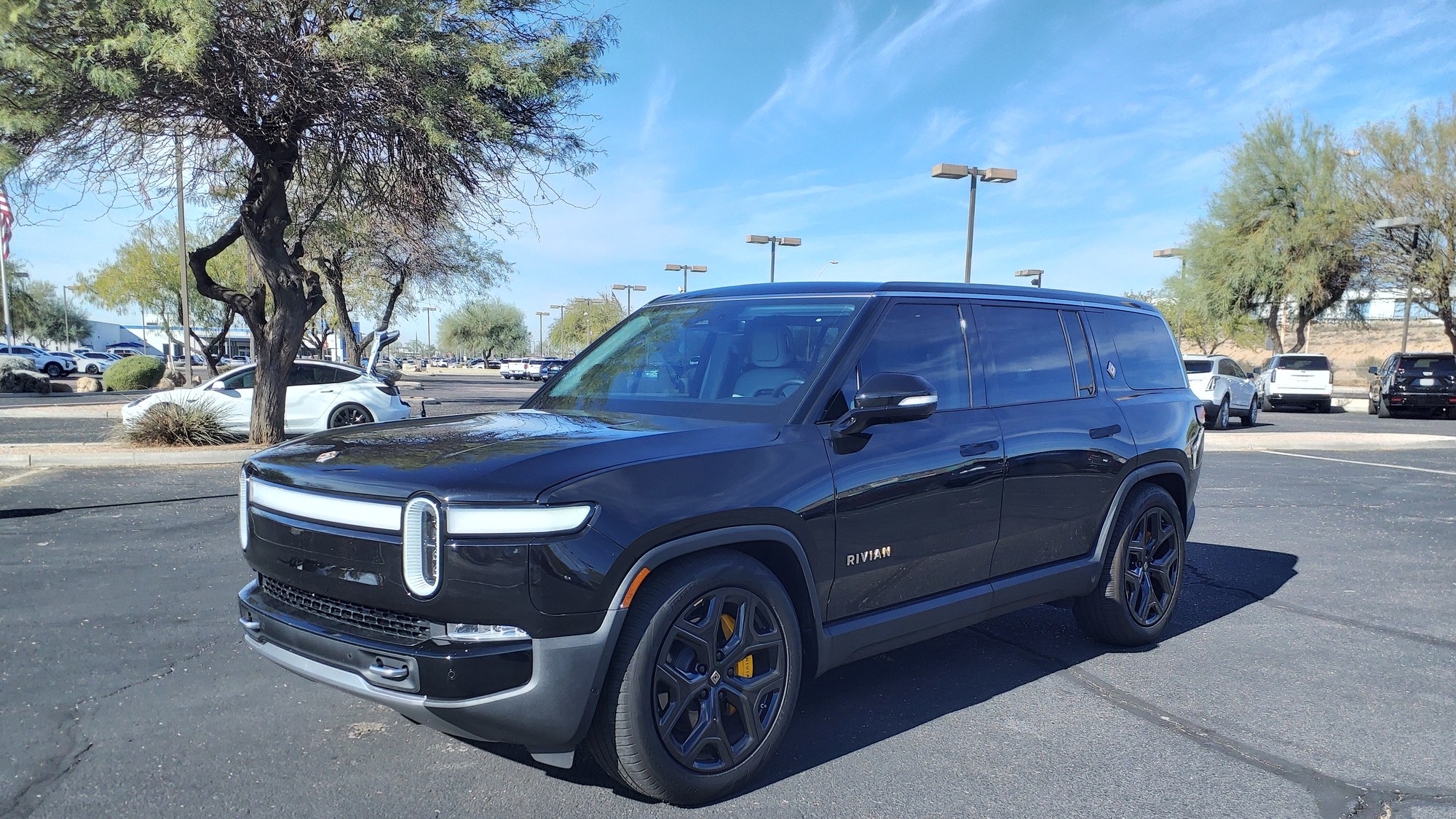
Rivian has told federal safety regulators it is recalling 98,828 vehicles because a software notification can sit over the backup camera image at the exact moment a driver needs to see behind the vehicle. The recall, filed with the National Highway Traffic Safety Administration as campaign 26V597, spans 62,259 R1S SUVs, 34,088 R1T pickups and 2,481 R2 crossovers. Rivian is closing the defect with a free over-the-air update rather than a service appointment, and any owner who has not already received it is due a formal notification letter by November 9.
What no genuine recall text asks for: Rivian never requests payment or login details for this fix, and The Senior Fraud Defense & First-Hour Recovery Kit’s caller-verification steps and family code word cover that kind of contact. Confirm a recall contact is really Rivian →
What NHTSA’s Recall Record Says Went Wrong
Rivian’s own Part 573 defect report filed with NHTSA describes a narrow, specific sequence rather than a constant malfunction: a drive-mode notification can overlap the rearview camera image when the vehicle shifts into reverse, and “in certain rare circumstances” that overlap keeps the camera from displaying for the length of time federal rules require. NHTSA’s own recall summary for campaign 26V597 ties that gap directly to Federal Motor Vehicle Safety Standard 111, the rear-visibility rule, and states plainly that “a rear-view image that does not display at the start of a backing event may increase the risk of a crash.” Rivian reached that conclusion internally on September 10, 2026, when it “determined that a potential noncompliance to FMVSS 111, Rear Visibility cannot be ruled out,” according to its own filing.
Three Different Rivians, One Shared Notification
The recall population is not concentrated in a single model. Rivian’s Part 573 filing puts 62,259 R1S SUVs built between March 30, 2022 and August 6, 2026 and 34,088 R1T pickups built between August 23, 2021 and July 6, 2026 in the campaign, alongside 2,481 R2 crossovers built between April 23 and August 10, 2026. That spread means a notification bug in shared vehicle software reached Rivian’s oldest production line and its newest one at the same time, rather than surfacing as a defect isolated to one platform or a single model year.
A Fix Most Owners Never Had To Drive In For
Rivian is not asking owners to schedule a dealer or service-center visit. The company’s Part 573 report states the over-the-air correction “is already available” and that more than 95 percent of the affected fleet had it installed before the recall was even filed with NHTSA. For an owner checking their own vehicle, the practical test is simple: if the software has already updated on its own, the notification-and-camera conflict is already closed, and nothing further is owed on the recall itself, financially or otherwise.
Why The November 9 Letter Still Goes Out
Even with most vehicles already patched, NHTSA’s recall record lists a formal owner-notification window of November 9, 2026, run as a single “phased recall” mailing rather than a rolling schedule spread across months. Federal recall rules treat the letter as its own obligation, separate from the software fix, because not every registered owner is guaranteed to have a vehicle connected and pulling updates on a given day, and a mailed notice is the backstop that reaches someone regardless of that. The letter also creates a paper record that the vehicle was formally recalled, which matters later if an owner ever sells the vehicle or needs to show a buyer that an open safety campaign was closed. Anyone who owns one of the 98,828 recalled vehicles and has not seen an update prompt by early November should expect that letter, not a phone call or a text, as Rivian’s next contact about campaign 26V597.
Checking A VIN Without Waiting For The Mail
An owner does not have to wait for November 9 to find out whether a specific vehicle is included. NHTSA’s own recalls page runs a public VIN lookup that the agency describes plainly: “When searching by license plate or VIN, you’ll learn if a specific vehicle needs to be repaired as part of a recall.” The 17-character VIN sits on the lower left of the windshield, on the vehicle’s registration card and often on an insurance card, and the same tool lets someone check up to 100 VINs at once, which is useful for a household or a small fleet checking more than one vehicle against campaign 26V597 in a single search rather than waiting on separate letters.
What A Free Recall Is Actually Worth
There is no invoice attached to this campaign. NHTSA’s own recall summary lists Rivian’s remedy as “an over-the-air (OTA) software update, free of charge,” the same language the agency requires on every safety recall regardless of manufacturer. A comparable camera or sensor repair paid out of pocket, outside a recall, can run into hundreds of dollars in parts and labor at an independent shop, which is part of why campaign 26V597 is worth confirming rather than ignoring even after the software has already updated itself. That free-of-charge status is also the detail worth remembering the next time a message references a Rivian recall and asks for a fee, a gift card number or an account login to “process” the repair: a legitimate recall carries no price, and Rivian’s own Part 573 filing with NHTSA remains the fastest way to check what campaign 26V597 actually requires of an owner. NHTSA’s recall summary also lists two direct verification channels for anyone unsure a contact is genuine: Rivian’s customer line at 1-888-748-4261 and NHTSA’s own vehicle safety hotline at 1-888-327-4236, both of which can confirm whether campaign 26V597 applies to a given VIN without relying on whatever number or link arrived in an unsolicited message.
The Difference Between A Recall Letter And A Recall Scam
NHTSA’s record for campaign 26V597 shows Rivian’s fix already reaching most owners as a no-cost software update pushed automatically, with a formal letter following by November 9 for anyone who has not yet received it. Nothing in that process asks an owner to click a link, read out a card number or confirm an account, which is precisely the opening a fake “recall” message tries to fill once a recall this size becomes public.
The Senior Fraud Defense & First-Hour Recovery Kit lays out the first-hour recovery plan for anything that looks like fraud and a fraud evidence and report log for saving a suspicious text or email before it gets deleted.
Compare an unexpected recall contact against the first-hour steps in The Senior Fraud Defense & First-Hour Recovery Kit.
This article was produced with AI assistance and checked against the primary sources linked above.