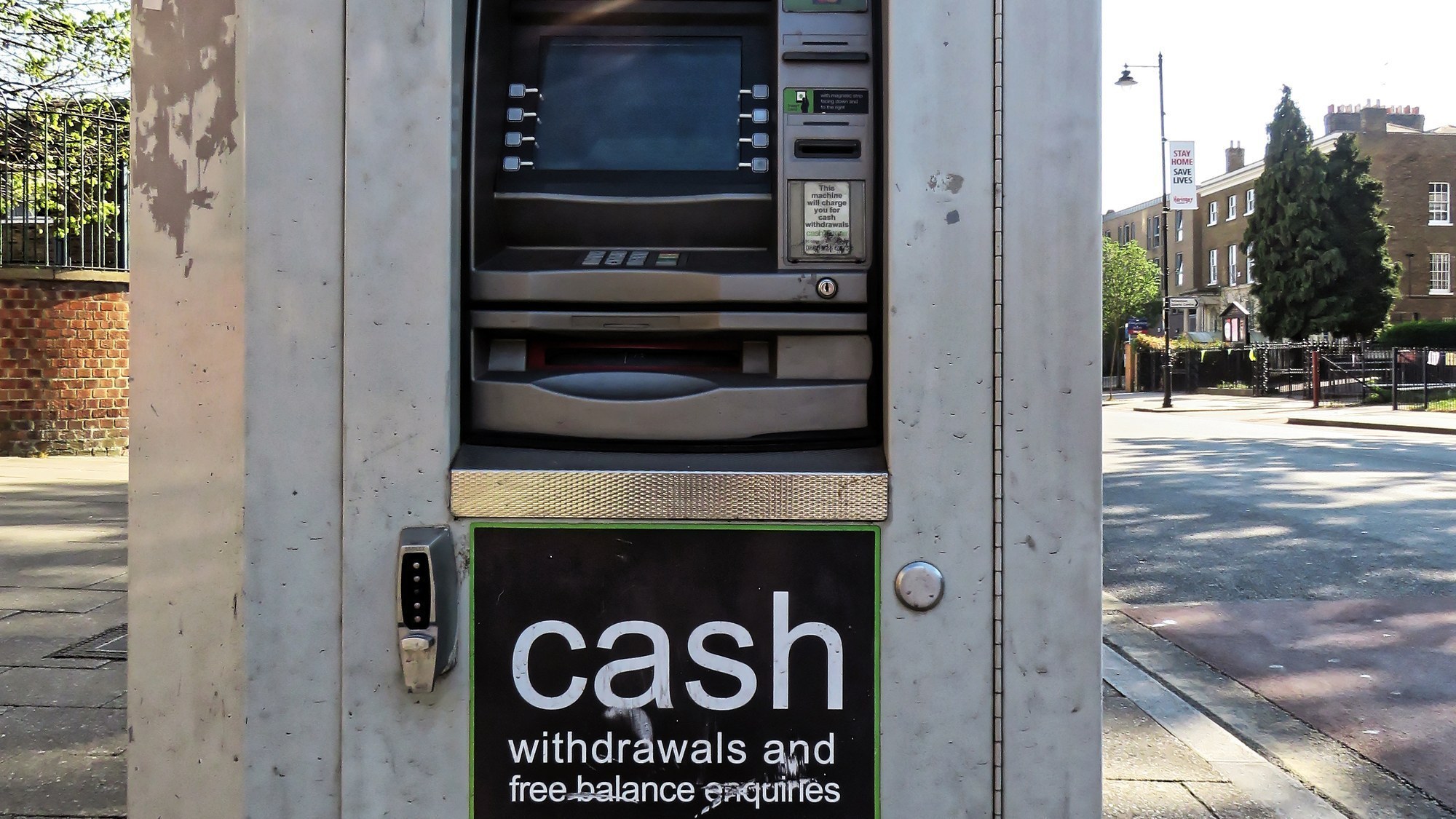
Cash or a check fed into a cash machine that belongs to another institution can sit unavailable for most of a working week. Federal Reserve Board rules for check holds, known as Regulation CC, let a bank wait until the fifth business day to release money deposited at what the rule calls a nonproprietary ATM. The same rule gives banks only two business days on many checks handed to a teller, so the machine a depositor picks changes how fast the money arrives.
The fifth business day under 12 CFR 229.12(f)
The text of 12 CFR 229.12, which the eCFR showed as current on September 29, 2026, is short on this point. Paragraph (f) says a depositary bank “shall make funds deposited in an account at a nonproprietary ATM by cash or check available for withdrawal not later than the fifth business day following the banking day on which the funds are deposited.”
Two details in that sentence matter. The first is the phrase “by cash or check.” Currency put into an out-of-network machine gets no exemption; it waits on the same schedule as a check. The second is “not later than.” Five business days is the outer limit the regulation tolerates, not a fixed wait. A bank may release funds sooner, and many do, but the rule does not oblige it to.
A simple count shows the stakes. Money deposited on a Monday banking day, with no federal holiday in the following week, can legally stay locked until the next Monday. A deposit made late on a Friday can run into the week after that, because the clock runs from the banking day on which the funds are deposited, not from the moment the machine accepts the envelope or card.
Which machines count as nonproprietary
The word “nonproprietary” is defined in 12 CFR 229.2, current as of October 1, 2026, and the definition is built by exclusion. A nonproprietary ATM, the section says, “means an ATM that is not a proprietary ATM.” A proprietary ATM is one that is owned or operated by, or operated exclusively for, the depositary bank; one located on the premises of the bank, including its outside wall; or one within 50 feet of the bank’s premises and not identified as being owned or operated by another entity.
That test is why the plain-English version of the rule needs care. A machine the bank does not own can still be proprietary if the bank operates it, runs it exclusively, or if it stands on the bank’s own wall or lobby. A machine run by a processor or a different bank, away from the depositary bank’s own premises, falls outside the proprietary definition, and a deposit there falls into the fifth-business-day category. The ownership, operation and location tests all point in the same direction: the rule follows the bank’s own network, not the logo on the card.
How the schedule compares with a teller deposit
The same section puts nonlocal checks on an identical footing. The regulation text lists nonlocal checks as “not later than the fifth business day,” so an ATM deposit is treated as if it were the slowest kind of check, whatever it contains. By contrast, the rule says a bank must make funds from a local check available “not later than the second business day.”
The fastest category is out of reach at an out-of-network machine. The next-day availability rules in 12 CFR 229.10 for categories (ii) through (v) apply only when the deposit is made in person to an employee of the depositary bank. A machine, and especially a machine run by someone else, has no such employee. Items that qualify for next-day treatment at a teller window therefore cannot rely on that treatment at a nonproprietary ATM.
Remote locations and the one-day extension
Regulation CC adds a separate allowance for Alaska, Hawaii, Puerto Rico, American Samoa, the Northern Mariana Islands, Guam and the U.S. Virgin Islands. Paragraph (e) of section 229.12 lets banks extend certain timeframes by one business day for deposits at branches in those places when the checks are drawn on banks outside the state. That wording is tied to branch deposits and out-of-state checks, and it does not by itself rewrite the nonproprietary ATM rule in paragraph (f).
What the rule leaves to each bank
Regulation CC sets maximums. It does not tell any bank to hold a deposit for the full five days, and it does not require a bank to explain the schedule at the machine. Each institution decides how much of the allowed time it will use, and that policy sits in the account agreement and the funds-availability disclosure rather than on the ATM screen. A depositor who relies on a benefit or payroll check landing for rent or a utility bill has the regulation text, not the machine, as the place where the outer limit is stated: the fifth business day following the banking day of the deposit, under paragraph (f) of 12 CFR 229.12.
Keeping a bank account protected when money is delayed
Households that depend on one checking account sometimes face a held deposit, a frozen balance or a collector’s letter in the same month. The kit is built for sorting out which protections apply to the account and what to answer first.
The Bank Account & Debt Protection Kit is a 10-page kit that covers the 2-month bank protection rule and the frozen-account response, so a reader can work through a freeze step by step.
Open The Bank Account & Debt Protection Kit for frozen-account steps →
This article was written with AI assistance and verified line by line against the primary records linked in it.