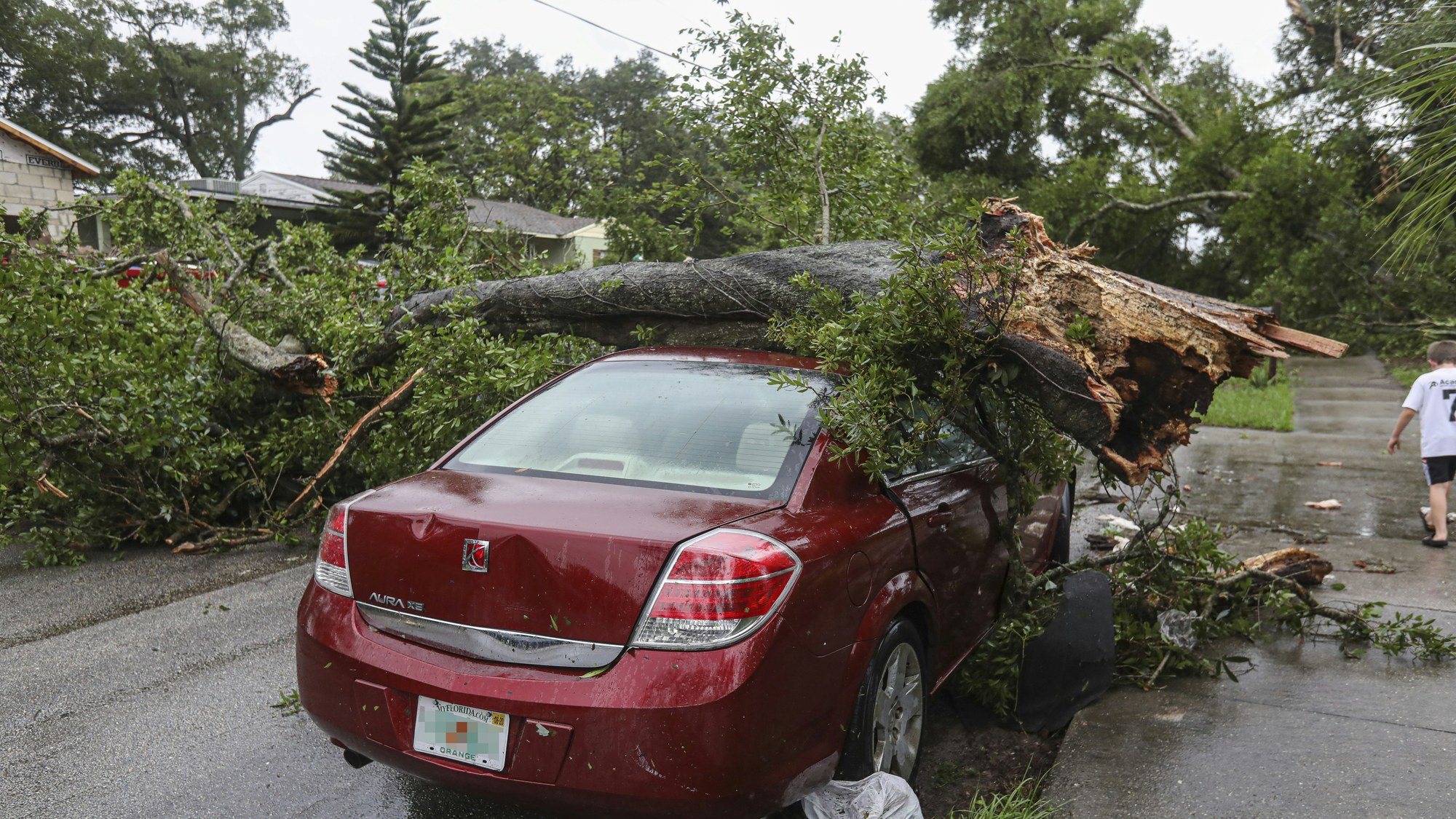
Allstate said catastrophe losses reached $1.65 billion in the third quarter, including $220 million in September. The insurer put the after-tax cost at $1.30 billion for the quarter and $173 million for the month. September was by far the mildest stretch of the summer, a point that matters for homeowners watching what their premiums do next.
A light September after two heavy months
Allstate’s October 15 monthly release gives the September estimate as $220 million before taxes. According to the insurance-linked securities site Artemis, which tallied Allstate’s monthly announcements, July cost $682 million and August $748 million. September therefore came in at roughly 30 cents for every dollar of August’s losses.
The three months add up to the $1.65 billion Allstate reported for the quarter. The spring quarter ran about the same size: April was $870 million, May $289 million and June $563 million, for $1.72 billion. The third quarter therefore came in about $70 million under the second, with the losses bunched in July and August.
Artemis counts $3.372 billion in catastrophe losses since April 1, the start of the period that matters for Allstate’s aggregate reinsurance coverage. That is the six-month total of the monthly figures. Allstate’s release does not give a figure for the full calendar year to date, and the first quarter is outside this count.
Homeowners is where the storms land
Allstate’s second-quarter results, issued August 5, show where catastrophe losses fall. Homeowners absorbed $1.41 billion of that quarter’s $1.72 billion in catastrophe losses. The company’s second-quarter total was down 13.5% from $1.99 billion a year earlier, and homeowners was down 12.8%.
Those same results show what the policyholder pays. Average gross written premium for Allstate-brand homeowners insurance rose 5.8% in the second quarter, which the company attributed to rate increases and higher home replacement costs. Premiums written in homeowners climbed 8.1% to $4.75 billion, and the line covered 7.82 million policies, up 2.9%.
What changed this year: Social Security and Medicare change every year, and nobody sends you a memo. The Retirement Money Brief breaks down what changed and what to do.
Get the Retirement Money Brief →
We may earn a commission from links on this page.
Cleaner weather did not make the underlying business cheaper to run. Allstate’s underlying combined ratio for homeowners, which strips out catastrophes and prior-year reserve changes, rose to 61.5 from 58.6 a year earlier. The company said that reflected higher loss costs. A combined ratio below 100 means an insurer earned an underwriting profit on the line.
The recorded homeowners combined ratio, which includes storms, improved 7.4 points to 94.6 from 102.0. Homeowners produced $226 million in underwriting income in the quarter, against a $76 million loss a year before. In other words, a lighter storm bill is what turned the line profitable, not cheaper repairs.
The spring quarter was a strong one on the bottom line despite the storms. Allstate reported net income applicable to common shareholders of $3.24 billion, or $12.51 a share, up from $2.08 billion a year earlier, on revenue of $18.6 billion. Adjusted net income was $2.33 billion, up 46.4%.
Auto, the larger line, moved differently from homeowners. Auto premiums written grew only 0.4% to $9.57 billion in the second quarter, and the line’s recorded combined ratio fell 2.7 points to 83.3. The company’s auto book grew to 25.95 million policies, up 2.8%, with new business up 8.8%, so price is not the lever it is in homeowners.
What Allstate has not said about the quarter
The monthly figure is an estimate. Allstate will report third-quarter earnings on November 5, and that release is where the combined ratio, reserve changes and homeowners results for July through September will appear. The monthly announcement carries no comparison with last year and no split between homeowners, auto and other lines.
The company is large enough that a single month rarely moves its finances. Allstate says it has 216 million policies in force, and the second-quarter release put its property-liability business alone at 38.9 million policies, including 25.95 million in auto. The firm returned $1.3 billion to shareholders in the second quarter, including $1.0 billion in buybacks and $280 million in dividends.
Chief executive Tom Wilson said then that Allstate “delivered strong operating and financial results in the second quarter of 2026.” That quarter carried $1.72 billion in storm losses, close to the third quarter’s $1.65 billion, so the November 5 report will show whether the same level of storms produced a similar result.
Allstate also carries catastrophe protection. Artemis reports that a $150 million Class B tranche of its Sanders Re III catastrophe bond attaches at $4.78 billion of aggregate losses and runs out at $5.28 billion, and that the company bought a new $1 billion layer of aggregate excess reinsurance attaching at $8.5 billion. Not all reported losses count toward those thresholds, Artemis notes.
That leaves the question a policyholder holds. Allstate’s $220 million September is a lull in a year of $3.37 billion in storm losses since April, and its homeowners rates rose 5.8% in the spring quarter even as claims eased. Whether a quiet month changes the next renewal notice is something Allstate has not addressed.
Is a bigger homeowners premium on your renewal notice?
Allstate’s homeowners premiums rose 5.8% on average last quarter while its storm bill fell, so a household cannot count on a quiet month to hold a renewal flat. When insurance, taxes and utilities climb together, the help that covers them has to be applied for, and each program has its own limits and phone number.
This story’s money question is a household one, which is the job The Benefits Checklist finishes. It scans 11 benefit programs retirees most often miss, including property-tax breaks and heating help, with the 2026 income limits, a 50-state phone directory and a printable application tracker for the filings.
Check 11 programs that offset rising home costs in the Benefits Checklist →
More Financial Reading
- 21 Ways to Stretch a $2,087 Social Security Check
- 15 Places to Find Your Share of the $4.25 Billion States Give Back
- 15 Ways Retirees Are Tapping a Record $14.9 Trillion in Home Equity
This article was produced with AI assistance and edited for accuracy against the sources linked above.