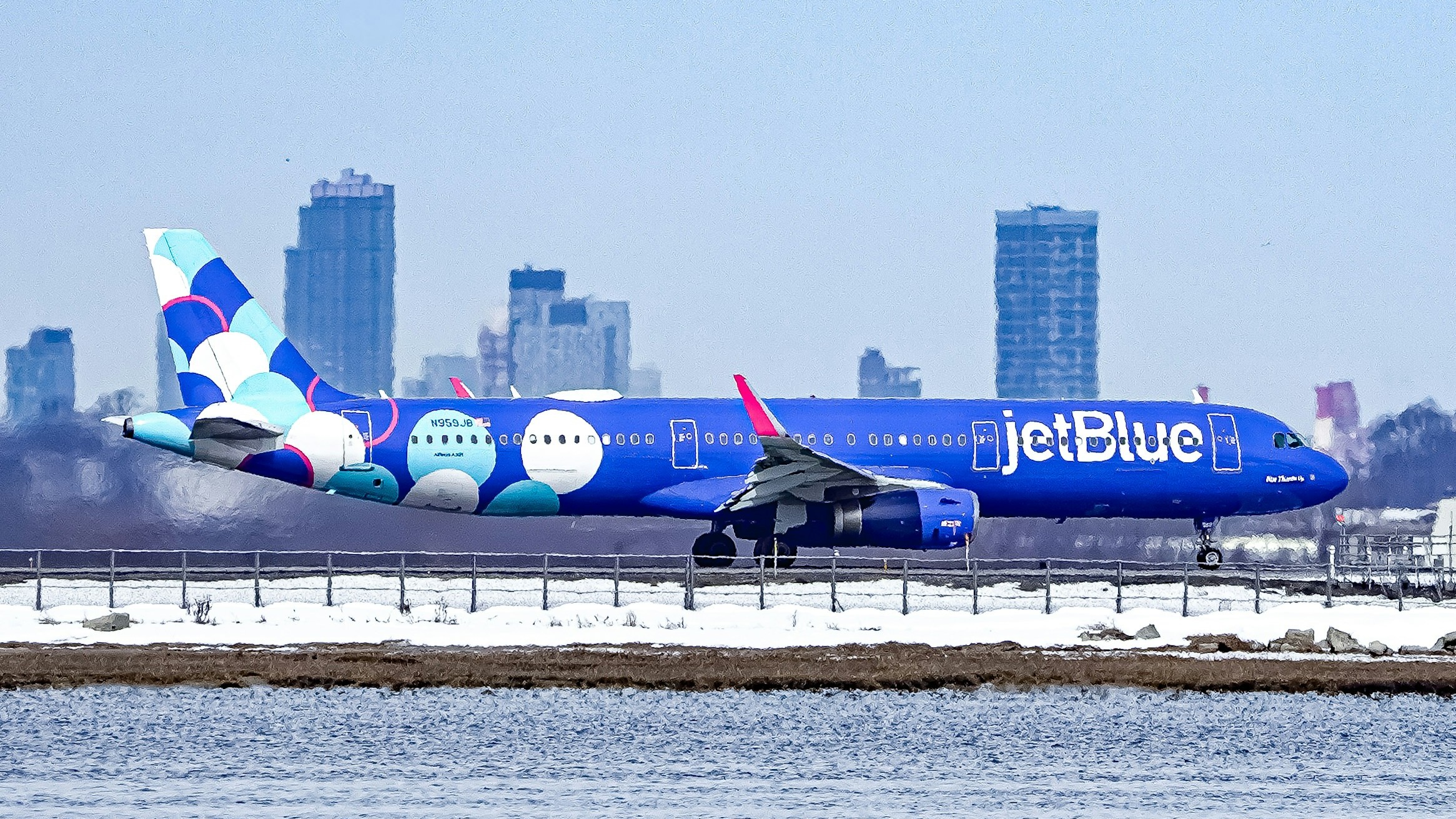
JetBlue Airways spent roughly $2.7 billion on jet fuel in fiscal 2024, making it the airline’s single largest operating expense. That same year, the carrier wrote a $69 million check to Spirit Airlines just to walk away from a merger a federal judge killed. Now, as JetBlue tries to convince Wall Street that its JetForward turnaround plan can deliver sustained profitability, those two financial wounds are still bleeding.
The carrier’s 2025 annual report and its 2026 investor guidance frame the challenge plainly: fuel economics remain the widest variable in JetBlue’s earnings math, and the sunk costs of the Spirit saga have left the balance sheet with less cushion than management would like. With the airline carrying more than $6 billion in long-term debt and lease obligations as of its most recent filing, the margin for error is thin.
Fuel remains the make-or-break variable
Airlines live and die by the price of kerosene, and JetBlue is more exposed than some of its larger rivals. The carrier lacks the deep hedging programs that Delta Air Lines and Southwest Airlines have historically used to smooth out crude-price swings. In its 2025 Form 10-K, JetBlue breaks down aircraft fuel expense to include taxes, into-plane fees, transportation, storage, and the net effect of hedging, but the risk-factor disclosures are blunt: even modest moves in crude oil benchmarks can materially shift operating margins.
JetBlue’s 2026 guidance pegs its fuel cost projections to the Brent crude futures curve and the prevailing Brent-to-jet crack spread. Those are observable market inputs, not locked-in contracts, which means the numbers management presented are estimates built on a price environment that could shift overnight. A geopolitical flare-up in the Middle East, a refinery outage along the Gulf Coast, or a wider-than-expected crack spread could push JetBlue’s per-gallon costs well past the top end of its published range.
What the filings do not reveal is how aggressively JetBlue has hedged for the quarters ahead. The company references hedging activity in general terms but stops short of disclosing precise positions, its tolerance for basis risk, or any contingency playbook for a sustained price shock. For context, JetBlue’s fuel cost per gallon in 2024 averaged around $2.80, according to its annual report. A swing of even 15 to 20 cents per gallon on roughly one billion gallons consumed annually translates to $150 million to $200 million in additional expense, enough to wipe out a fragile operating profit.
The Spirit deal’s long financial tail
JetBlue’s attempt to acquire Spirit Airlines collapsed in early 2024 after a U.S. District Court in Massachusetts permanently blocked the merger on January 16, ruling that eliminating Spirit as an independent low-fare competitor would likely harm consumers on overlapping routes. JetBlue initially appealed, then dropped the effort; the appeal was formally dismissed in March 2024.
Walking away carried a steep price. JetBlue’s fiscal year 2024 annual report confirms the airline paid a $69 million termination fee to Spirit on March 5, 2024, booked as a special item rather than a routine operating cost. Before that, JetBlue had been sending monthly ticking-fee payments of $0.10 per share to Spirit shareholders from January 2023 through February 2024, a slow cash drain that accumulated while regulators and the courts deliberated. All told, the ticking fees added tens of millions more to the tab.
The deal’s financial shadow extended further. JetBlue had arranged a $3.5 billion senior secured bridge facility to fund the cash portion of the transaction. That commitment was terminated when the merger fell apart, but its sheer size illustrates how much balance-sheet risk the airline had been willing to shoulder. Advisory fees, integration planning costs, and the harder-to-quantify toll of management distraction over a multi-year process do not appear as discrete line items in any filing, making the true all-in cost of the failed merger impossible to pin down from the outside.
Spirit, meanwhile, filed for Chapter 11 bankruptcy protection in November 2024 and emerged as a smaller carrier in early 2025. The competitive map JetBlue operates on today looks markedly different from the one that existed when the merger was first proposed, and the option of buying into Spirit’s ultra-low-cost customer base is gone for good.
What’s still missing from the turnaround picture
JetBlue has staked its credibility on JetForward, a strategy built around network optimization, premium product upgrades (including its Mint business-class cabin), and unit-cost discipline. Management has pointed to early wins: stronger ancillary revenue, improved completion factors, and selective capacity cuts on underperforming routes. But as of spring 2026, several critical pieces of the profitability puzzle remain absent from the public record.
There is no published sensitivity analysis bridging the company’s fuel-price guidance ranges to specific earnings or margin targets. Investors know the projected cost-per-gallon band, but they must infer on their own how a move to the top or bottom of that band would ripple through the income statement. Historical relationships between fuel costs, unit revenue, and non-fuel CASM offer rough guidance, but JetBlue has not spelled out the math.
The airline’s debt and liquidity position also deserves scrutiny. JetBlue ended 2024 with more than $6 billion in combined long-term debt and operating lease obligations, against roughly $1.8 billion in unrestricted cash and short-term investments. That liquidity buffer is adequate for normal operations, but it leaves limited room to absorb a prolonged fuel spike or an unexpected revenue shortfall without tapping credit markets at potentially unfavorable rates.
Then there is the strategic question of how JetBlue plans to grow without Spirit. The airline can expand organically into new markets, deepen partnerships (its Northeast Alliance with American Airlines was already dismantled by a separate antitrust ruling in 2024), or focus almost entirely on margin repair at existing stations. The available filings and investor materials outline the framework but leave operational specifics for future earnings calls.
Why the next two quarters will tell the story
For travelers, the practical stakes are route availability and fare levels. If fuel costs surge and JetBlue tightens capacity to protect margins, some markets, particularly smaller leisure routes, could see reduced frequency or higher ticket prices. For investors, the next several quarters will test whether JetForward’s cost and revenue initiatives can generate enough momentum to offset fuel volatility and absorb the sunk costs of the Spirit chapter.
The data in JetBlue’s SEC filings is solid and well-documented. What is still missing is the connective tissue: a transparent fuel-sensitivity model, a detailed hedging disclosure, and granular route-level economics that would let outsiders judge whether the turnaround math actually works. JetBlue’s management has promised profitability is within reach. The airline’s upcoming second-quarter 2026 results, expected in late July, will be the first real test of whether that promise holds up against the cost pressures the company cannot fully control.