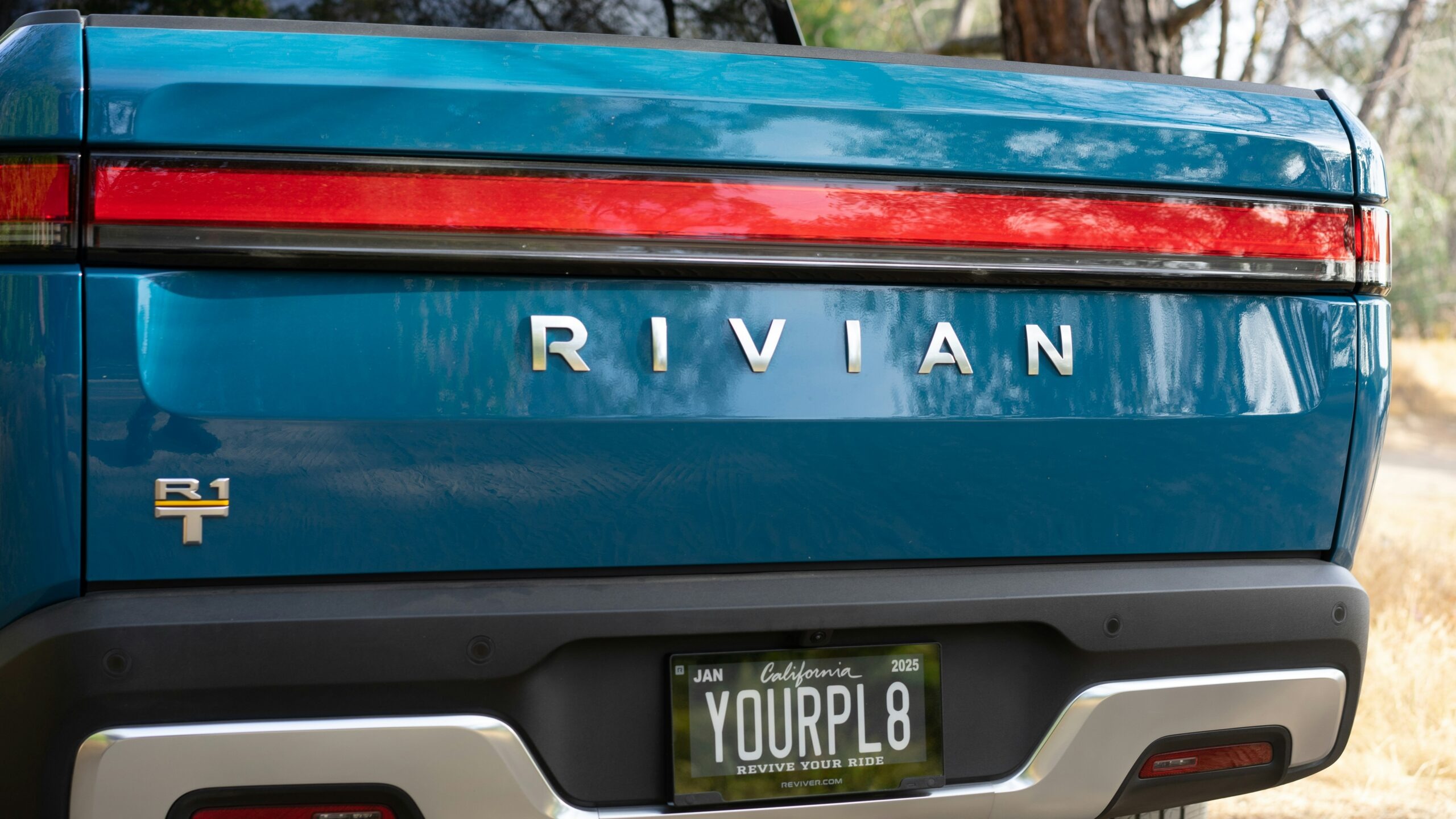
Rivian Automotive lifted its full-year 2026 delivery forecast after a second quarter that exceeded the company’s own projections, sending shares up roughly 8 percent on a day when rival EV maker Lucid Motors disclosed weaker results and leadership changes. The upward revision, from a range of 62,000 to 67,000 vehicles to 65,000 to 70,000, reflects a production quarter in which Rivian built 12,613 vehicles and delivered 12,194, well above its prior Q2 outlook of 9,000 to 11,000 units.
Why the guidance raise changes Rivian’s near-term calculus
The gap between what Rivian expected and what it actually shipped in the second quarter is the detail that matters most. Delivering 12,194 vehicles against a ceiling of 11,000 is not a marginal beat; it represents roughly 11 percent more volume than the top of the company’s own range. That kind of outperformance gave management room to raise full-year delivery guidance by 3,000 units at both ends, shifting the 2026 target to 65,000 to 70,000.
The previous range of 62,000 to 67,000 had been set after Rivian’s first-quarter results in late April. That baseline already reflected early R2 production activity and broader demand trends. Raising the bar just two months later suggests the company is converting pre-production learning into real output faster than its own internal models predicted and gaining confidence that supply chains and factory utilization can support a higher run rate.
For investors, the stock reaction captured a simple calculation: higher deliveries translate into higher revenue, and Rivian is doing it while at least one direct competitor is moving in the opposite direction. Lucid Motors reported its own Q2 production and delivery figures alongside announcements of leadership actions aimed at improving execution, a combination that signaled internal trouble rather than momentum. On a relative basis, Rivian’s beat-and-raise quarter underscored that capital and consumer demand in the premium EV segment are not evenly distributed.
Q2 production numbers and the pace required to hit 70,000
Rivian’s July 2 Form 8-K filing is the primary record. The company produced 12,613 vehicles and delivered 12,194 during the second quarter of 2026, according to the SEC submission. Deliveries exceeded the prior Q2 outlook of 9,000 to 11,000 units, and the company used that outperformance to justify the revised annual target.
Reaching the upper end of the new range, 70,000 deliveries for the full year, requires sustained quarterly output near or above Q2 levels through the second half. If Rivian delivered roughly 12,200 units in Q2, it will need both continued growth from its existing R1 lineup and a smoother ramp of newer models to maintain that pace. The lower end of 65,000 allows more room for seasonal slowdowns, supplier constraints, or temporary line reconfigurations.
The company’s ability to hold or slightly improve on Q2 throughput will depend on how quickly it can push plant utilization closer to designed capacity without sacrificing quality. Any missteps could compress margins or force service campaigns that offset the benefit of higher volume. Conversely, if Rivian can gradually increase weekly production while keeping warranty costs in check, the updated guidance may prove conservative rather than aggressive.
Rivian’s execution versus Lucid’s reset
The contrast with Lucid sharpens the picture. Lucid’s second-quarter disclosure, paired with leadership restructuring, suggested a business still focused on stabilizing operations rather than scaling. Management changes framed as efforts to “improve execution” typically indicate that existing processes and oversight have fallen short of internal or market expectations.
Rivian, by comparison, is signaling that its early-phase manufacturing headaches are easing. The company’s second-quarter performance implies that bottlenecks in component supply, labor training, or line balancing are now less severe than they were in prior periods. That does not mean Rivian is insulated from the broader EV slowdown or pricing pressure, but it does show that the company can translate order books into delivered vehicles more reliably than some peers.
For investors evaluating the sector, this divergence matters. In an environment where capital is no longer cheap and patience for extended cash burn is limited, the market is rewarding automakers that can demonstrate credible paths to scale. Rivian’s raised outlook, grounded in a tangible beat on its own guidance, fits that profile; Lucid’s leadership overhaul, by contrast, reads as an admission that its current operating model is not yet working.
What the guidance says about the road ahead
The new delivery range does not guarantee profitability or long-term success, but it does reframe Rivian’s near-term narrative. A company that repeatedly underdelivers on its own projections tends to trade at a discount and struggle to raise capital; one that can modestly surpass expectations and lift guidance earns more room from both equity and debt markets.
Rivian still faces familiar challenges: a competitive EV landscape, uncertain consumer demand at higher price points, and the need to keep investing in new models and charging infrastructure. Yet the second quarter shows that, at least for now, execution risk is trending lower rather than higher. If the company can string together several more quarters of meeting or beating its own forecasts, the 65,000 to 70,000 delivery goal for 2026 could become a stepping stone rather than a stretch.