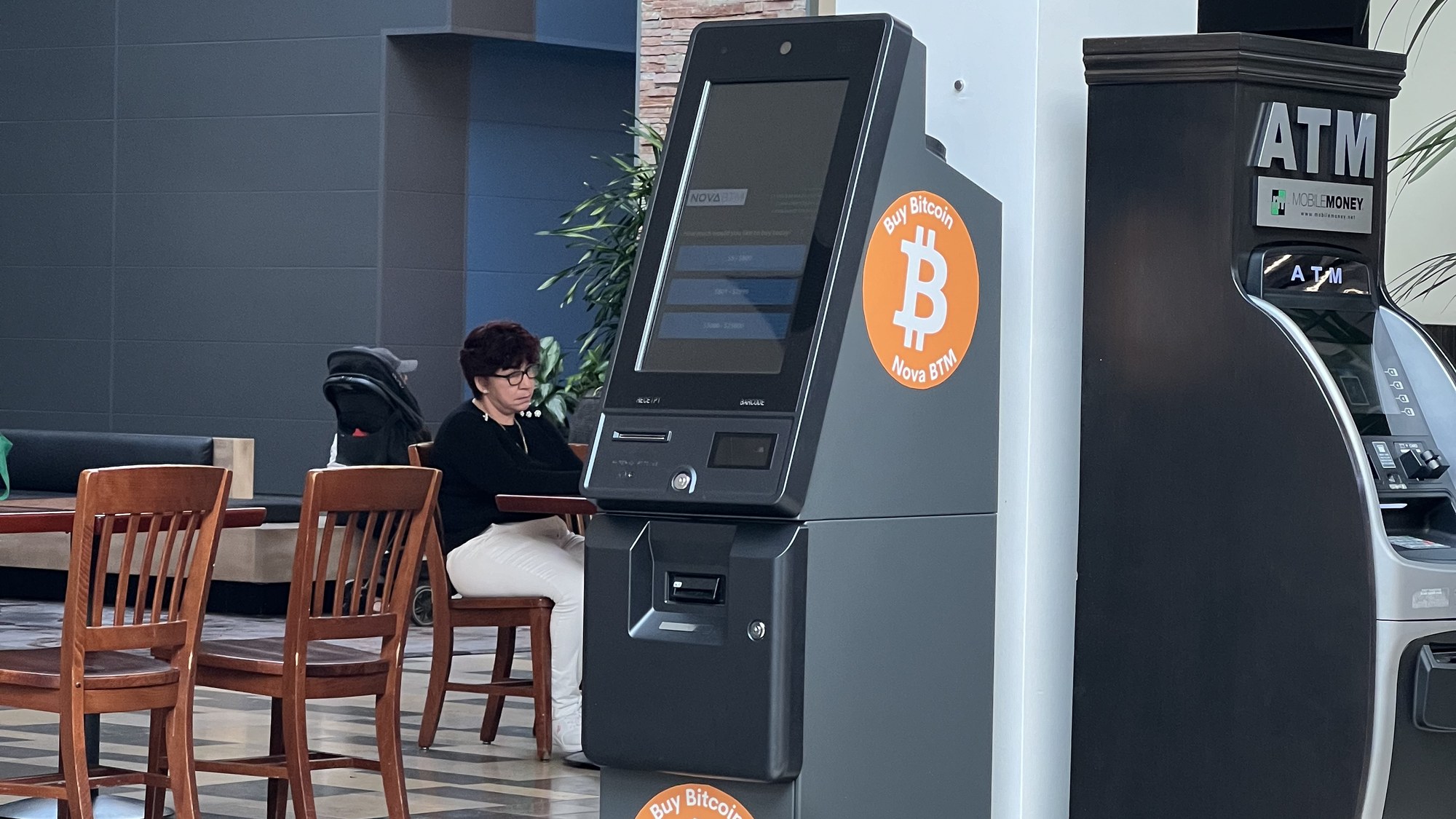
The instruction sounds urgent and official: an account is under attack, the money must be moved to safety right now, and the only way to do it is to withdraw cash and feed it into a machine at the corner store. That machine is a Bitcoin ATM, and the moment the bills go in and a code is scanned, the money is gone for good. This is one of the fastest-growing schemes aimed at older Americans, and its cruelty is in the details — victims are talked into handing over their own savings, in person, believing they are protecting it.
How a Bitcoin ATM turns cash into an unrecoverable transfer
A cryptocurrency ATM, often branded as a Bitcoin ATM, is a kiosk that accepts cash and converts it into digital currency sent to a crypto “wallet.” In a legitimate transaction, that wallet belongs to the customer. In the scam version, the wallet belongs to the criminal. The victim is told to scan a QR code the scammer provides, and that code silently directs every dollar into the scammer’s account rather than a safe one.
What makes the tactic so damaging is that a crypto transfer clears almost instantly and cannot be reversed. Unlike a disputed credit-card charge or a bank transfer that a fraud department can sometimes claw back, money sent through one of these machines is beyond recall the second it lands. The Federal Trade Commission has reported sharp increases in losses from this method, with older adults hit especially hard, often for large sums drawn straight from checking or savings.
Free retirement updates: Scam calls targeting retirees change every week. Our free Retirement Shield newsletter flags the ones going around and the one tell that stops each. Sign up free.
The impersonation that convinces people to act
Nobody walks into a store to deposit cash into a crypto machine on a whim, so the scam depends on a convincing authority figure and a manufactured emergency. The caller may claim to be from a government agency, a bank’s fraud department, a computer tech-support line, or even a police officer. The story is always some version of the same alarm: the target’s money is in danger, criminals have accessed the accounts, and only immediate action can save the funds.
From there, the pressure is relentless and the isolation deliberate. Victims are frequently kept on the phone the entire time — during the drive to the bank, through the withdrawal, and while standing at the kiosk — and told not to discuss the matter with tellers, family, or anyone who might interrupt the plan. That secrecy is engineered to keep a bank employee or relative from recognizing the fraud and stopping it before the cash is fed into the machine.
Why retirees lose the most to this scheme
Several factors line up to make older Americans the preferred target. Many hold substantial balances in accessible checking and savings accounts, which means a single successful call can drain a meaningful share of a household’s cash reserves. The premise of the scam — that a trusted institution is calling to help — also lands harder with a generation more accustomed to answering the phone and cooperating with anyone claiming to be an official.
The financial damage tends to be severe because the money is withdrawn as cash and converted directly, leaving no pending transaction to cancel and no counterparty to dispute. Where a wire transfer might occasionally be recalled if caught within minutes, a completed crypto-ATM deposit offers no such window. For a retiree, the loss can represent an emergency fund, a chunk of a nest egg, or money earmarked for medical costs, wiped out in a single afternoon and impossible to retrieve.
The one rule the FTC says stops it cold
The defense here is refreshingly absolute, and it removes any need to judge how credible a caller sounds. According to the FTC’s consumer alert on Bitcoin ATM scams, no legitimate government agency, bank, utility, or business will ever direct someone to withdraw cash and move it to a cryptocurrency ATM to keep it safe. There is no real scenario in which “protecting” money requires feeding it into a Bitcoin machine — the instruction itself is the proof of a scam.
That single principle short-circuits the entire scheme, because the scam cannot succeed without persuading the target to visit the kiosk. Anyone who receives such a demand can hang up and independently contact the real institution using a number from a bank statement, an account card, or the agency’s official website, rather than any number or link the caller supplies. A pause to verify, and a willingness to tell a teller or a family member what is happening, is often all it takes to keep an irreversible transfer from ever being made. For older Americans, treating any “move your cash to a crypto ATM” request as an automatic red flag is the simplest way to keep hard-earned savings out of a stranger’s wallet.
This article was produced with AI assistance and reviewed by The Financial Wire editorial team.
More Financial Reading
- Adding someone to your bank account: tax traps and smart moves
- The ideal retirement withdrawal rate so your savings actually last