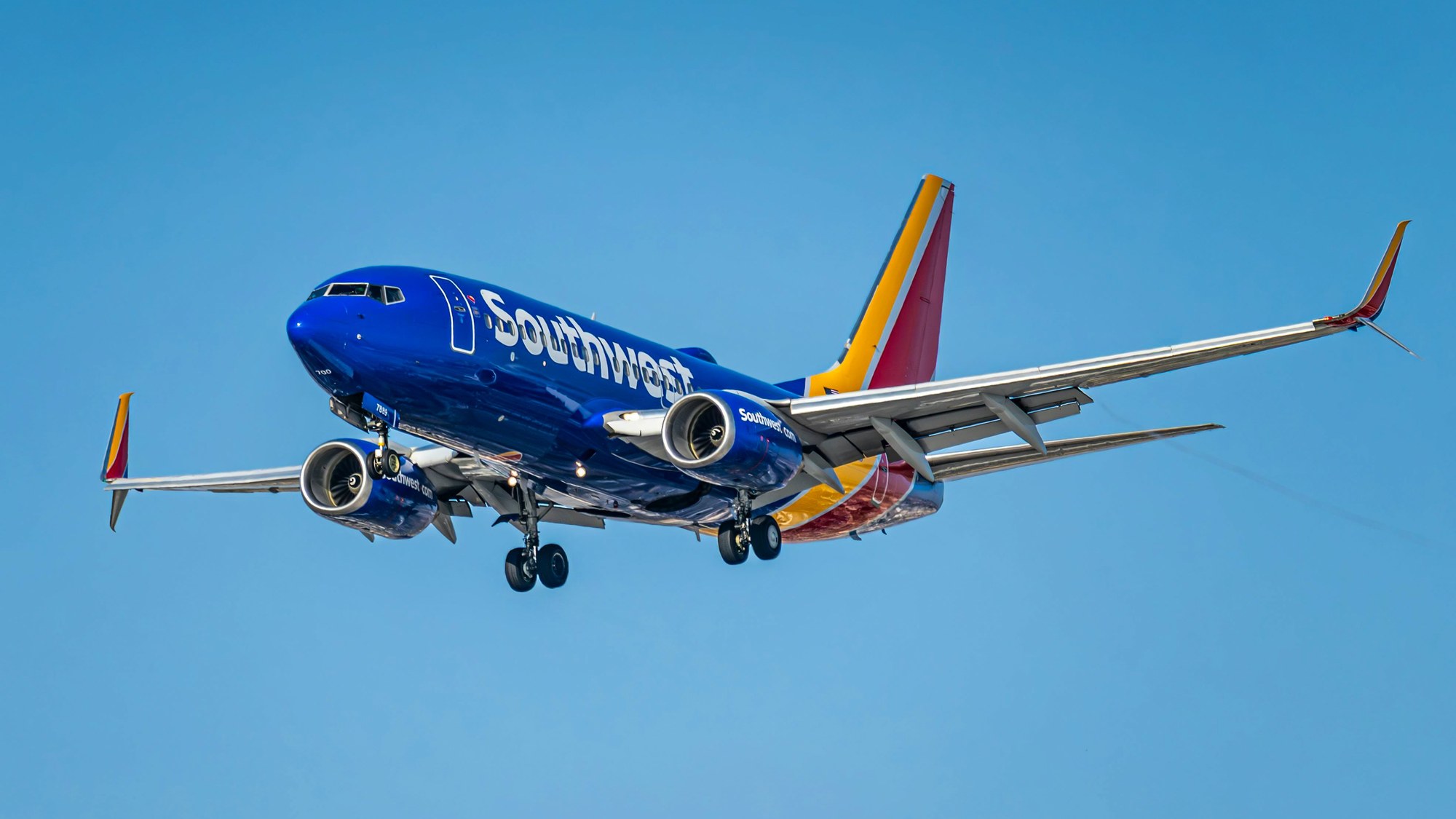
Southwest Airlines passengers paid an average of $231.69 per ticket in the third quarter, up 26.9% from $182.56 a year earlier, while the airline carried 3.2% fewer customers. Southwest reported the numbers October 21 alongside quarterly profit of $270 million. Higher fares did most of the work.
Fewer passengers, each paying more
For the three months ended September 30, Southwest carried 33,467,000 revenue passengers, down from 34,581,000 a year earlier. The airline’s own operating statistics filed with the SEC show the fare as the average paid per passenger. That is $49.13 more per trip than in the third quarter of 2025.
Planes were not emptier. The load factor, the share of seats filled, was 79.8% in both years. Capacity measured in available seat miles slipped 0.4%, to 45.4 billion, and enplaned passengers, which count each boarding including connections, fell 1.1% to 43.3 million. Southwest flew almost the same amount of seats and sold almost the same share of them, only to fewer people at higher prices.
Passenger revenue yield, the cents earned per passenger-mile flown, rose 23.3% to 21.41 cents. Over nine months the average fare was $227.81, up 21.6% from $187.36, and passengers carried fell 3.1%. The jump is not a one-quarter blip, though it was larger in the summer.
Chief Executive Bob Jordan credited a changed product. “Customers are responding to the enhanced Southwest offering, and it shows in our results,” he said. He also said demand held up “as we lapped last year’s bag fee and other commercial initiatives,” a reference to the bag fee the airline introduced last year.
Retirement deadlines, in your inbox: Miss an enrollment or claim deadline and the money can be gone. Join the Retirement Money Brief and we’ll send you our 2026 Government Check Reality Tracker as a welcome gift.
Get the Brief + the check tracker →
We may earn a commission from links on this page.
Revenue and profit swung higher
Operating revenue came in at $8.4 billion, up 21.2%. Revenue per available seat mile, a standard airline yardstick, hit 18.55 cents, up 21.6% and an all-time record for Southwest. Net income was $270 million, or 55 cents a share, against $54 million, or 10 cents, in the third quarter of 2025.
Excluding special items, adjusted net income was $328 million, or 66 cents a share. The operating margin rose 4.0 points to 4.5%. Those are healthier results than a year ago, though a 4.5% margin leaves little cushion if fuel or demand moves against the carrier.
Costs rose too, but far less than prices did. Unit cost per available seat mile climbed 16.8% to 17.72 cents, and 3.8% to 12.68 cents when fuel and special items are excluded. Fuel expense alone rose $821 million and cut $1.08 from adjusted earnings per share.
Fuel moved the wrong way in the quarter. Southwest paid $3.92 a gallon, up 63.3% from $2.40, and above the $3.70 to $3.75 it had expected. Over nine months the cost averaged $3.56 a gallon, against $2.40 a year earlier. For the fourth quarter the airline assumes about $4.55 a gallon, based on the October 15 forward curve.
What the fourth quarter looks like for fares
Southwest told investors that revenue per seat mile should rise 19% to 21% in the fourth quarter. Capacity should grow 3% to 4%. The company said “robust demand has continued,” and that its guidance assumes the current fare environment and demand trends stay broadly intact.
Full-year capacity growth is now expected at about 1.2%, trimmed from about 1.5%. Southwest has also removed six seats from each Boeing 737-700 to make room for extra-legroom seating. The airline estimates the change adds a 1.0-point drag on its unit costs in the fourth quarter, because the same flights carry fewer seats.
The company forecast full-year adjusted earnings of $2.60 to $2.85 a share, and $0.55 to $0.80 for the fourth quarter. Those targets rest on fares staying high. A traveler booking holiday flights is paying the prices that the guidance counts on.
Costs, layoffs and what shareholders received
Jordan said that “with the transformation complete, our efforts have shifted to optimizing the business.” In practice that means squeezing more revenue from the same planes. Over nine months Southwest flew 0.8% more passenger miles on 0.4% more seat miles, while carrying 3.1% fewer passengers, 96,973,000 against 100,078,000.
Southwest booked $30 million of severance and related costs in the quarter, $45 million for nine months, tied to corporate workforce reductions. The company also lists gross leverage of 1.9 times. Cash stood at $3.6 billion, with total liquidity of $5.6 billion, including a $2.0 billion revolving credit line.
Shareholders received $176 million in dividends during the quarter and $357 million over nine months. There were no stock buybacks in the third quarter, after $1.25 billion in repurchases over the first nine months. About $450 million remains under the $2.0 billion repurchase authorization, per the company’s investor release.
For anyone who flies Southwest to see family or take a trip, the practical effect is simple: the same seat costs more. A fare that rose 26.9% in a year is a larger jump than most household budgets absorb easily. Southwest has not said whether fares will fall back if fuel costs ease.
Paying $49 more per Southwest trip than last year?
A fare that rose 26.9% in a year is a bill that arrives whether or not a pension or Social Security check rose to match. Money spent on higher fares is money not left for the costs that programs could cover, and those programs do not apply automatically.
The Benefits Checklist scans 11 benefit programs, including SNAP, heating help and property-tax breaks, with the 2026 income limits and a 50-state phone directory. Airfares are outside what it covers; it finishes a related job, finding help with household costs elsewhere in the budget, and a printable tracker comes with the download.
Offset higher travel costs: scan 11 benefit programs with the Benefits Checklist →
More Financial Reading
- 21 Ways to Stretch a $2,087 Social Security Check
- 15 Places to Find Your Share of the $4.25 Billion States Give Back
- 15 Steps to Stop the Scams That Took $7.7 Billion From Seniors
This article was produced with AI assistance and edited for accuracy against the sources linked above.