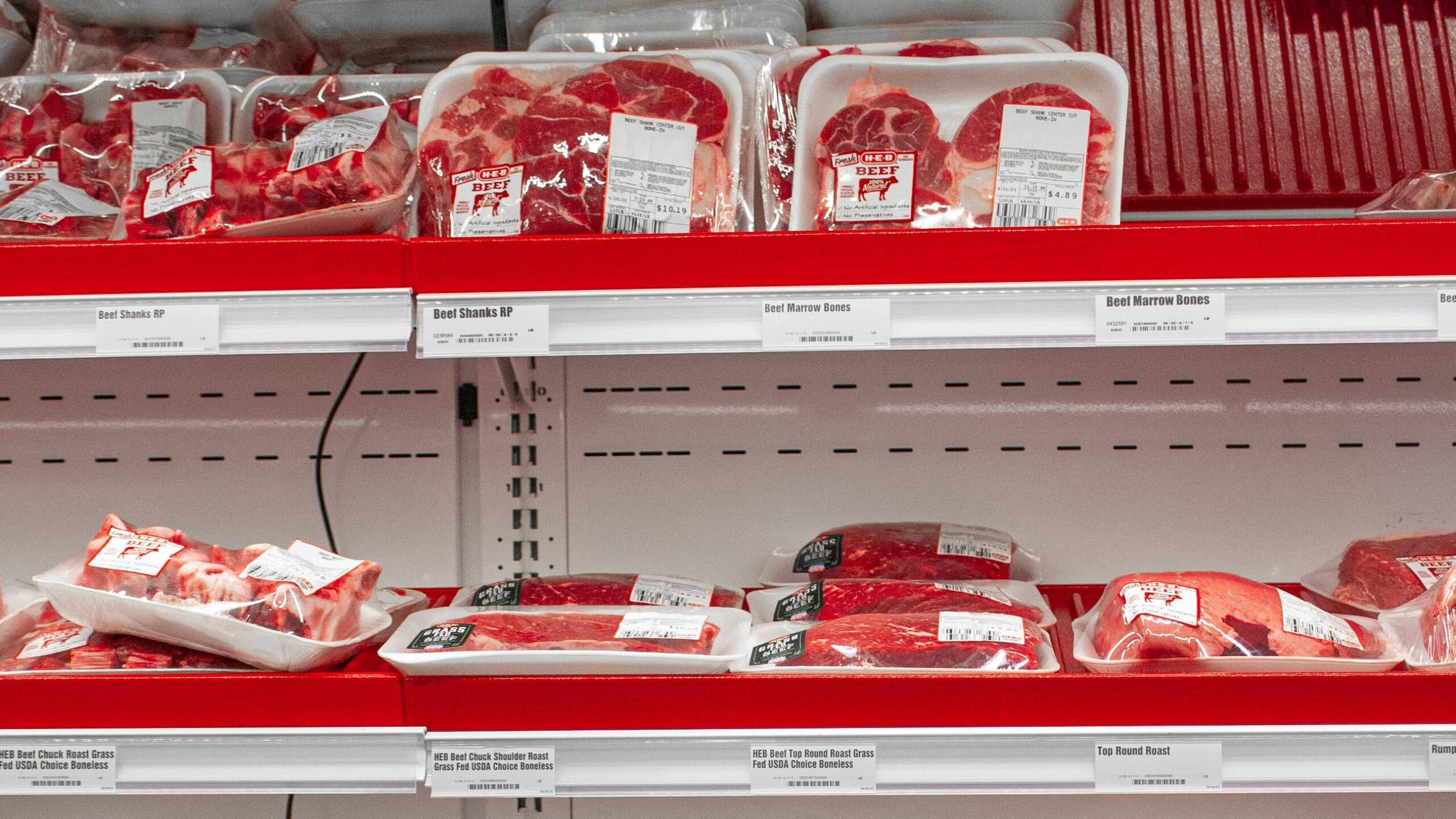
The last time many Americans fired up the grill for Memorial Day, a pound of boneless sirloin steak cost roughly $10. This year, that same cut averages $12.74 a pound at U.S. grocery stores, the highest price the Bureau of Labor Statistics has ever recorded. Ground beef sits at $6.70 a pound, also an all-time high. And the forecast from Washington suggests the worst may not be over: the USDA’s April 2026 Food Price Outlook projects beef and veal prices could rise as much as 18 percent by year’s end, a scenario that would make the summer of 2026 the most expensive grilling season on record.
Put differently, a family of four buying two pounds of sirloin and three pounds of ground beef for a backyard cookout is now spending north of $45 on meat alone, before buns, charcoal, or anything else hits the cart. Two years ago, that same haul ran closer to $35.
Where the numbers come from
Both records are drawn from the BLS Consumer Price Index Average Price Data program, which collects transaction prices from thousands of retail outlets each month. The sirloin series tracks boneless cuts graded USDA Choice and hit $12.74 per pound in March 2026. The ground beef series, covering 100 percent beef products, registered $6.70 per pound that same month. Both datasets are distributed through the Federal Reserve Bank of St. Louis’s FRED database.
These figures reflect what shoppers actually pay at the register, not advertised sale prices or self-reported spending. The methodology makes the series a reliable gauge of national trends, though it smooths over regional gaps. A warehouse club in Fort Worth and a corner grocery in Brooklyn can be worlds apart on any given week.
The USDA’s forward-looking projections build on those BLS readings. Each month, the Economic Research Service publishes forecast workbooks with low, mid, and upper values for every major food category. In the April 2026 release, beef and veal carry the widest prediction spread of any major protein, a signal that government modelers see unusually high uncertainty about where prices land by December.
The 18 percent number needs context
That 18 percent figure deserves a careful read. It represents the top end of the ERS’s 95 percent prediction interval, not the agency’s baseline expectation. The midpoint forecast calls for beef and veal price increases in the range of 6 to 10 percent for 2026. Even the middle of that range would mean new records stacking on top of records already set this spring.
The upper bound is not a fantasy, though. It maps to a scenario where several pressures converge at once: continued drought in cattle country, trade disruptions that limit imports, and strong consumer demand heading into summer. None of those conditions is far-fetched. All of them are already in play to some degree.
Why the cattle market is so tight
The biggest force behind record prices is old-fashioned scarcity. The U.S. beef cow herd has been shrinking for years. Persistent drought across major cattle states, particularly Texas, Kansas, and Oklahoma, dried up pastureland and forced ranchers to send breeding cows to slaughter earlier than planned. According to USDA National Agricultural Statistics Service inventory reports, the January 2025 count of all cattle and calves fell to its lowest level since the early 1960s.
Rebuilding takes time. Ranchers must hold back heifers for breeding instead of sending them to feedlots, which tightens the supply of finished cattle in the near term even as it sets the stage for eventual recovery. “You can’t just flip a switch and make more cows,” as one Oklahoma cattleman told reporters earlier this year. “Every heifer we hold back is one less animal going to the packer this fall.” The industry rule of thumb is that a meaningful supply response takes two to three years from the point ranchers start retaining heifers.
On top of the supply squeeze, input costs remain stubborn. Corn and soybean meal, the two primary feedlot rations, are still roughly 25 to 30 percent above their 2019 averages. Packing plant wages have climbed as processors compete for labor in rural areas where workers have other options. Diesel and refrigerated trucking rates add another layer. Each of those costs gets folded into the retail price per pound.
Trade policy adds another variable. The U.S. imports significant volumes of beef from Australia, Brazil, and Canada. Tariffs, retaliatory duties, or shifting trade agreements can restrict those flows and tighten domestic availability further. Smoother trade, on the other hand, could act as a modest pressure valve. The USDA’s wide forecast range implicitly accounts for that uncertainty, but the agency does not spell out specific trade scenarios in its public outlook.
Other proteins tell a different story
Beef’s surge stands out because the rest of the meat case has not followed the same path. Overall food-at-home inflation has cooled from its pandemic-era peaks. Eggs, which spiked dramatically during avian influenza outbreaks in 2023 and again in early 2025, have seen partial price reversals as flocks recovered. Boneless chicken breast, while not cheap, still averages roughly $4.50 a pound nationally, about a third the cost of sirloin steak. Pork chops hover near $4.80.
That price gap is wide enough to change behavior. “Consumers are rational,” said Scott Brown, a livestock economist at the University of Missouri. “When steak is three times the price of chicken, you see more chicken in the cart.” Grocery executives have echoed that observation, noting increased promotional activity around poultry and pork as beef prices climb. Anecdotal reporting and retailer surveys suggest shoppers are also trading down within the beef category itself: swapping ribeyes for chuck roasts, stretching ground beef with beans or lentils, and buying family-size packs to lock in a lower per-unit cost.
Federal purchase data has not yet captured a clear, measurable protein-switching trend for 2026. The BLS tracks prices, not quantities bought. So while the economic logic of substitution is strong, the scale of the shift remains an open question until more data arrives later this year.
How to plan for the most expensive grilling season ever
For families planning around Memorial Day cookouts, Fourth of July barbecues, and every weekend in between, a few realities are worth sitting with.
The record prices already documented in federal data are unlikely to reverse quickly. Herd rebuilding is a multi-year process, and the supply constraints behind today’s numbers were years in the making. Even if rainfall returns to cattle country and ranchers begin expanding, the effects will not reach grocery shelves for many months.
The 18 percent worst-case scenario is exactly that: a worst case. The USDA’s midpoint forecast suggests a more moderate increase, though still enough to sting. Shoppers who see the headline number should understand it as a risk tied to specific conditions, not a guaranteed outcome.
Flexibility at the store matters more than it has in years. Comparing prices across retailers, watching for loss-leader sales on ground beef, experimenting with less popular cuts like flat iron or tri-tip, and mixing chicken or pork into the weekly rotation are all ways to keep grilling without blowing the grocery budget.
The cattle cycle will eventually turn. Herds will rebuild, supplies will loosen, and prices will come off these peaks. But that cycle runs on its own clock, measured in years, not weeks. For the summer of 2026, the federal data leaves little room for ambiguity: beef is the most expensive it has ever been, and the outlook says it could get pricier before it gets cheaper.