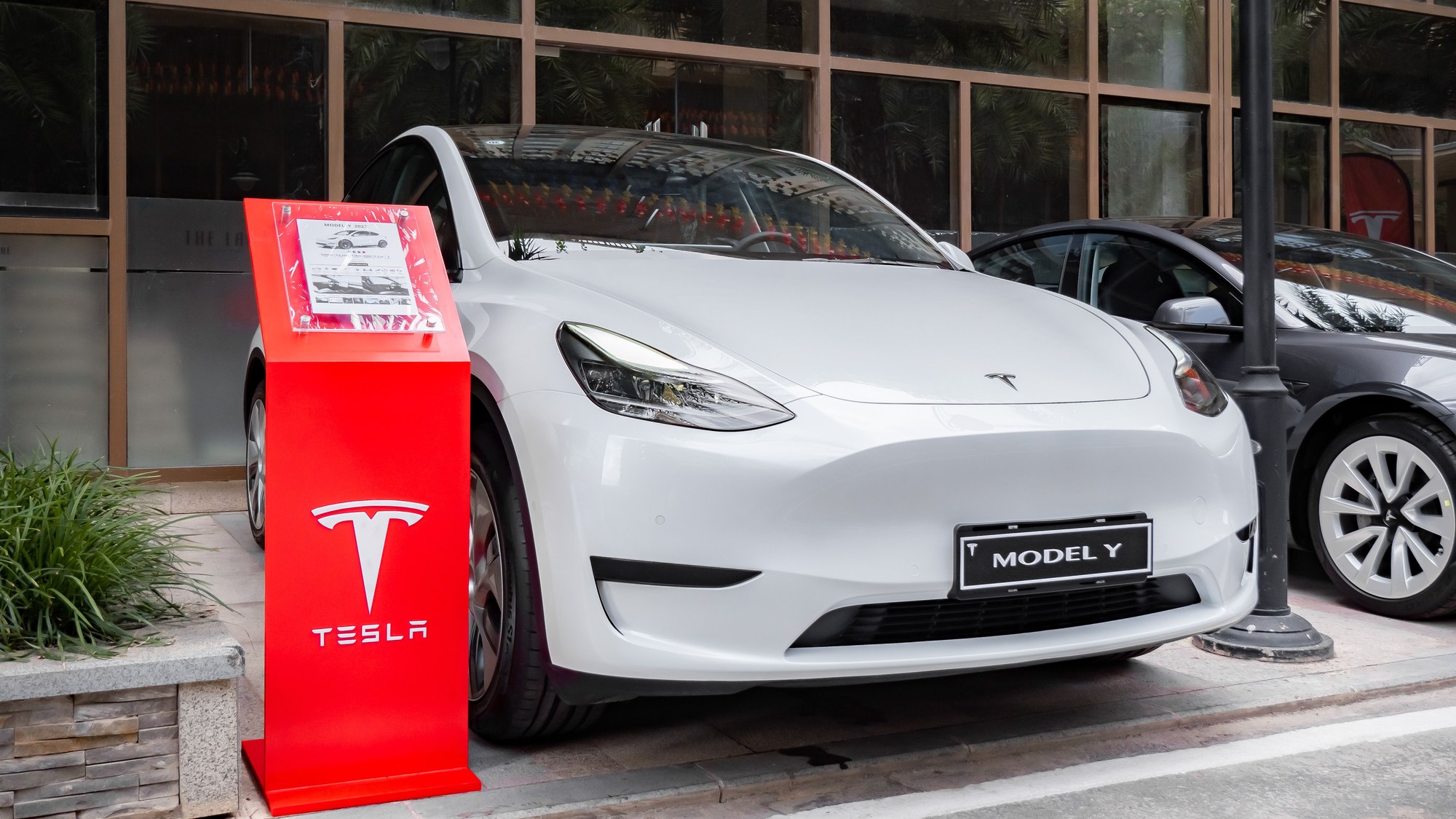
Tesla handed 486,532 vehicles to customers in the third quarter and built 464,391 over the same three months, so customers took home 22,141 more cars than the factories made. The gap means Tesla sold down vehicles it already had, and it let the company beat the deliveries analysts expected. The profit numbers it reported on October 21 tell a less cheerful story.
486,532 delivered, 464,391 built
Tesla’s October 2 release breaks the quarter down by model. Model 3 and Model Y production was 457,387 and deliveries were 478,237. All other models saw 7,004 built and 8,295 delivered. Tesla also deployed 13.7 gigawatt-hours of energy storage.
The delivery gap runs across both groups: 20,850 more Model 3 and Model Y vehicles went out than were built, and 1,291 more of the other models. Those differences are arithmetic from Tesla’s table, not a figure the company states. About 1% of deliveries were subject to operating lease accounting, while the other models ran at 4%.
The release warns that deliveries and storage deployments are “only two measures” of financial performance and should not be relied on as an indicator of quarterly results. Tesla names no executive in it and gives no comparison with last year or any inventory number. Those details come from the quarterly filing.
Deliveries beat the forecast and the last quarter
Tesla publishes a company-compiled analyst consensus before each quarter. The September 29 version put third-quarter deliveries at 461,974, with a median of 463,406 across 24 estimates. Actual deliveries of 486,532 came in 24,558 above that average, roughly 5%.
The same consensus page lists the second quarter at 480,126 deliveries, of which 467,762 were Model 3 and Model Y. The third quarter therefore added about 6,400 deliveries on the quarter. Analysts had expected 15.9 gigawatt-hours of storage, and Tesla deployed 13.7, up from 13.5 in the second quarter but short of the target.
What changed this year: Social Security and Medicare change every year, and nobody sends you a memo. The Retirement Money Brief breaks down what changed and what to do.
Get the Retirement Money Brief →
We may earn a commission from links on this page.
The same consensus page has analysts averaging 1,767,255 deliveries for all of 2026 and 1,923,138 for 2027. Tesla says it does not endorse those estimates. Second-quarter deliveries of 480,126 and third-quarter deliveries of 486,532 together come to 966,658 vehicles for the two quarters.
What the October 21 filing shows about profit
Tesla’s quarterly report shows revenue of $28.05 billion, flat against $28.10 billion a year earlier. Automotive sales were $20.09 billion, down 1.3% from $20.36 billion, even though the company delivered more cars than it made. Automotive cost of revenues fell faster, down 4.8% to $16.75 billion. Gross profit rose 8.7% to $5.49 billion, lifting gross margin to about 19.6% from about 18.0%.
Profit fell all the same. Net income was $804 million against $1.39 billion, or $0.22 a diluted share against $0.39. Operating income dropped 55.8% to $718 million from $1.62 billion, because operating expenses rose 39.2% to $4.78 billion.
The increase came from research and development, which grew 69.4% to $2.76 billion, and from selling, general and administrative costs, up 29.0% to $2.02 billion. Last year’s quarter also carried a $238 million restructuring charge that did not recur.
Credits, storage and the cash bill
Revenue from regulatory credits, which other automakers buy to meet emissions rules, was $113 million against $417 million. The filing says Tesla reversed $475 million of credit revenue for returns of credits it had already delivered, and that recent government and regulatory actions have restricted certain credit programs. Energy generation and storage revenue slipped 15.6% to $2.88 billion.
The nine-month figures show where cash is going. Purchases of property and equipment were $13.01 billion, more than double the $6.13 billion of a year earlier. Cash and equivalents were $17.85 billion on September 30 against $16.51 billion at year-end 2025, and inventory was $14.09 billion against $12.39 billion.
The nine-month picture is better than the quarter. Revenue is $78.67 billion, up 12.5%, automotive sales are up 13.2% to $55.57 billion, and operating income is $2.06 billion, down 30.2%. Tesla sold more cars this year at lower profit, and the third quarter was the weakest part of that.
The filing also shows the cost of cars already on the road. Tesla’s accrued warranty balance was $10.14 billion on September 30, up from $8.08 billion a year earlier, and warranty costs paid in the quarter were $642 million against $464 million. New warranty provisions were lower, at $597 million against $727 million.
Is a bigger delivery total a better investment?
For a shareholder, the 486,532 figure and the $804 million profit point in different directions. The first says demand for the cars Tesla makes held up. The second says each dollar of sales is leaving less behind after the research and sales spending.
The quarter’s numbers do establish one thing: Tesla delivered 22,141 more cars than it built, and its balance sheet still carried $14.09 billion in inventory, against $12.39 billion at the end of 2025. Whether next quarter’s profit follows the deliveries or the research bill is the question for anyone holding the stock.
Which household costs are still unprotected?
A company’s quarterly deliveries and profit say nothing about what a household pays for its own car, power or groceries, and those bills keep arriving whatever Tesla reports. Help with them, from heating aid to property-tax breaks, has to be applied for, and each program has its own limits and phone number.
This story is a company-results story, so the turn is plain: the related job is household costs, which The Benefits Checklist finishes. It scans 11 benefit programs retirees most often miss, with the 2026 income limits, a 50-state phone directory and a printable application tracker for the filings.
Check 11 programs that cover everyday household costs in the Benefits Checklist →
More Financial Reading
- 21 Ways to Stretch a $2,087 Social Security Check
- 15 Places to Find Your Share of the $4.25 Billion States Give Back
- 21 Ways Retirees Can Raise $1,000 Fast Without a Job
This article was produced with AI assistance and edited for accuracy against the sources linked above.