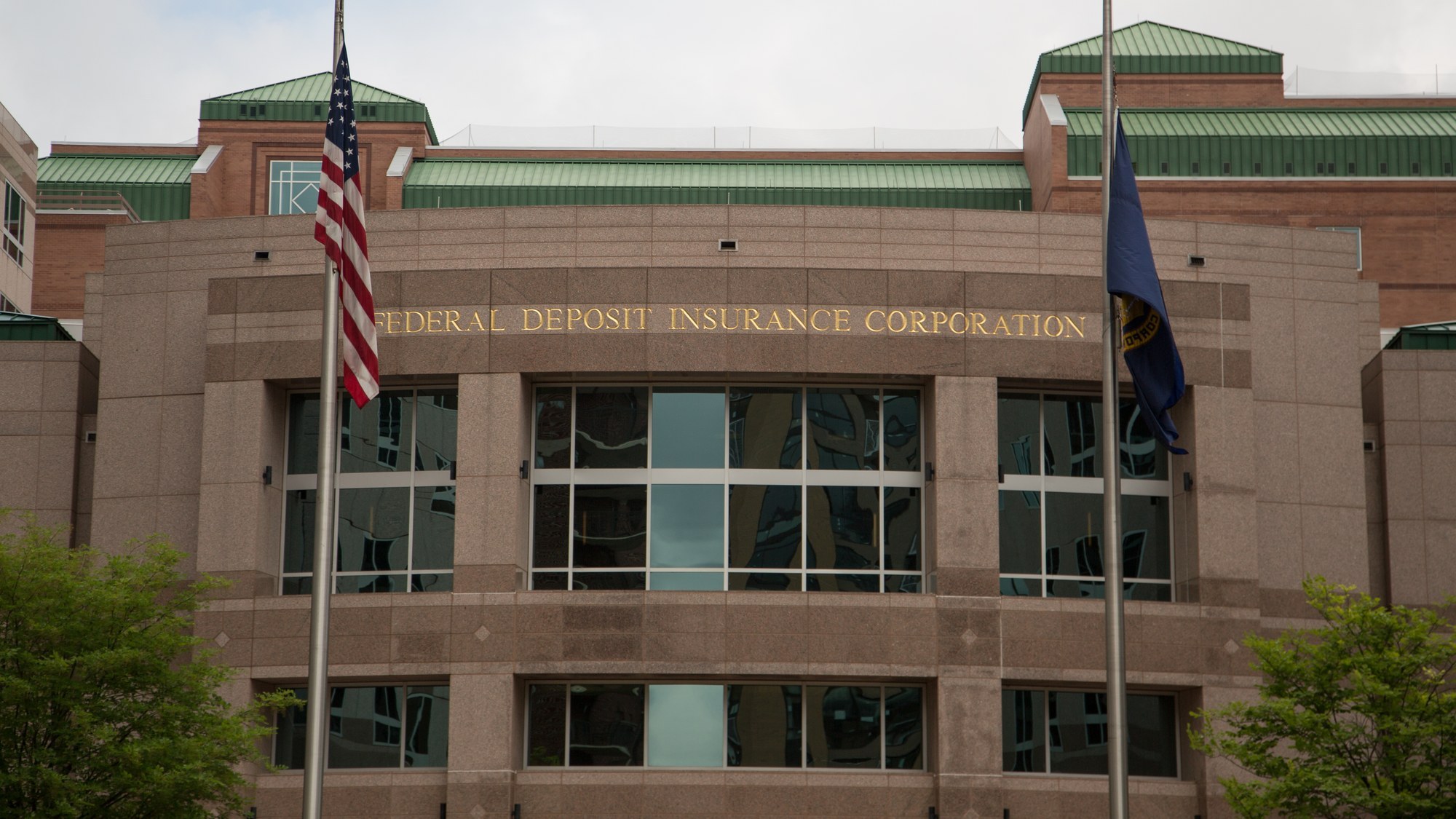
Old Glory Bank of Elmore City, Oklahoma, reported a Tier 1 leverage ratio of 2.69 percent on June 30, and the Federal Deposit Insurance Corporation has since issued the bank a supervisory prompt corrective action directive classifying it as significantly undercapitalized. The directive appeared on the FDIC’s list of August 2026 enforcement orders, published in a Sept. 25 bulletin. A directive is a supervisory restriction, not a bank failure, and deposits at an FDIC-insured bank remain insured up to the standard limit.
What the FDIC’s Sept. 25 bulletin lists
The FDIC’s bulletin, “FDIC Publishes Enforcement Orders for August 2026,” carries the entry “Supervisory Prompt Corrective Action Directive: Old Glory Bank, Elmore City, OK.” It points readers to the agency’s orders portal for the documents and does not reproduce the directive’s text. The ratio and classification in this article therefore rest on the FDIC’s call-report data, its capital rule and Banking Dive’s reading of the order, each attributed below.
What the call report data show
The FDIC’s own financial data for the bank, certificate 18924, put its leverage ratio at 2.69 percent as of June 30, 2026. The same record shows total assets of $276.8 million, deposits of $268.7 million, equity capital of $6.8 million and a year-to-date net loss of about $8.0 million. The record also lists Tier 1 capital of $7.5 million. Set against a year-to-date loss of about $8.0 million, that shows how thin the cushion had become by midyear. The bank is listed in the FDIC’s institution directory with the same certificate number and report date.
Banking Dive, which reported the directive Sept. 28, gave total assets as $279.4 million, a figure that differs from the FDIC’s June 30 data; the ratio, the classification and the loss of roughly $8 million for the first half match.
Where 2.69 percent falls on the capital ladder
Under the FDIC’s rule, 12 CFR 324.403, an institution is adequately capitalized with a leverage ratio of 4.0 percent or greater. It is significantly undercapitalized if the leverage ratio is less than 3.0 percent, or if certain risk-based ratios fall below their own limits. At 2.69 percent, Old Glory sits about 1.3 percentage points under the adequate line and 0.31 points under the 3.0 percent cutoff, in the fourth of the five capital categories.
Restrictions that touch depositors’ rates
According to Banking Dive’s account of the directive, issued Aug. 28 and made public Sept. 26, the bank may not accept brokered deposits or employee benefit deposits, and it must restrict the interest rates it pays on deposits. The directive also limits capital distributions and management fees where they would harm capital, requires regulatory approval for bonuses to senior executives, calls for qualified senior officers and requires monthly written compliance reports to the FDIC.
The rate limit matters most to savers, since a bank under a directive cannot pay whatever it likes to attract cash, and the bar on brokered deposits closes another route to raising funds. The restrictions remain in place until the bank has been adequately capitalized for four consecutive quarters, and the bank was told to submit an updated capital restoration plan within two weeks, the outlet reported.
A consent order from 2024 and a merger that did not close
The bank has operated under an FDIC consent order since May 2024 that required a 14 percent Tier 1 leverage ratio, Banking Dive reported, and the bank had sought what it called a more reasonable ratio of 7 to 9 percent. The gap between that 14 percent target and the 2.69 percent reported in June is the distance the 2024 consent order left the bank to close, and it explains why the FDIC moved from a consent order to a prompt corrective action directive in August. A planned merger with Digital Asset Acquisition Corp., a special purpose acquisition company, was scrapped in August after the Federal Reserve did not approve it. “The Fed knocked us down by not approving our deSPAC,” the bank said, according to the outlet. The deal would have created a Nasdaq-listed holding company named OGB Financial Company.
Insurance limits for a depositor holding retirement money
The FDIC’s deposit insurance page says the agency insures deposits to at least $250,000 per depositor, per ownership category at each FDIC-insured bank. Single, joint and retirement accounts are separate ownership categories, so an older couple with an individual retirement account, a joint checking account and a single-owner savings account at the same bank can be insured in each category. The page also states the FDIC’s record: “Since the FDIC was founded in 1933, no depositor has lost a penny of FDIC-insured funds.” The agency offers an Electronic Deposit Insurance Estimator that shows how much of a depositor’s balance is covered, which is the check a saver with more than $250,000 in one category at any single bank would run first.
Benefit deposits and the 2-month protection window
Federal benefits deposited to a bank account carry protection from garnishment, but the protection has to be demonstrated before the money moves. That problem falls on benefit recipients whose accounts are frozen by a creditor, which is who the kit is written for.
The Bank Account & Debt Protection Kit sets out the 2-month bank protection rule, the debt-validation steps and the frozen-account response, with a protected-funds and dispute log.
Keep a protected-funds and dispute log for benefit deposits →
This article was produced with AI assistance and checked against the primary sources linked above.