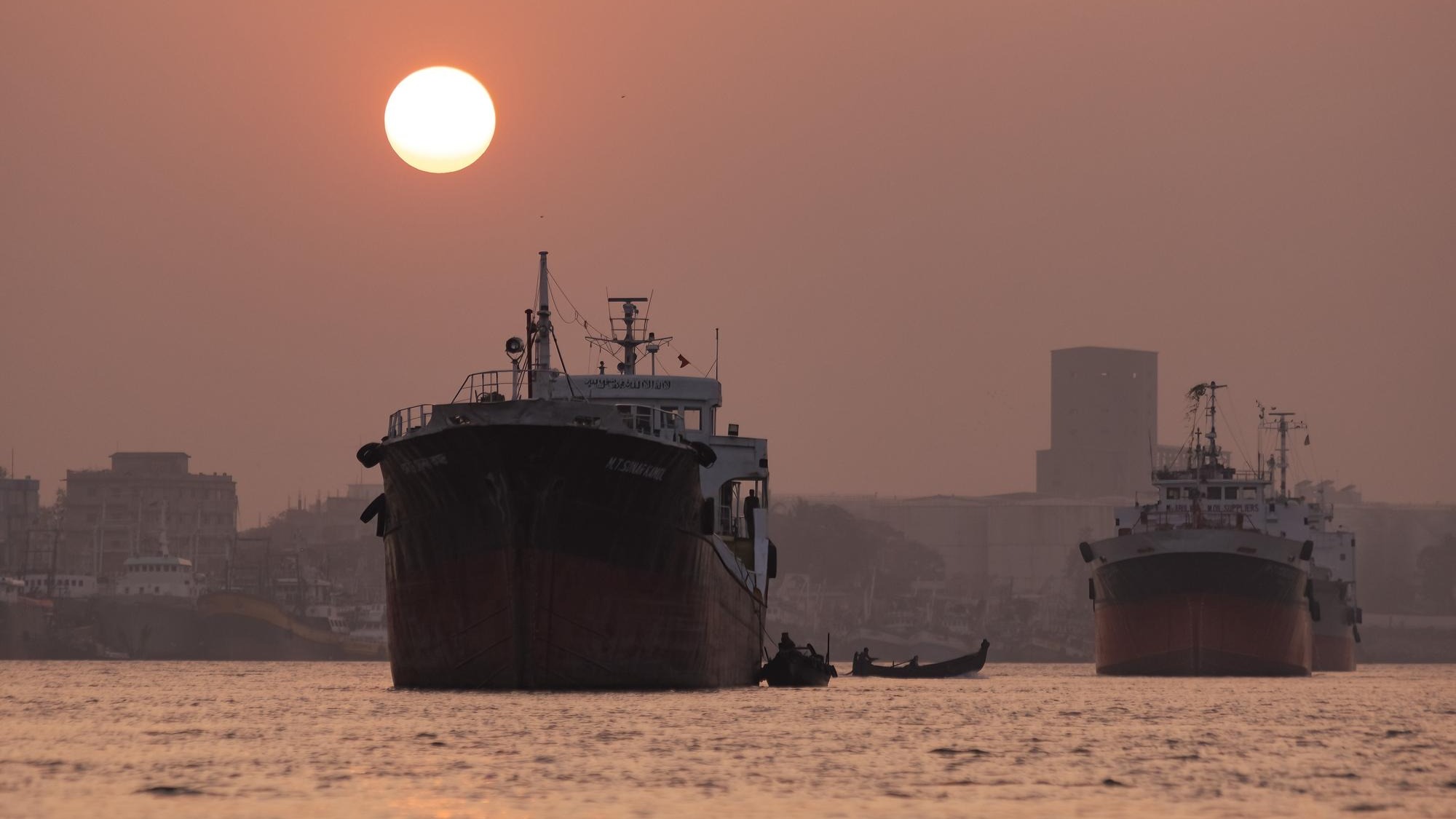
Two commercial ships were attacked near the Strait of Hormuz on a single day in June 2026, one seized by armed men near the United Arab Emirates and the other sunk in Omani waters, while Iran’s vice president declared on state television that the waterway “belongs to Iran” and that Tehran would not give it up “at any price.”
The back-to-back incidents represent the most serious disruption to Persian Gulf shipping in months. An estimated 21 million barrels of oil per day move through the strait, according to a U.S. Energy Information Administration analysis, a volume that accounts for about a fifth of global petroleum consumption. Any sustained threat to that flow ripples through energy markets within hours.
The seizure near the Strait of Hormuz
The United Kingdom Maritime Trade Operations center, a Royal Navy-run monitoring hub based in Bahrain, issued an alert stating that armed individuals had boarded and diverted a commercial ship near the strait, the Associated Press reported. UKMTO alerts are compiled from real-time reports by vessel operators and serve as the primary early-warning system for maritime security events in the region.
As of this writing, the name, flag state, cargo, and crew nationalities of the seized vessel have not been publicly confirmed. Neither the UAE nor Oman has released official logs or coordinates related to the boarding, leaving it unclear whether the ship was targeted because of its flag, its cargo, or commercial ties to a specific country.
Iran has a documented history of seizing commercial vessels in and around the strait. In 2019, the Islamic Revolutionary Guard Corps captured the British-flagged tanker Stena Impero and held it for more than two months. In 2023, Iran seized at least two tankers in the Gulf of Oman within a single week, drawing condemnation from the United States and European allies. Each episode temporarily spiked global oil prices and prompted calls for expanded naval escorts.
The sinking of an Indian-flagged vessel
India’s Ministry of External Affairs confirmed separately that an Indian-flagged commercial ship was attacked and sunk in Omani waters. In a formal statement published on its official updates page, the ministry condemned the attack in strong terms and said all crew members had been rescued with the help of Omani authorities. (The direct URL for the individual statement may change as new items are posted.)
New Delhi’s language left little ambiguity. The ministry described the sinking as a hostile act and specifically thanked Oman for coordinating the rescue, signaling that India does not consider it accidental or the result of a navigational error. The statement stopped short, however, of attributing responsibility to any state or armed group.
The loss marks a rare direct hit on an Indian-flagged vessel in the Gulf. India is one of the world’s largest importers of crude oil transported through the strait, and its merchant fleet regularly transits these waters. A sustained threat to Indian shipping could force New Delhi to recalculate its naval posture in the Arabian Sea, where the Indian Navy already maintains anti-piracy patrols.
Iran’s sovereignty claim
Vice President Mohammad Reza Aref’s declaration that the Strait of Hormuz “belongs to Iran” goes further than the diplomatic language Tehran has typically used. Iranian officials have long asserted influence over the waterway, but framing it as sovereign territory contradicts the international legal framework that governs it.
Under the United Nations Convention on the Law of the Sea, the Strait of Hormuz is classified as a strait used for international navigation, and all vessels engaged in lawful transit have the right of passage. The waterway sits between Iran to the north and Oman to the south; neither country holds exclusive sovereignty over the shipping lanes.
The timing sharpens the message. Delivered on the same day as the seizure and the sinking, Aref’s comments function as a political signal whether or not they were intended as a claim of responsibility. Iranian state media broadcast the statement widely, ensuring a global audience at a moment when the world was already watching the strait.
Who carried out the attacks
No government or military body has publicly linked the two incidents to a single command structure or coordinated operation. UKMTO documented the seizure; India’s foreign ministry confirmed the sinking. Neither authority has drawn an explicit connection between the events.
Iran’s military and its Islamic Revolutionary Guard Corps Navy, which operates independently from the regular Iranian navy in Gulf waters, have not issued statements about either incident. That silence leaves open several possibilities: the seizure and the attack could have been carried out by IRGC naval units, by affiliated militias, by piracy networks, or by entirely separate actors. The Houthi movement in Yemen, which has conducted extensive attacks on commercial shipping in the Red Sea and Gulf of Aden since late 2023 and has gradually expanded its operational reach, has not claimed involvement.
No intercepted communications, satellite imagery, or independent forensic evidence tying a specific actor to the Indian vessel’s sinking has been made public. Until such evidence surfaces, definitive attribution is not possible.
Consequences for Gulf shipping and energy markets
Even without a confirmed link between the two events, the combination of a seizure, a sinking, and an aggressive sovereignty claim on the same day will almost certainly affect commercial calculations. Marine insurers typically raise war-risk premiums for Gulf transits after incidents like these, and shipping companies may reroute vessels or request naval escorts. Higher premiums translate directly into higher freight costs, which can push up fuel prices for consumers far from the Gulf.
The United States maintains its Fifth Fleet headquarters in Bahrain, and a multinational naval coalition patrols Gulf waters. Whether Washington or allied navies adjust their posture in response could shape how quickly tensions either escalate or stabilize. As of this writing, no public statement from the U.S. Department of Defense or the Combined Maritime Forces has addressed either incident.
The broader backdrop adds weight. U.S.-Iran relations remain strained over Tehran’s nuclear program and ongoing American sanctions on Iranian oil exports. Any military escalation in the strait would collide with those pressures, raising the stakes for diplomats and military planners on all sides.
Why definitive attribution still matters for the Strait of Hormuz
The facts so far are stark but incomplete: two commercial ships were attacked near the world’s most important oil chokepoint, one of them lost, and a senior Iranian official used the moment to assert that the waterway is Iran’s. Whether governments treat these as isolated provocations or the opening moves in a broader confrontation will determine the trajectory of Gulf security in the weeks ahead. For the shipping industry, the calculus is simpler and more immediate: the Strait of Hormuz just became a more dangerous place to do business.