American households spent less freely in the first three months of 2026, even as the prices they faced climbed at the fastest pace in over a year. The U.S. economy grew at a 2.0% annual rate in the first quarter, according to the Bureau of Economic Analysis advance estimate released April 30. But beneath that headline number, the details are less reassuring: the personal consumption expenditures (PCE) price index jumped 4.5%, core PCE rose 4.3%, and consumer spending growth dropped to 1.6% from 2.9% in the fourth quarter of 2025.
The economy is still expanding. The trouble is that inflation is accelerating and the people who power most of that expansion are starting to pull back.
Consumer spending hit its weakest pace in over a year
Consumer spending accounts for roughly two-thirds of U.S. economic output, which makes the first quarter’s 1.6% annualized growth rate the most important figure in the entire report. That is a sharp step down from the 2.9% pace recorded in the BEA’s third estimate for Q4 2025, and it signals that families are making tougher tradeoffs with every paycheck.
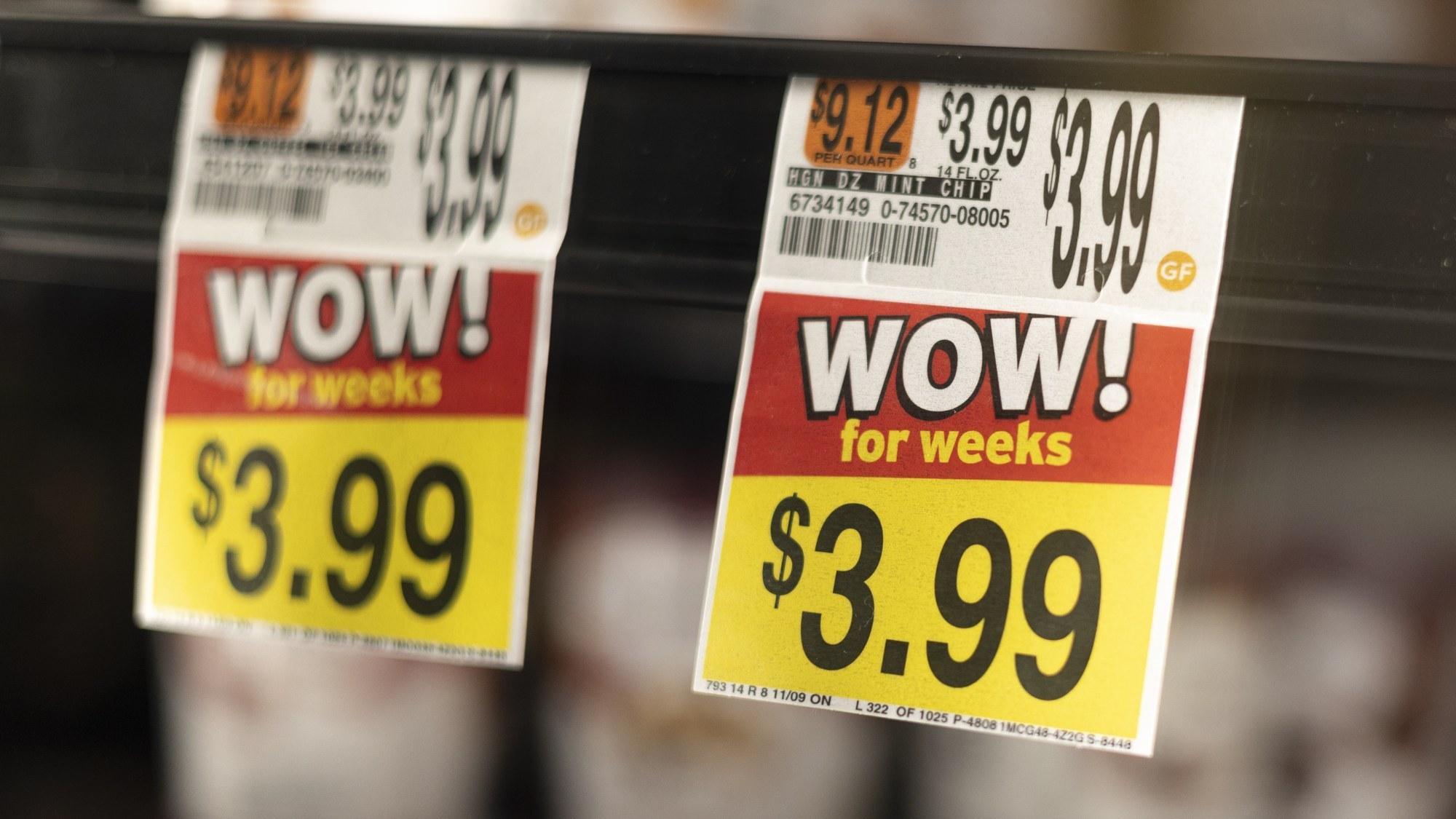
The math is straightforward. With the PCE price index running at 4.5%, more than double the Federal Reserve’s 2% target, the BEA’s report showed price increases spread across goods and services categories, squeezing both the grocery run and the monthly insurance bill. Real disposable income, the money people actually have left after taxes and inflation, grew only modestly in the advance estimate, leaving little cushion for anything beyond necessities.
When consumers pull back, the effects do not stay contained. Restaurants lose covers, automakers see softer order books, airlines discount seats, and the workers in those industries face reduced hours or hiring freezes. A 1.6% spending growth rate is not a recession signal on its own, but it is the kind of number that makes the next quarter’s data far more consequential.
Trade imbalances and tariff costs weighed on output
A widening trade deficit acted as a direct drag on the headline GDP figure. Imports outpaced exports during the quarter, and the resulting gap subtracted from overall growth even as domestic demand and inventory accumulation added to it.
That imbalance reflects the ongoing effects of the tariff escalation that began in early 2025, when the administration imposed broad new duties on imported goods from multiple trading partners. Higher tariffs have raised input costs for American manufacturers and retail prices for consumers. Several major trading partners, including the European Union and China, responded with retaliatory levies on U.S. agricultural and industrial exports, according to tracking by the Peterson Institute for International Economics.
Some of the import surge also appears to reflect front-loading: businesses pulling shipments forward ahead of anticipated tariff increases. That kind of stockpiling inflates inventory investment in GDP accounting without reflecting genuine consumer or business demand, and it tends to reverse in subsequent quarters.
Business investment and government spending kept GDP positive
The report was not uniformly bleak. Nonresidential fixed investment, covering business spending on equipment, structures, and intellectual property, contributed positively to growth. Companies continued to commit capital to technology upgrades and infrastructure projects even as consumer demand softened, suggesting that corporate investment plans are looking past the current quarter’s headwinds.
Government spending at the federal, state, and local levels also added modestly to GDP. Ongoing operations and previously authorized spending programs kept public-sector outlays rising, providing a floor under growth that the private sector alone might not have delivered.
These components prevented the quarter from looking considerably worse. But neither is large enough to substitute for broad-based household spending as the economy’s primary engine. If consumers continue to retreat, business investment will eventually follow as companies adjust to weaker demand.
The Federal Reserve’s options are narrowing
Rising inflation paired with slowing growth is the combination central bankers dread most. The Federal Reserve has held its benchmark federal funds rate steady through its most recent meetings, and the Q1 data makes the next move harder to call in either direction.
Cutting rates to stimulate growth risks amplifying inflation that is already running well above the 2% target. Raising rates to bring prices down could push cautious consumers into a deeper retreat and tip the economy closer to contraction. The second GDP estimate, expected in late May 2026, will incorporate more complete source data and could shift market expectations. As of early June 2026, fed funds futures pricing shows markets roughly split on whether the Fed’s next move will be a hold or a cut, reflecting genuine uncertainty about which risk the central bank will prioritize.
The Fed’s dual mandate of stable prices and maximum employment is being tested from both directions at once. Chair Jerome Powell and the Federal Open Market Committee will have the second GDP estimate and fresh employment data in hand before their next scheduled meeting in June, which could clarify the path forward.
The labor market adds another variable
One dimension the GDP report does not fully capture is the state of the job market. Consumer spending does not weaken in a vacuum; it typically reflects what households are experiencing with paychecks, job security, and hours worked. The Bureau of Labor Statistics employment situation reports for the first quarter showed hiring continuing but at a slower pace than in 2025, with some sectors, particularly retail and hospitality, posting softer payroll gains.
If the labor market holds steady, the consumer slowdown may prove temporary, a rational response to a price shock rather than the start of a deeper pullback. If job growth deteriorates alongside spending, the picture darkens considerably.
This is a first draft, not a final answer
An important caveat: the advance estimate is the first of three GDP readings the BEA publishes each quarter. It relies on incomplete source data, particularly for March 2026. The second estimate, expected in late May, and the third estimate in late June will incorporate more complete figures from the Census Bureau, the IRS, and other agencies. Revisions of several tenths of a percentage point in either direction are common and do not indicate an error in the initial release.
That means the 2.0% growth rate and the 4.5% inflation reading are the best available approximations right now, not settled facts. Readers and policymakers alike should treat them accordingly.
Where the pressure points are heading into summer
The first quarter of 2026 produced a GDP report that resists easy headlines. Growth held up on paper, but the composition tells a more cautious story: inflation running at more than double the Fed’s target, consumer spending at its weakest in over a year, and trade imbalances subtracting from output. The sectors that kept the number positive, business investment and government outlays, cannot carry the economy indefinitely if household demand keeps fading.
For families already stretching paychecks to cover higher prices, the data confirms what the monthly bills have been saying for a while. For the Fed, it narrows an already tight corridor between supporting growth and fighting inflation. And for anyone tracking the economy’s trajectory into the summer of 2026, the question is no longer whether pressures are building. It is how long they can build before something has to give.